
Portable Stair Lift Solutions: Why a Mobile Stair Lift and Electric Stair Climber Can Transform Access
Portable Stair Lift Solutions: Why a Mobile Stair Lift and Electric Stair Climber Can Transform Access Accessibility should allow people …

Estimated reading time: 12 minutes
Accessibility in education is about far more than entering a building. Pupils and students should be able to reach classrooms, laboratories, libraries, dining areas, performance spaces and other important parts of school or campus life.
However, many educational buildings were designed long before modern expectations around inclusive access. Older schools may have narrow staircases, split levels and classrooms spread across several floors. Colleges and universities frequently operate from historic buildings or large campuses containing a mixture of modern and traditional architecture.
A permanently installed stair lift or passenger lift can provide an excellent solution in the right location, but permanent installation is not always practical. Building work can be expensive, disruptive and difficult to complete within a busy educational setting. A conventional stair lift may also be unsuitable for a pupil or student who cannot transfer safely from their wheelchair.
In these circumstances, a portable stair lift, mobile stair lift or electric stair climber can provide a flexible alternative. Stair climbers can help educational establishments improve access without automatically requiring extensive structural alterations.
This article supports our complete guide to portable stair lift solutions, mobile stair lifts and electric stair climbers and looks specifically at how the technology can be used across schools, colleges and universities.
An inaccessible staircase can affect almost every part of a pupil or student’s experience. It can influence which lessons they attend, how they move between departments, whether they participate in school events and how independently they can use the building.
Moving a class to the ground floor may appear to solve the problem, but it can create new restrictions. Specialist teaching rooms, laboratories, art studios and technology facilities cannot always be relocated. A pupil may also feel separated from classmates if the timetable is repeatedly changed around the physical limitations of the building.
Accessibility should therefore be viewed as part of the entire educational experience rather than as a single route through the entrance.
The Department for Education’s guidance for school governing boards on SEN and disability explains that governing boards should play an active role in creating an environment where pupils with special educational needs and disabilities can thrive and take a full part in school life.
The guidance also states that schools should prepare and regularly update an accessibility plan. This should explain how the school intends to increase disabled pupils’ access to the curriculum, physical environment and information.
A portable stair lift can form part of this wider accessibility planning, particularly where immediate or flexible access is required.
A portable stair lift is a battery-powered mobility device that helps an operator move a person safely up or down a suitable staircase. Unlike a conventional stair lift, it is not permanently attached to the stairs.
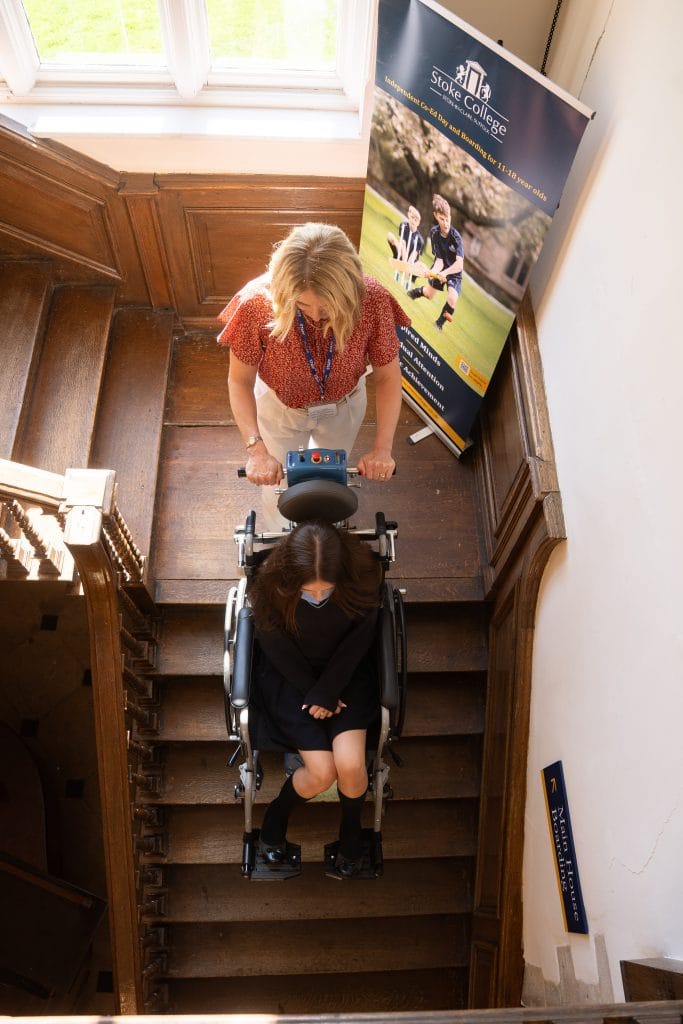
Some stair climbers have their own passenger seat. These models can be suitable for someone who is able to transfer safely from their usual wheelchair or mobility aid. Other electric stair climbers are designed to carry a person in a compatible wheelchair.
For pupils and students who use specialist seating, the ability to remain in their own wheelchair can be particularly important. Their chair may include moulded supports, lateral controls, headrests or a tilt-in-space system designed around their individual postural needs.
Transferring into an ordinary stair lift seat could be uncomfortable or unsafe. It may also introduce additional handling procedures for staff. A wheelchair-compatible mobile stair lift may allow the person to travel between floors while remaining supported by their usual seating system.
The equipment is controlled by a trained operator and uses a powered climbing mechanism to move on the stairs. Different models are suitable for different types of staircase, which is why a professional site and passenger assessment is essential.
A conventional stair lift is designed for one specific staircase. A rail is attached to the stairs or adjacent structure, and a seat travels along that fixed route.
This can work well in a domestic property, but an educational establishment presents different challenges. Corridors and staircases may be used by hundreds of pupils each day. Installing a stair lift can reduce available staircase width and introduce an obstruction in a high-traffic area.
A conventional stair lift may only provide access between two particular levels. It cannot be moved to another part of the school when a pupil’s timetable changes or when access is required in a different building.
The passenger must usually transfer onto the stair lift seat. For a wheelchair user with complex physical or postural needs, this may require additional staff, a second wheelchair or separate moving and handling equipment.
Schools must also consider how fixed installations affect the normal movement of pupils, cleaning, maintenance and the management of busy lesson-change periods.
A mobile stair lift provides a different model. It can be stored away from the staircase and brought into use when required. Subject to assessment, it may also be used in more than one suitable location.
An electric stair climber can offer educational establishments a flexible alternative to stair lifts, platform lifts and extensive building adaptations.
The equipment does not normally require a rail to be installed. This can reduce disruption and help protect the structure and appearance of older buildings. It may also allow access to be introduced more quickly while longer-term building plans are developed.
Portability is particularly valuable on a large school or university campus. A suitable stair climber can potentially be transported between assessed locations rather than being permanently restricted to one flight of stairs.
This does not mean that one machine will automatically work everywhere. Each staircase must be checked for width, gradient, tread dimensions, landings, turns, surfaces and surrounding hazards. The journey to and from the stairs must also be considered.
The correct electric stair climber should be selected around the building and the individual, not simply purchased because it is described online as portable.
The Stair Climbing Company provides complimentary site assessments to establish whether a proposed route is suitable and which stair climbing solution is most appropriate.
Every pupil has different requirements. Some children may be able to walk short distances but find stairs difficult or unsafe. Others may use a manual wheelchair, powered wheelchair or specialist paediatric seating system throughout the day.
The assessment should consider the pupil’s posture, mobility, weight, height, ability to transfer, communication needs and any relevant medical factors. It should also involve the people who understand the child’s needs, which may include parents, carers, Occupational Therapists, physiotherapists, school staff and moving and handling advisers.
The Government’s SEND Code of Practice emphasises the importance of involving children, young people and their families in decisions about support. This principle is particularly relevant when introducing equipment that will be used to move a pupil on the stairs.
The pupil should understand what the equipment does and, where appropriate, have an opportunity to experience it during a calm and carefully managed demonstration.
A successful portable stair lift provision should support confidence as well as physical access. The pupil should not feel that the process is rushed, improvised or carried out without their involvement.
When an inaccessible staircase is encountered, carrying a child or attempting to manually lift a wheelchair may appear to offer an immediate answer. In reality, these activities can expose the pupil and staff members to significant risk.
The Health and Safety Executive provides education case studies involving pupils with special needs. Its guidance highlights the importance of individual assessment, avoiding unnecessary manual handling and using suitable mechanical aids where risks cannot otherwise be controlled.
An electric stair climber can reduce reliance on physical lifting because its battery-powered mechanism performs the climbing movement. The operator still needs to guide and control the equipment, but they are not expected to carry the full combined weight of the passenger and wheelchair.
This distinction is important. A stair climber should not be regarded as a way to avoid planning or training. It is mechanical equipment that must be incorporated into an appropriate system of work.
The route, passenger, operator, wheelchair and equipment must all be considered. Staff should know who is authorised to use the stair climber, where it is stored, how it is checked and what procedure to follow if the intended route is unavailable.
Primary and secondary schools can contain a surprising number of internal access barriers. Even relatively modern buildings may have small changes in level, stepped entrances or departments positioned on upper floors.
A portable stair lift for schools can help maintain access to teaching spaces without requiring every room used by a disabled pupil to be moved downstairs. It can support a more inclusive timetable and allow the pupil to remain with classmates.
The solution can also respond to changing circumstances. A child may join the school after its accessibility plan has been created, or an existing pupil may experience a temporary or permanent change in mobility.
An electric stair climber can potentially be introduced more quickly than a major building project. It may provide access while the school considers whether further adaptations are necessary.
Special educational needs settings may have additional requirements. Pupils may use highly specialised wheelchairs or seating systems and may need carefully planned support throughout the day. The Stair Climbing Company works with Occupational Therapists and education professionals to configure its equipment around these more complex needs.
The Skyclimber is particularly useful where flexibility is important. It can be configured with a seat or adapted as a wheelchair carrier and uses a step-by-step climbing action. Its compact design can make it suitable for staircases with tighter turns and smaller landings, subject to assessment.
Further and higher education campuses present their own accessibility challenges. Students may move between lecture theatres, libraries, laboratories, accommodation, social areas and specialist departments throughout the day.
A university may occupy numerous buildings across a town or city. Some may be modern and accessible, while others may be listed, historic or difficult to alter.
Installing a fixed stair lift in every location may be unrealistic. A mobile stair lift can provide a more adaptable resource for particular routes, temporary requirements or areas awaiting permanent improvement.
The equipment may also support staff members, visiting lecturers, conference delegates and members of the public attending university events. Accessibility planning should consider everyone who may need to use the estate rather than focusing only on currently enrolled students.
For appropriate straight staircases with sufficient landing space, the Skyline stair climber provides a tracked wheelchair-carrying solution. It is frequently considered for public buildings, educational facilities and locations where the passenger should remain in their own wheelchair.
The Skyclimber may be more suitable where the route contains tighter turns or more complicated stair geometry. A site assessment will determine which system best matches the building.
Many schools, colleges and universities occupy buildings with significant architectural or historic value. Altering staircases, walls or decorative features can be difficult and may require extensive consultation and permission.
Government guidance in Approved Document M provides a baseline for access to and use of buildings in England when relevant building work is undertaken. However, existing and historic estates can still present practical challenges that cannot always be resolved through immediate structural work.
A portable stair lift can help provide access without permanently attaching equipment to the staircase. It can be stored when it is not required, helping the institution protect the character and normal use of the building.
This is not a reason to ignore broader accessibility improvements. A stair climber should form part of a considered strategy that examines entrances, circulation, teaching spaces, toilets, signage, information and emergency arrangements.
In some locations, a mobile solution may be temporary. In others, it may remain the most practical long-term option because permanent alterations would be disproportionate or physically impossible.
A passenger lift can become the main accessible route through a school, college or university. If it fails, entire floors can suddenly become unavailable to wheelchair users.
Educational establishments should not wait for a breakdown before considering what happens next. Lift-failure planning should identify which students, employees or visitors would be affected and how access will be maintained.
A portable stair lift can form part of a contingency plan. The institution can identify suitable alternative routes, arrange equipment, train staff and establish storage and charging procedures before they are urgently required.
The Stair Climbing Company offers short and long-term stair climber hire for lift failures, temporary access needs and planned building work.
A hired electric stair climber should still be assessed for the particular location and passenger. Rapid provision is valuable, but suitability and operator competence remain essential.
An electric stair climber may be capable of supporting both access and a planned evacuation arrangement, but these uses should not be assumed to be identical.
Day-to-day access usually takes place in controlled conditions. Emergency evacuation may involve alarms, smoke, reduced visibility, crowded routes and greater pressure on staff. The direction of travel may also be different.
Schools, colleges and universities should consider access planning alongside fire risk assessments, Personal Emergency Evacuation Plans and other emergency procedures. The proposed equipment must be suitable for the identified use, and sufficient trained operators must be available.
The access assessment should therefore confirm exactly what the stair climber is intended to do. If evacuation use is required, this should be specifically evaluated, practised and documented with appropriate professional input.
The quality of staff training is just as important as the quality of the equipment. A modern electric stair climber should not be left in a cupboard with the expectation that staff will work out how to use it during an urgent situation.
Operators need practical training on the exact model and the assessed staircase. They should understand how to prepare the equipment, attach the wheelchair where applicable, communicate with the passenger, move safely on the stairs and manoeuvre on landings.
Training should also cover battery charging, pre-use checks, storage and the procedure for reporting faults. Refresher training may be required, particularly if the stair climber is used infrequently or if trained employees leave the organisation.
Portable Stair Lift Solutions: Why a Mobile Stair Lift and Electric Stair Climber Can Transform Access Accessibility should allow people …
A conventional stair lift can provide an effective way to overcome stairs, but it is not the right solution for …
The Complete Guide to Safe and Flexible Access Stairs remain one of the most common barriers faced by wheelchair users …

Schools Evacuation Planning School evacuation is changing because expectations are changing. Parents rightly expect schools to provide an environment where …

School Evacuation in England: Why Powered Stair Climbers Should Be Part of Every Conversation School evacuation is one of the …