Powered Stair Climbers for Workplace Access: Removing Barriers Without Major Building Work
Powered Stair Climbers for Workplace Access: Removing Barriers Without Major Building Work Need to improve wheelchair access in your workplace? …

School evacuation is changing because expectations are changing. Parents rightly expect schools to provide an environment where every child is protected. Governors want reassurance that emergency procedures are robust, while academy trusts and local authorities are looking for practical investments that improve both accessibility and resilience. This is why powered stair climbers are becoming an increasingly important part of conversations about school safety.
For many years, the traditional evacuation chair has been viewed as the standard solution for moving a person with reduced mobility down a staircase during an emergency. Evacuation chairs remain an effective option in many situations and continue to have an important role within school evacuation procedures. However, advances in powered stair climber technology now give schools another option that can offer greater flexibility and significantly reduce the physical demands placed upon staff.
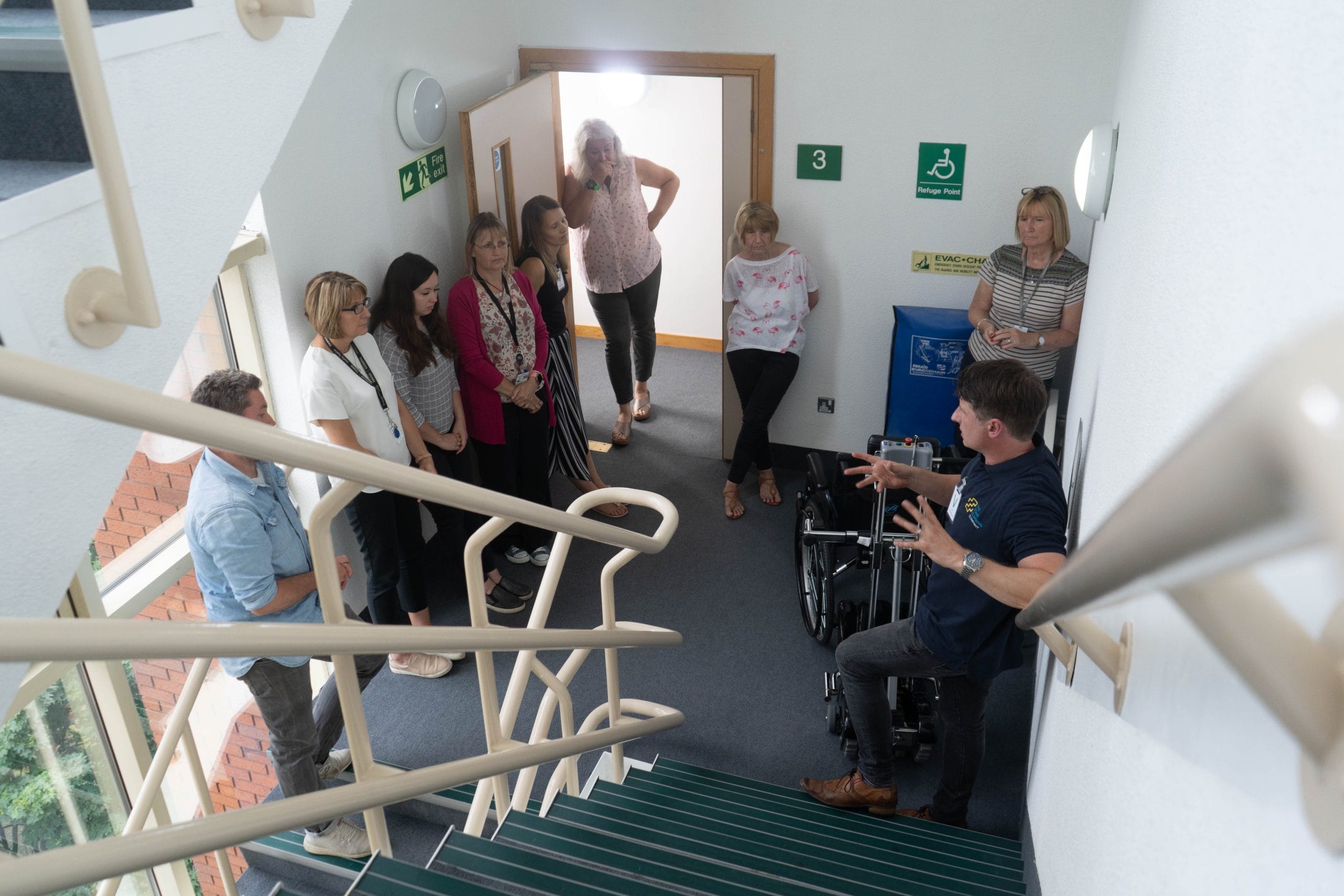
A powered stair climber allows trained operators to move wheelchair users over stairs using battery powered assistance rather than relying solely on physical strength. This reduces operator fatigue and helps maintain better control throughout the evacuation process. In a busy school environment where staff may already be managing hundreds of pupils during an emergency, reducing manual handling demands can make a significant difference.
Many schools also recognise another important advantage. Powered stair climbers are not restricted to emergency situations. They can be used throughout the school day to improve accessibility whenever passenger lifts are unavailable or when pupils need access to areas that would otherwise remain difficult to reach. During refurbishment projects, examinations, assemblies or maintenance work, the same equipment continues to support inclusion across the school.
This everyday use creates familiarity.
When equipment forms part of normal school life, staff become more confident using it. Confidence developed during routine access translates directly into greater confidence during an emergency. Instead of operating unfamiliar equipment under pressure, staff are using technology they already understand.
This practical experience can be just as valuable as formal training.
Personal Emergency Evacuation Plans continue to play a central role in school fire safety. Every pupil, member of staff or regular visitor who may require assistance during an emergency should have arrangements that reflect their individual needs. Guidance continues to evolve and schools are increasingly reviewing how these plans work in practice rather than simply ensuring documentation exists.
Residential educational settings also require careful consideration. Boarding schools and residential colleges supporting young people with disabilities may need Residential Personal Emergency Evacuation Plans alongside wider fire safety procedures. These plans should consider sleeping accommodation, overnight staffing, refuge arrangements and the most appropriate evacuation equipment for each individual.
The National Fire Chiefs Council provides useful guidance on inclusive fire safety planning through https://www.nationalfirechiefs.org.uk while the Fire Protection Association offers additional resources covering fire risk management at https://www.thefpa.co.uk.
Technology alone will never replace good planning.
Successful evacuation depends upon suitable equipment, trained staff, realistic procedures and regular review. The best outcomes occur when accessibility, fire safety and operational management are considered together rather than separately.
This collaborative approach is becoming increasingly common across England.
Headteachers are working alongside facilities managers, responsible persons, occupational therapists, fire risk assessors and health and safety professionals to develop evacuation strategies that reflect the realities of modern education.
Powered stair climbers naturally become part of those discussions because they address several challenges simultaneously.
They improve accessibility.
They strengthen evacuation capability.
They reduce manual handling.
They increase operational flexibility.
Few accessibility investments can deliver benefits across so many different areas.
Schools are also under increasing financial pressure. Every purchasing decision must demonstrate value for money.
Installing permanent accessibility equipment throughout a large school estate may require substantial capital expenditure. By comparison, a powered stair climber can often support multiple staircases across different buildings, providing flexibility that fixed installations cannot always achieve.
This does not mean permanent lifts or ramps are unnecessary. Every school requires its own accessibility strategy based upon the building, pupil requirements and long term estate planning. In many cases, however, a powered stair climber complements existing accessibility infrastructure while providing resilience when permanent systems become unavailable.
The result is a stronger overall accessibility strategy.
Special schools have perhaps demonstrated this most clearly.
Many pupils use specialist seating systems, customised wheelchairs or powered wheelchairs that form an essential part of their daily lives. Remaining within familiar seating wherever possible can reduce anxiety while improving comfort during movement around the school. Powered stair climbers capable of accommodating a wide range of wheelchair types provide schools with greater flexibility while maintaining the dignity of the pupil.
Occupational therapists frequently recognise that every child has different physical, emotional and clinical needs. The evacuation solution should therefore reflect the individual rather than expecting every individual to adapt to one piece of equipment.
This philosophy sits at the heart of inclusive education.
The Department for Education continues to promote inclusive learning environments that support participation for every pupil. Creating safe evacuation procedures forms an important part of achieving that objective.
Further guidance relating to school buildings and education policy can be found at https://www.gov.uk/government/organisations/department-for-education.
The Stair Climbing Company has worked with schools, academy trusts, local authorities and specialist education providers throughout England to improve both accessibility and evacuation planning. Rather than supplying equipment alone, the company undertakes detailed site assessments, evaluates staircase layouts, reviews wheelchair compatibility and provides practical operator training so schools gain long term confidence in their investment.
Its Skyline and Skyclimber powered stair climbers have become recognised throughout the education sector because they offer exceptional stability, reduced operator effort and the flexibility required by modern school environments. Many wheelchair users can remain within their own wheelchair, helping reduce transfers while improving dignity and comfort during both everyday access and emergency evacuation.
Professional servicing and ongoing support are equally important. Evacuation equipment should always be maintained in accordance with manufacturer recommendations and schools should ensure staff receive refresher training as part of their wider fire safety programme. This helps maintain operational readiness while demonstrating a proactive approach to pupil safety.
More information about powered stair climbers, school accessibility assessments and evacuation planning is available at https://thestairclimbingcompany.com.
Schools looking to strengthen their wider evacuation strategy may also benefit from specialist evacuation consultancy, training and equipment support available through https://theevacuationcompany.com.
School evacuation will continue to evolve as technology advances and expectations surrounding accessibility increase. The conversation is moving beyond minimum compliance towards creating learning environments where every pupil can participate fully and where every member of staff has confidence that appropriate equipment is available should an emergency occur.
Powered stair climbers are becoming an increasingly important part of that future.
They support inclusive education, strengthen emergency preparedness, improve everyday accessibility and help schools create safer environments for pupils, staff and visitors alike.
For schools committed to delivering the highest standards of accessibility and safety, powered stair climbers deserve to be part of every evacuation conversation.
Powered Stair Climbers for Workplace Access: Removing Barriers Without Major Building Work Need to improve wheelchair access in your workplace? …

Powered Stair Climbers for Wheelchair Access: A Flexible Way to Overcome Stairs Need to create wheelchair access where stairs are …

Part M Stair Climbers for London Buildings: Accessible Retrofit Without Major Structural Change Improving accessibility in an existing London building? …

Part M Stair Climbers for Retrofit Buildings: Creating Accessible Buildings Without Major Structural Change Retrofitting an existing building and struggling …
Part M Stair Climbers for London Retrofit Buildings: Practical Access in Constrained Spaces Discuss a London Access Assessment Retrofitting a …

Part M Stair Climber Access: Creating More Inclusive Buildings Without Losing Flexibility Creating an accessible building is rarely about a …
Estimated reading time: 6 minutes