Powered Stair Climbers for Workplace Access: Removing Barriers Without Major Building Work
Powered Stair Climbers for Workplace Access: Removing Barriers Without Major Building Work Need to improve wheelchair access in your workplace? …

Retrofitting a London building for better accessibility can be far more complex than designing a new property from a blank page. Historic fabric, narrow plots, split levels, planning controls, shared ownership, limited budgets and the need to keep premises open can all restrict the available options.
Architects, access consultants, designers and facilities managers still need to find practical ways for disabled people to enter and use these buildings. Permanent level access, correctly designed ramps and suitable lifts should be considered wherever they are feasible. Yet there are many existing properties where a conventional solution cannot be installed immediately or where it would require disproportionate alteration to the building.
In these situations, Part M stair climbers can contribute to a carefully managed access strategy. A powered stair climber can transport a wheelchair user over a suitable staircase with assistance from a trained operator. It requires little or no permanent structural work and may provide access while longer-term alterations are developed, or in locations where fixed access remains genuinely constrained.
The Stair Climbing Company specialises in assessing and supplying stair climbers for access in existing buildings. Our approach considers the user, wheelchair, staircase, operator and complete journey, helping project teams understand when portable equipment offers a credible solution and when another form of access should be prioritised.
London’s built environment has developed over centuries. Georgian townhouses have become offices, Victorian schools have expanded into neighbouring buildings, warehouses have been converted into creative workspaces and historic hotels have introduced modern facilities around protected interiors. Even relatively recent commercial properties can contain raised entrances, basement meeting rooms, mezzanines and changes of level that interrupt an otherwise accessible route.
The pressure to reuse existing buildings is growing. Retrofit can retain architectural character, reduce the need for demolition and allow organisations to adapt their premises for new purposes. However, a successful retrofit must consider people as well as energy, structure and appearance.
A beautifully refurbished building is not truly successful if a wheelchair user cannot reach the reception, workspace, classroom, consultation room or event area. Accessibility should therefore be addressed at the start of the project, not left until construction is nearly complete.
London sites can make this difficult. A lift shaft may remove valuable floor area or conflict with services. A long permanent ramp may not fit within the pavement or entrance forecourt. Altering a listed staircase may affect significant fabric. Tenants may have limited authority to modify the common parts of a building. These constraints do not remove the need for inclusive access, but they do require thoughtful assessment of every reasonable option.
Approved Document M gives guidance on access to and use of buildings in England. Volume 1 relates to dwellings, while Volume 2 covers buildings other than dwellings. The guidance supports compliance with the Building Regulations where relevant building work is undertaken.
Part M is often used as shorthand for accessibility as a whole, but the position is more detailed. The Building Regulations apply to defined building work, and the requirements affecting an alteration, extension or change of use depend on the project. Approved Documents show common ways of satisfying requirements, but they are not a universal checklist for every existing property.
Other responsibilities may also apply. Service providers and employers should consider their duties under the Equality Act 2010, including the duty to make reasonable adjustments in relevant circumstances. Planning policy, listed building controls, lease terms, fire safety and British Standards may also influence the access strategy.
Professional advice is therefore essential. A powered stair climber should not be described as making a building Part M compliant simply because it can travel on the stairs. It is normally an assisted and managed access solution, while a passenger or platform lift may offer more independent access.
The correct question is not whether a stair climber replaces Part M. It is whether the equipment can form an appropriate part of the project’s access arrangements after the physical constraints, user experience and other possible solutions have been considered.
A powered stair climber is portable equipment that uses a motorised climbing system to move a person up or down a staircase. Some models have an integrated seat. Non-transfer wheelchair stair climbers attach to a compatible wheelchair, allowing the individual to remain in their own seating during the journey.
Unlike a fixed stair lift or platform lift, a portable device does not normally require a rail, shaft or permanent structure. It can be stored away when it is not required and may be used on more than one staircase where each route has been assessed as suitable.
This creates several potential roles within a London retrofit project. A stair climber may provide interim access while permissions and funding for a permanent lift are secured. It may serve an occasional-use space where major building work is not reasonably achievable. It can provide resilience during a lift refurbishment or breakdown. In a heritage property, it may offer access with minimal effect on significant interiors.
This flexibility should not be confused with universal suitability. A stair climber requires a trained operator and may not provide the same independence as a fixed lift or correctly designed ramp. The staircase needs sufficient width, appropriate step geometry and adequate space at the landings. The passenger and wheelchair must be compatible with the selected machine.
The Powered Stairclimber complete guide explains the different equipment types, assessment process and comparisons with fixed access solutions.
London contains thousands of listed buildings and many more properties within conservation areas. Improving access in these settings often requires designers to balance inclusion with the conservation of significant fabric.
Historic England’s guidance on improving access to historic buildings supports the principle that access and conservation should be considered together. Early understanding of the building’s significance can help teams identify changes that improve access while avoiding unnecessary harm.
Permanent alterations should not be dismissed automatically. Sensitive ramps, carefully positioned lifts and adjustments to entrances can sometimes be integrated successfully. Where they are not currently practical, a stair climber may provide a less intrusive option because it does not normally change the structure or appearance of the staircase.
Historic stairs require detailed assessment. Stone edges may be worn, timber surfaces may be vulnerable and landings can be irregular. A tracked stair climber suitable for a straight modern flight may not work on a narrow turning staircase. The equipment should be demonstrated on the actual route so that its operation and impact can be understood before it is specified.
The Stair Climbing Company regularly works with heritage settings where a standard catalogue recommendation would be inadequate. Our role is to test what is achievable in the real building and provide honest advice on the benefits and limitations.
Central London offices often occupy older façades wrapped around extensively altered interiors. A main passenger lift may serve most floors while leaving a mezzanine, basement or raised meeting suite inaccessible. Mixed-use properties can create further difficulties because responsibility is divided between freeholders, managing agents, tenants and event operators.
A powered stair climber can sometimes support access to these secondary spaces without taking a staircase out of use for major construction. It can also act as a planned temporary measure while a lift is modernised. However, the access procedure must identify ownership, trained operators, maintenance and availability across the building’s full opening hours.
Hybrid working makes staff coverage less predictable. A solution cannot depend on one facilities employee who may not be present when a visitor arrives. Appropriate numbers of staff should be trained, and responsibility should remain clear during receptions, evening functions and weekend use.
The user experience should be considered before an invitation or appointment is confirmed. Clear access information allows a visitor to discuss their requirements in advance and avoids an uncomfortable conversation at the foot of the stairs.
A permanent ramp can provide independent access, but even a modest rise may require considerable length once gradient, landings and manoeuvring space are included. A platform lift can offer frequent independent access, but it needs space, structural work, power, maintenance and approvals. A powered stair climber can normally be introduced more quickly, although it depends on a trained operator and requires storage, charging and servicing. These options can complement each other. The strongest retrofit selects the solution that fits the route, frequency of use and needs of disabled people.
Every proposed Part M stair climber access route should be assessed before equipment is purchased or included in an access statement. The staircase angle, tread and riser dimensions, stair width, landings, turns, surfaces and handrails can all affect suitability.
The proposed operators should take part in the process. A powered motor reduces the effort needed to move the person on the stairs, but the operator remains responsible for positioning, guiding and monitoring the machine. Training and confidence are essential.
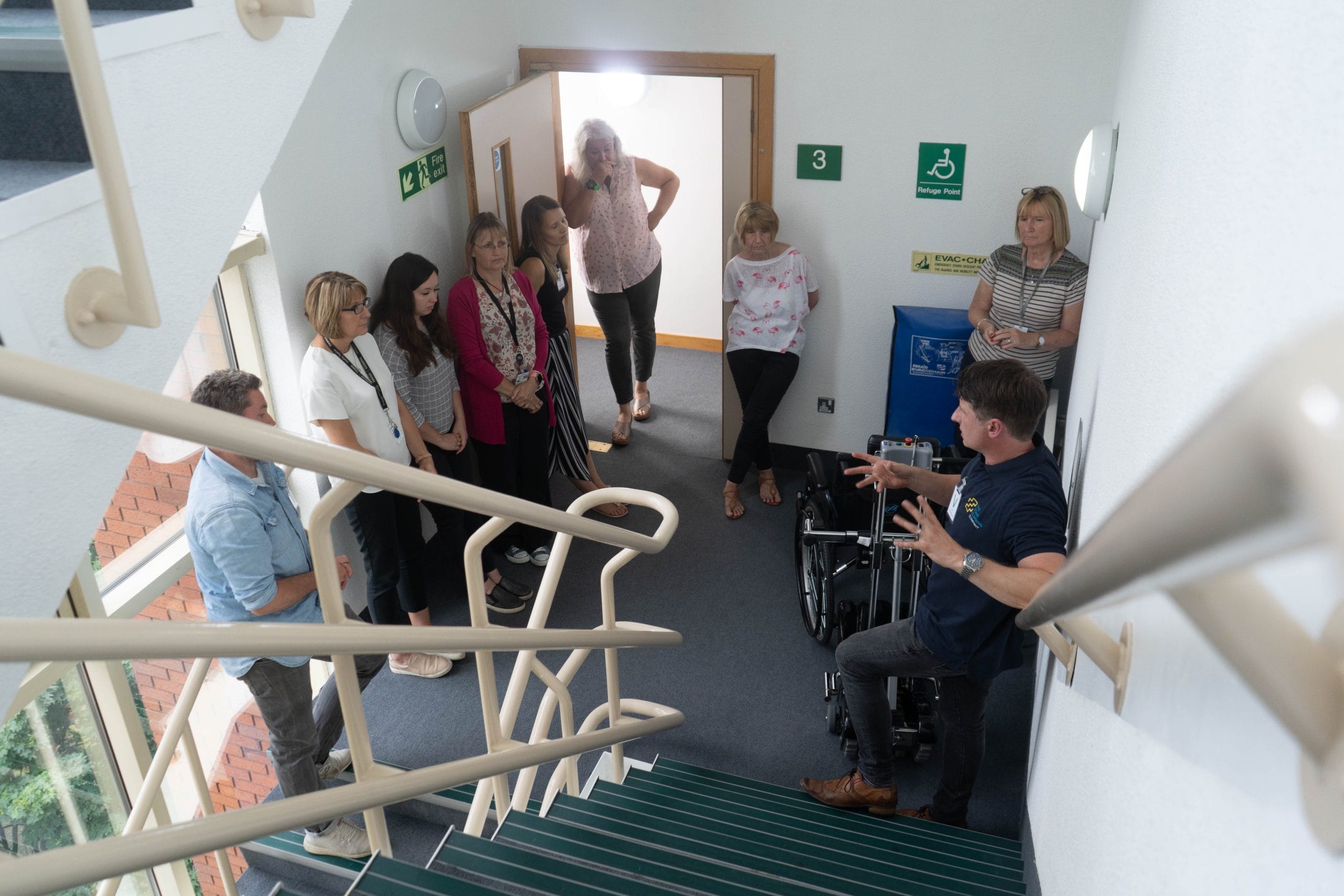
The Stair Climbing Company offers practical site assessments and demonstrations. This allows the client, design team and user to see how the equipment performs on the intended route and identify any changes required to the management plan.
A retrofit access strategy must continue working after project completion. Staff changes, altered layouts and declining battery condition can turn a sound initial plan into an unusable one.
Operators should receive practical instruction on the specific stair climber. Training should cover safety checks, wheelchair attachment or passenger positioning, controls, movement on the stairs, communication and procedures for reporting faults. Enough employees should be trained to maintain coverage during all advertised access hours.
The equipment should be stored appropriately, kept charged and protected from damage. Planned servicing and routine checks should follow the manufacturer’s instructions. Where the stair climber is work equipment, the Provision and Use of Work Equipment Regulations 1998 may be relevant to its suitability, maintenance, inspection and use by trained people.
The Stair Climbing Company provides training, servicing and aftercare alongside supply and hire. This continuing support helps the access arrangement remain reliable rather than becoming forgotten equipment in a storage room.
The Stair Climbing Company will demonstrate portable access at NeuroPlaces, part of Shoreditch Design Week, from 15 to 17 September 2026. The event takes place at Protein Studios, 31 New Inn Yard, Shoreditch.
As Gold Sponsor for Accessibility in Action, we are providing portable ramps and a stair climber to help visitors navigate areas where step-free access is limited. The setting provides a practical example of a familiar retrofit challenge. An existing venue contains access barriers, the event is temporary and major permanent work is not part of the organiser’s immediate scope.
Portable equipment allows the barrier to be addressed rather than ignored. Visitors can also see how a stair climber operates and speak with our team about the assessment, training and management that sit behind successful use.
For architects, interior designers, facilities managers and access professionals, NeuroPlaces offers an opportunity to explore inclusive design as a lived experience. The event demonstrates that good access is not achieved by a label or policy alone. It depends on whether people can use the space in practice.
The Stair Climbing Company has extensive experience in solving access barriers across homes, education, workplaces, hospitality venues, heritage properties and events. We understand that retrofit projects need more than a product specification.
Our specialists assess the complete situation, including the user, wheelchair, staircase, destination and operator. We provide on-site trials so that decisions can be based on evidence from the actual route. Our range includes seated and non-transfer powered stair climbers, with hire and purchase options for permanent, temporary and interim requirements.
We also support architects, occupational therapists, access consultants, local authorities, facilities managers and contractors during planning. Clear information about dimensions, limitations and management requirements helps project teams incorporate the solution accurately into access strategies.
Our commitment continues through operator training, servicing and aftercare. This joined-up approach is why The Stair Climbing Company is trusted to create practical access in buildings where conventional alterations are difficult.
Retrofitting London’s buildings is essential to their future, but improvement should be measured by how well the finished space works for people. Part M provides an important regulatory foundation, while inclusive design, consultation and competent assessment help teams go further.
A permanent lift or ramp may be the correct solution for a principal route. Where space, heritage or project timing creates a genuine constraint, a powered stair climber can offer a flexible way to provide access without major structural alteration.
The Stair Climbing Company can assess your building, demonstrate suitable equipment and support the complete service with training and ongoing maintenance.
Book a London stair climber access assessment or meet us at NeuroPlaces during Shoreditch Design Week from 15 to 17 September 2026.
Estimated reading time: 11 minutes
Powered Stair Climbers for Workplace Access: Removing Barriers Without Major Building Work Need to improve wheelchair access in your workplace? …

Powered Stair Climbers for Wheelchair Access: A Flexible Way to Overcome Stairs Need to create wheelchair access where stairs are …

Part M Stair Climbers for London Buildings: Accessible Retrofit Without Major Structural Change Improving accessibility in an existing London building? …

Part M Stair Climbers for Retrofit Buildings: Creating Accessible Buildings Without Major Structural Change Retrofitting an existing building and struggling …

Part M Stair Climber Access: Creating More Inclusive Buildings Without Losing Flexibility Creating an accessible building is rarely about a …

Stair Climber Machine and Portable Stair Lift Solutions for Adults Living at Home For many adults, losing the ability to …