Powered Stair Climbers for Workplace Access: Removing Barriers Without Major Building Work
Powered Stair Climbers for Workplace Access: Removing Barriers Without Major Building Work Need to improve wheelchair access in your workplace? …

Retrofitting an existing building and struggling to create an accessible route between different levels?
Contact The Stair Climbing Company for a FREE Part M Stair Climber Assessment
Our team can assess your building, staircase, wheelchair access requirements and proposed route to establish whether a powered stair climber could form part of a practical accessibility strategy.
For a complete introduction to powered stair climbing technology, applications and access planning, read our Powered Stairclimber Complete Guide.
Improving accessibility in a new building should begin at the design stage. Architects can consider level entrances, circulation routes, passenger lifts, accessible toilets, appropriately designed ramps and suitable internal spaces before construction begins.
Retrofitting an existing building is different.
Across London and the rest of the UK, thousands of offices, schools, universities, hotels, shops, heritage buildings and public buildings were constructed long before today’s expectations around inclusive access.
A retrofit project may therefore start with an existing staircase, narrow circulation spaces, split levels, restricted landings or a building where significant structural alteration is extremely difficult.
This creates an important challenge.
How can architects, building owners and facilities managers improve accessibility while working within the constraints of the existing building?
In appropriate circumstances, a powered stair climber can be considered as part of the solution.
The important distinction is that purchasing a stair climber does not automatically make a building compliant with Part M. Instead, a professionally assessed Part M stair climber solution may contribute towards an overall access strategy where the building, proposed works and needs of users have all been properly considered.
The starting point for projects in England should be the Government’s current Approved Document M Volume 2, which provides statutory guidance concerning access to and use of buildings other than dwellings.
Part M of the Building Regulations concerns access to and use of buildings.
For existing non-domestic buildings, the position can be more nuanced than simply applying the standards for a completely new building to every part of an old property.
Approved Document M explains that where an alteration to a non-domestic building constitutes a material alteration, relevant work must comply with Requirement M1. It specifically identifies features such as entrances and arrangements for moving from one level to another.
It also states that the building as a whole must be no less compliant with Requirement M1 following a material alteration.
Material changes of use can create further requirements, depending on how the building is going to be used.
The full Government guidance should therefore always be considered by the project’s architect, designer, access consultant and building control professional.
Read Approved Document M on GOV.UK
The important point for retrofit projects is that accessibility needs to be considered properly rather than dismissed because the building already exists.
Imagine converting a Victorian building in London into a modern workplace.
The building might have four or five steps at its entrance, another short staircase between internal levels and a basement containing meeting rooms or facilities.
Installing a traditional passenger lift could require substantial structural alterations.
A platform lift may require space that simply isn’t available.
Creating a permanent ramp could require a considerable amount of floor area and potentially interfere with existing entrances, corridors or architectural features.
A fixed stair lift could reduce the usable width of an important staircase.
In a listed or heritage building, significant alterations may introduce additional planning and conservation considerations.
These are exactly the situations where retrofit accessibility requires a broader conversation.
Rather than asking:
“Where can we install a lift?”
The better question can be:
“How can we create the most practical accessible journey through this existing building?”
A powered stair climber may be one of the options worth considering.
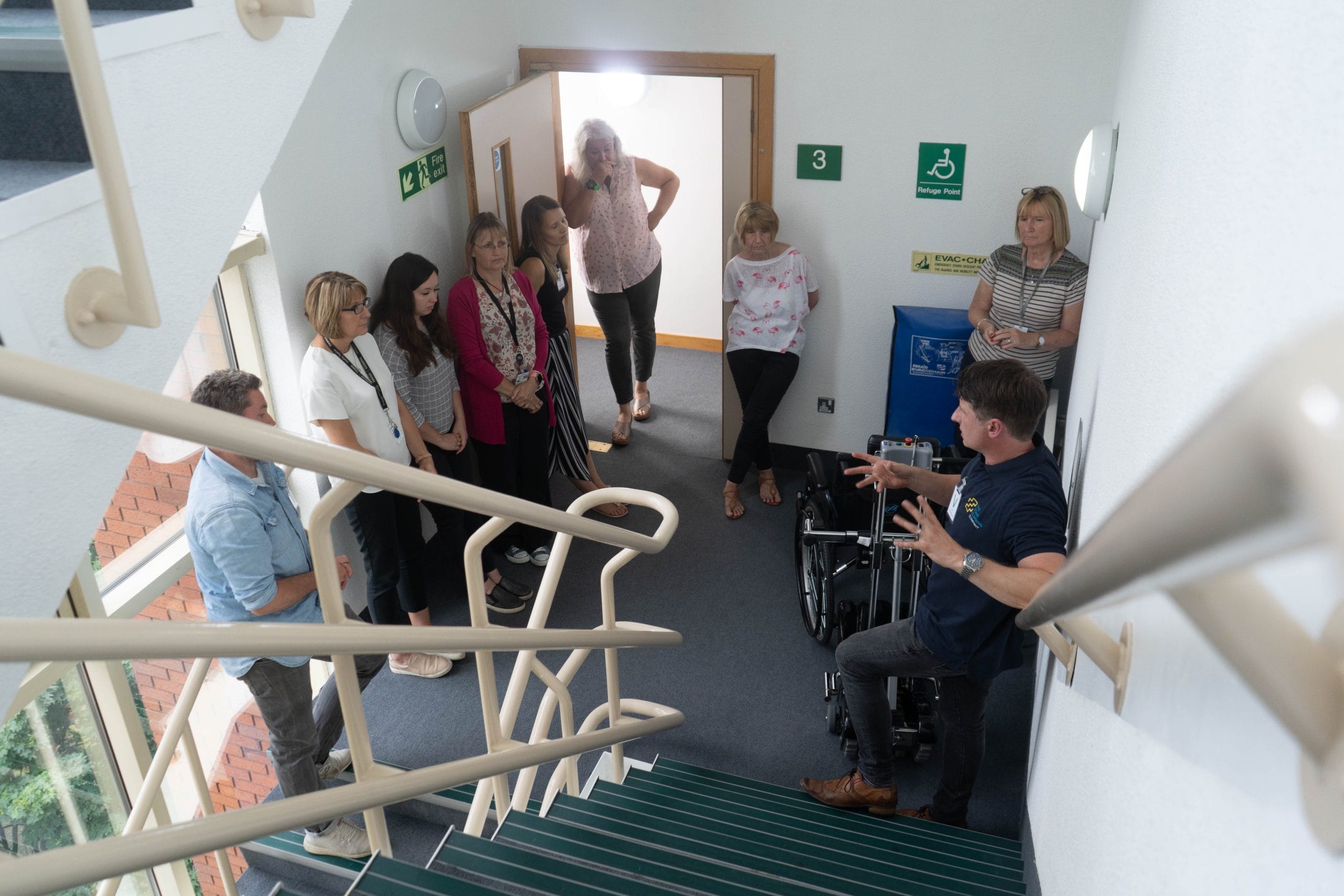
A powered stair climber is a mobile device designed to help transport a person safely up or down a suitable staircase with the assistance of a trained operator.
Different types of stair climber are available.
Some incorporate their own seating system. Others are designed to accommodate compatible wheelchairs, meaning that the wheelchair user may not need to transfer from their own chair.
This non-transfer approach can be particularly valuable for people who use specialist wheelchairs or seating systems.
Unlike a conventional stair lift, a portable stair climber is not normally permanently attached to the staircase.
There is no rail running along the wall and, depending on the particular solution, major building work may not be required.
After use, the stair climber can be stored in an appropriate location.
Subject to assessment, a mobile stair climber may also potentially serve more than one suitable staircase.
You can learn more about how this equipment works in our Powered Stairclimber Complete Guide.
This is one of the most important questions we are asked.
A stair climber should not be marketed as a product that simply “makes a building Part M compliant.”
Part M relates to the building and building work, not simply to the presence of a particular piece of access equipment.
A Part M stair climber can, however, be considered as part of a wider accessibility strategy, particularly when dealing with an existing building where permanent alterations are constrained.
The appropriate solution will depend on factors including the building, proposed alteration or change of use, users, frequency of access, alternative routes, staircase geometry and the practicality of providing reliable assistance.
The relevant building control body should be involved where Building Regulations approval is required.
This approach is particularly important because Part M and the Equality Act are not the same thing.
Government guidance specifically explains that compliance with Part M does not itself demonstrate compliance with the broader obligations imposed by the Equality Act.
Read the Government clarification on Part M and the Equality Act
That distinction should be understood at the beginning of a retrofit project rather than after the work has been completed.
Good retrofit design should not simply aim to achieve the minimum possible standard.
The objective should be to create an environment that can genuinely be used by as many people as reasonably possible.
Another useful reference for architects and designers is BS 8300-2:2018, which provides recommendations for the design of accessible and inclusive buildings.
The principles of inclusive design encourage project teams to think about the complete user journey.
Can someone enter the building?
Can they reach reception?
Can they access meeting rooms?
Can they move between floors?
Can they access toilets and other facilities?
Can they participate in the same activities as other building users?
A retrofit project should consider this complete journey rather than simply treating an individual staircase as an isolated problem.
The biggest advantage of a powered stair climber in a retrofit environment is flexibility.
Existing buildings frequently contain physical constraints that cannot simply be designed away.
A powered stair climber can potentially use the existing staircase rather than requiring a new vertical circulation system to be constructed.
This can make stair climbers worth investigating where permanent alterations would be disproportionate, impractical or damaging to important building features.
It can be especially relevant for:
Historic and listed buildings
Older offices
Converted residential buildings used commercially
Schools and colleges
Universities
Hotels
Restaurants
Museums and galleries
Places of worship
Community buildings
Healthcare environments
Public buildings
Retail premises
Split-level workplaces
London properties with limited internal space
In each case, the correct approach begins with assessment rather than simply specifying a machine.
London provides perhaps the clearest example of why Part M stair climbers are becoming increasingly relevant to retrofit discussions.
Many London buildings were designed decades or even centuries before modern accessibility standards.
At the same time, replacing these buildings is neither desirable nor realistic.
Existing buildings therefore need to evolve.
The City of London guidance on inclusive design highlights the importance of accessibility and points designers towards resources including Approved Document M and BS 8300.
For architects working on retrofit projects in areas such as the City of London, Westminster, Shoreditch, Kensington or other densely developed areas, physical space can be one of the greatest obstacles.
A permanent ramp may simply not fit.
A passenger lift could involve significant structural work.
A platform lift may conflict with the existing layout.
Heritage considerations may also restrict what can reasonably be changed.
A properly assessed powered stair climber can therefore provide another option for the project team to consider.
Accessibility becomes particularly interesting when retrofit meets conservation.
The UK contains an enormous number of historically important buildings that continue to function as hotels, museums, universities, workplaces, visitor attractions and public buildings.
Their architectural significance needs protecting, but accessibility should still be actively considered.
Permanent structural intervention is not always the most sympathetic solution.
A portable stair climber may provide access using the existing staircase without permanently attaching a rail or major lifting structure to historic fabric.
This does not mean a stair climber will always be appropriate.
Every building and every user journey needs to be assessed individually.
But it does mean project teams have another potential tool available when considering how accessibility and conservation can work together.
Historic England provides extensive guidance for owners and professionals considering accessibility within historic environments through its Easy Access to Historic Buildings guidance.
One of the biggest mistakes in retrofit planning is treating a stair climber like a standard piece of equipment that can simply be added to a specification.
Real buildings rarely behave exactly as drawings suggest.
A professional stair climber assessment should consider the complete environment.
At The Stair Climbing Company, we look at the staircase itself, including tread depth, riser height, stair angle, staircase width, nosings, surfaces, turns and available landing space.
We also look beyond the stairs.
Doors, corridors, approach routes, thresholds, storage and the space available for manoeuvring can all determine whether a proposed solution will work.
Most importantly, the user must be considered.
Wheelchair dimensions, combined user and chair weight, posture, seating systems, attachments and transfer requirements can all influence the appropriate equipment.
The result should be an access solution, not simply a product sale.
For many wheelchair users, transferring into a separate stair lift seat is neither convenient nor desirable.
For some people, it may not be practical at all.
A wheelchair user may have specialist postural support, pressure management equipment or a seating system specifically configured around their needs.
This is where a non-transfer wheelchair stair climber can become particularly valuable.
Subject to compatibility and individual assessment, the user’s wheelchair can be secured to the stair climber so that they remain seated in their own chair while travelling over the staircase.
For architects, Occupational Therapists, facilities managers and access consultants, this opens up another route to overcoming existing stair barriers.
There is an important difference between a permanent lift and a portable stair climber.
A lift can potentially provide independent access.
A powered stair climber normally requires a trained operator.
That means the management strategy is just as important as the equipment.
If a building intends to rely on a stair climber as part of its accessibility arrangements, trained operators need to be available when the building is in use.
The equipment needs to be correctly stored, charged, inspected and maintained.
Staff need to understand who can use it and how assistance is requested.
The access route must remain clear.
Training also needs to be refreshed when appropriate.
A stair climber locked in a cupboard with nobody trained to operate it is not a meaningful access strategy.
The Health and Safety Executive provides useful guidance concerning manual handling at work and the importance of assessing and controlling handling risks.
For architects and retrofit consultants, the best time to consider a stair climber is early.
Do not wait until the project is almost complete and then discover that a wheelchair user cannot reach an important part of the building.
Map the accessible journey during the design process.
Identify changes in level.
Consider permanent step-free solutions first.
Where physical or heritage constraints exist, investigate alternatives.
Then arrange a practical stair climber assessment if the technology appears potentially suitable.
The findings can then be incorporated into the wider access strategy and discussed with the relevant professionals.
This creates a much stronger approach than attempting to solve accessibility as an afterthought.
The Stair Climbing Company has more than a decade of experience working with powered stair climbing equipment across access and mobility environments.
We work with architects, Occupational Therapists, facilities managers, schools, universities, businesses, heritage organisations, care providers and individuals across the UK.
Our approach begins with the real environment.
We assess the staircase.
We assess the wheelchair.
We assess the user.
We assess the route.
We consider the people who will operate the equipment.
Only then can we establish which stair climber may be appropriate.
Our powered stair climber solutions include options for wheelchair users who need to remain in their own wheelchair, alongside other stair climbing systems for different environments and user requirements.
We can also provide training and ongoing support so that the solution works beyond the day it is delivered.
The future of accessibility is not limited to new buildings.
Some of the greatest opportunities lie in improving the buildings we already have.
Offices, schools, universities, heritage properties, hotels and public buildings can all present significant accessibility challenges when they are refurbished or repurposed.
Part M provides an important regulatory framework, while the Equality Act creates broader duties around accessibility and reasonable adjustments.
But successful inclusive retrofit ultimately requires practical thinking.
A powered stair climber will not be the correct solution for every staircase or every building.
Where permanent step-free access can reasonably be achieved, it should be properly explored.
Where the physical constraints of an existing building make conventional solutions difficult, however, a professionally assessed Part M stair climber strategy can give architects, building owners and facilities managers another practical option to investigate.
At The Stair Climbing Company, our role is not simply to provide equipment.
It is to help organisations understand whether a powered stair climber can genuinely solve the access problem in front of them.
If you are an architect, access consultant, facilities manager, building owner or designer working on an existing building, involve us early in the process.
We can assess proposed access routes, existing staircases and wheelchair requirements and demonstrate suitable equipment in the actual environment.
Contact The Stair Climbing Company today for a FREE Stair Climber Access Assessment
Or continue reading our Powered Stairclimber Complete Guide to understand how powered stair climbers can support accessible buildings throughout the UK.
Creating Accessible Places without unnecessary structural change.
Estimated reading time: 12 minutes
Powered Stair Climbers for Workplace Access: Removing Barriers Without Major Building Work Need to improve wheelchair access in your workplace? …

Powered Stair Climbers for Wheelchair Access: A Flexible Way to Overcome Stairs Need to create wheelchair access where stairs are …

Part M Stair Climbers for London Buildings: Accessible Retrofit Without Major Structural Change Improving accessibility in an existing London building? …
Part M Stair Climbers for London Retrofit Buildings: Practical Access in Constrained Spaces Discuss a London Access Assessment Retrofitting a …

Part M Stair Climber Access: Creating More Inclusive Buildings Without Losing Flexibility Creating an accessible building is rarely about a …

Stair Climber Machine and Portable Stair Lift Solutions for Adults Living at Home For many adults, losing the ability to …