
Portable Stair Lift Solutions for OTs: How a Stair Climber Machine Can Support Living at Home
Portable Stair Lift Solutions for OTs: How a Stair Climber Machine Can Support Living at Home For many people with …

For many adults, losing the ability to safely use the stairs can have a disproportionately large impact on everyday life.
A person may still be able to prepare meals, move around their home, socialise, work and manage many aspects of their daily routine, yet suddenly find that an upstairs bedroom or bathroom is inaccessible.
For someone returning home after a hospital stay, the staircase can even become one of the barriers delaying discharge.
This is where Occupational Therapists can play an important role in looking beyond the obvious solution and considering how the individual can continue to use their home safely.
A conventional fixed stairlift may be appropriate. In other situations, a through-floor lift or alterations to the property might provide the best long-term outcome.
But there is another option that should also be considered.
A Stair Climber machine, sometimes referred to as a Portable stairlift or Portable stair lift, can enable an adult with reduced mobility to negotiate a suitable staircase without permanently installing equipment onto the stairs.
For OTs assessing adult home access, this can provide a valuable additional tool when the objective is helping someone remain safely and comfortably in their existing home.
For a comprehensive introduction to the technology, visit The Stair Climbing Company’s Powered Stairclimber guide.
The ability to use stairs can change surprisingly quickly.
An adult may have managed their home independently for decades before a stroke, neurological condition, injury, surgery or general reduction in mobility makes climbing stairs difficult or unsafe.
In other cases, mobility changes gradually.
A person may initially use the bannister for additional support. They might then begin climbing the stairs one step at a time before eventually relying upon another person for assistance.
Eventually, the risk associated with the staircase can become unacceptable.
At that point, families can understandably start asking whether the person can continue living in their current property.
But the staircase itself does not necessarily mean the home is no longer viable.
The Royal College of Occupational Therapists recognises the important relationship between housing, health, independence and people’s ability to participate in everyday activities.
From an Occupational Therapy perspective, the important question is therefore not simply whether the person can physically climb the stairs.
The question is what those stairs are preventing them from doing.
Are they unable to access their bedroom?
Can they no longer reach the only bathroom?
Are they effectively living entirely on the ground floor?
Is their partner having to provide increasing physical assistance?
Could the staircase prevent them from returning home following hospital treatment?
Once the desired outcome is established, different access solutions can be properly considered.
A Stair Climber machine is powered mobility equipment designed to assist a person in travelling up or down a suitable staircase.
Unlike a conventional stairlift, it does not normally rely upon a rail permanently installed onto the stairs.
Instead, the machine moves over the staircase itself.
Depending upon the equipment, this may be achieved using a powered tracked system or a stepping mechanism that moves progressively from one stair to the next.
The technology is sometimes described as a Portable stairlift because the equipment is not permanently attached to the building.
However, there is an important distinction.
A traditional stairlift is generally designed to be independently controlled by the user where they have the physical and cognitive ability to do so.
A powered stairclimber is usually controlled by a trained operator.
This difference needs to form part of any OT assessment.
There is rarely one solution that works for every adult or every home.
A fixed stairlift can be an excellent option for someone who can transfer safely onto the seat and operate the lift independently.
But this may not work for everyone.
Consider an adult who uses a wheelchair throughout the day.
To use a conventional stairlift, they may need to transfer from their wheelchair onto the stairlift at the bottom of the stairs. Once upstairs, they may then require another wheelchair or mobility aid.
This creates additional transfers every time they change floors.
For someone with limited trunk control, reduced strength, pain, fatigue or complex seating requirements, those transfers may be difficult.
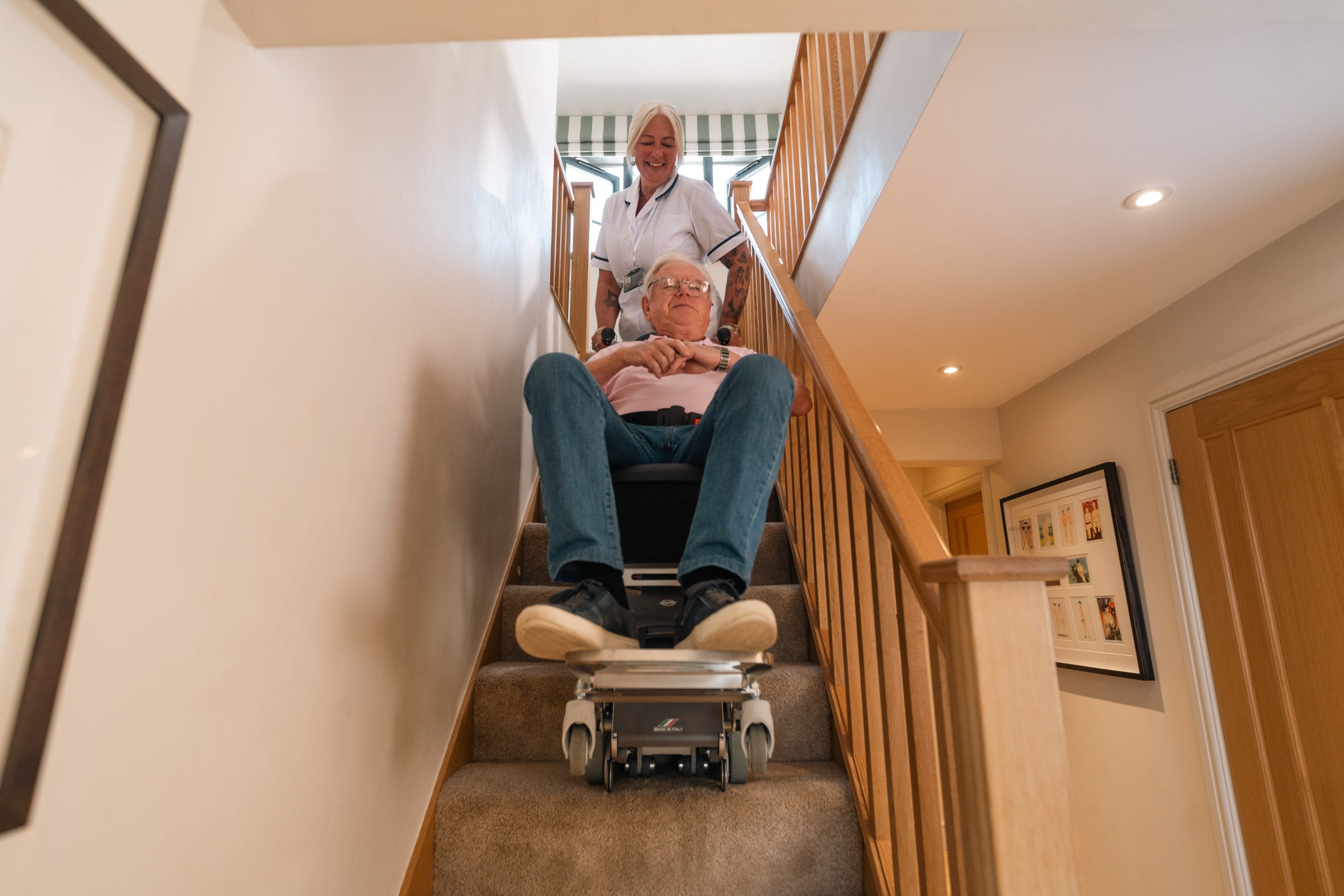
A compatible non-transfer Stair Climber machine can potentially provide a different approach by allowing the person to remain within their wheelchair while travelling between levels.
This is one of the reasons powered stairclimbers can be particularly interesting to Occupational Therapists working with adult wheelchair users.
A wheelchair is not simply a means of getting from one place to another.
For many users, it is a carefully selected piece of equipment supporting posture, comfort, pressure management and functional independence.
Some adults may spend much of their day in their wheelchair.
Asking them to transfer repeatedly into another seat simply because they need to negotiate a staircase may therefore introduce unnecessary complexity.
Depending upon the person’s wheelchair and the stairclimber being considered, it may be possible to attach the compatible wheelchair to the machine.
The individual can then remain in their familiar seating system.
This can potentially reduce the number of transfers involved in moving between floors.
It does not mean every wheelchair can be used with every Stair Climber machine.
Compatibility must always be properly assessed.
But for OTs exploring alternatives to a traditional Portable stair lift, the ability to remain in the wheelchair is an important consideration.
Hospital discharge is one area where home access problems can become particularly apparent.
A person may have entered hospital independently mobile but leave with substantially different abilities.
They might now require a wheelchair.
They may be unable to climb stairs.
They might have reduced balance or strength.
Yet their home has not changed.
The bedroom may still be upstairs.
The bathroom may still be on another level.
The entrance may still include steps.
The NHS provides guidance on home adaptations that can help people continue carrying out everyday activities safely and independently.
For an OT involved in discharge planning, the home environment can therefore be just as important as the person’s clinical progress.
A Portable stairlift or Stair Climber machine may provide one potential option where the staircase is a major barrier to returning home.
The emphasis should always remain on assessment rather than simply supplying equipment.
Permanent adaptations are sometimes absolutely the right solution.
A through-floor lift, fixed stairlift or reconfigured ground floor can transform someone’s ability to use their home.
However, significant building work is not always necessary or desirable.
An adult’s reduced mobility might be temporary.
Their long-term prognosis may be uncertain.
They may live in rented accommodation.
They might be waiting for a larger adaptation.
The household may not want a permanent stairlift occupying part of the staircase.
Or the property may make conventional alterations difficult.
In these circumstances, a Portable stair lift can provide another possibility because it does not normally require a permanent rail.
This flexibility can be particularly useful when an OT needs to consider both the client’s current needs and what may happen over the coming months or years.
The desire to remain in a familiar home can become increasingly important as people get older.
A home may contain decades of memories and provide established connections with neighbours, friends, healthcare services and the wider community.
Yet many UK homes were never designed around reduced mobility.
Stairs can eventually become one of the greatest challenges.
Government information about the Disabled Facilities Grant explains how adaptations may be available to help disabled people access and use their homes more safely.
For OTs, the key is to consider what intervention provides an appropriate and sustainable outcome.
Sometimes that will be a conventional stairlift.
In other circumstances, particularly where wheelchair transfers are problematic or a permanent installation is unsuitable, a Stair Climber machine may deserve consideration.
Being unable to climb stairs independently should not automatically mean that someone needs to stop using half of their home.
It is important not to present a powered stairclimber as inherently better than a fixed stairlift.
They solve different problems.
For an independently mobile adult who can transfer safely, sit securely and operate a stairlift, a fixed installation can provide excellent independent access between floors.
The equipment remains available whenever they need it.
A Portable stairlift, in the form of a powered stairclimber, generally requires another person to operate it.
That dependency must be considered.
However, the situation can look very different for a full-time wheelchair user.
If a conventional stairlift requires two wheelchair transfers every time the individual changes floors, the benefits of a non-transfer Stair Climber machine may become much more significant.
The OT assessment should therefore focus on the complete activity rather than simply the staircase.
One of the most important principles when considering home access is to look beyond individual obstacles.
Imagine an adult wheelchair user whose bedroom is upstairs.
A Stair Climber machine may successfully transport them to the first floor.
But what happens next?
Is there sufficient space on the landing?
Can their wheelchair enter the bedroom?
Can they access the bed?
Is there an accessible bathroom on that floor?
Can carers provide assistance where required?
The objective is not simply to reach the top of the staircase.
It is to enable meaningful access to the home.
The same applies at the bottom of the stairs.
There needs to be sufficient space to safely approach and position the equipment.
The complete route should therefore form part of the assessment.
A powered stairclimber is not suitable for every staircase.
This is why a practical assessment is so important.
Width is an obvious consideration, but it is only part of the picture.
Stair angle, tread dimensions, landings, turns, handrails and obstacles can all affect whether equipment can be safely operated.
Space at the top and bottom of the stairs is particularly important.
A machine may technically fit on the staircase itself but still be impractical if there is insufficient room to manoeuvre into position.
This is one reason The Stair Climbing Company works directly with Occupational Therapists and clients to assess equipment within the actual home environment.
A brochure can tell you the dimensions of a Stair Climber machine.
An assessment can tell you whether it actually works in someone’s home.
A powered stairclimber usually requires a trained operator.
Within a domestic environment, this could be a partner, family member, personal assistant or professional carer.
Their involvement needs to be considered from the beginning.
Who will operate the equipment?
Are they physically capable of doing so?
Are they available when required?
What happens if the main operator is away?
Will several carers need to be trained?
These questions are particularly important when assessing whether a Portable stair lift can provide a sustainable everyday solution.
If the person needs to access the stairs several times each day, operator availability becomes a major consideration.
The best access solution is one that works within real daily routines rather than only during an assessment.
Reduced mobility does not only affect the individual.
It can also change the role of partners and family members.
A partner may begin physically assisting someone on the stairs.
Family members may attempt to support or lift the person.
Over time, this can introduce additional moving and handling concerns.
The Health and Safety Executive provides guidance on moving and handling people and highlights the importance of avoiding hazardous manual handling wherever reasonably practicable.
Appropriate equipment can form part of reducing unnecessary manual handling.
A powered Stair Climber machine controls the movement over the staircase mechanically rather than relying upon someone physically carrying another adult up or down the stairs.
Training and correct use remain essential, but this is an important distinction.
Not every mobility problem is permanent.
An adult recovering from surgery, trauma or illness may be unable to manage stairs for several months before their mobility improves.
In other circumstances, someone’s condition may be progressive and their requirements may change over time.
This is where the flexibility associated with a Portable stairlift can be useful.
A portable solution may sometimes be hired rather than permanently installed.
For OTs dealing with changing or uncertain circumstances, this can create options while rehabilitation continues or longer-term decisions are being made.
It can also prevent an immediate access problem from forcing a premature decision about major building alterations.
Funding is understandably an important consideration when assessing home access.
The Disabled Facilities Grant can provide financial support for eligible adaptations designed to help disabled people live more independently within their homes.
The exact funding route and eligibility will depend upon the individual circumstances and local authority.
For OTs, it can be useful to define the required functional outcome before focusing on a particular product.
For example:
The desired outcome may be safe access between the living area and upstairs bedroom.
There may then be several possible ways of achieving it.
A stairlift could be one.
A through-floor lift could be another.
Reconfiguration of the home might work.
A Stair Climber machine could also be considered.
Starting with the occupational outcome helps ensure the equipment serves the person rather than the assessment becoming driven by a predetermined product.
Occupational Therapists working with adults need access to a broad range of possible solutions.
No single piece of equipment can meet every need.
The value of powered stairclimbers is therefore not that they replace traditional home adaptations.
They expand the available choices.
For some adults, a fixed stairlift will remain the best solution.
For others, remaining on one level with an adapted bathroom and bedroom may provide the greatest independence.
A through-floor lift may offer the ideal long-term arrangement for another client.
But where transfers are difficult, the property cannot easily be altered or flexibility is particularly important, a Portable stair lift should not be overlooked.
The Stair Climbing Company works with Occupational Therapists, adult social care teams, healthcare professionals, local authorities, families and individuals to assess powered stair climbing solutions.
Our approach centres on establishing whether the equipment works for the person in the environment where it will actually be used.
This means considering the adult, their mobility, their wheelchair where relevant, the staircase, the home and the proposed operator.
Different powered stairclimber technologies can then be explored.
Tracked solutions such as the Skyline can accommodate compatible wheelchairs and can be particularly useful when avoiding transfers is important.
The Skyclimber uses a powered stepping system and provides another adaptable approach to negotiating stairs.
The most appropriate solution can only be established through proper assessment.
For more information about the technology and available options, read The Stair Climbing Company’s complete Powered Stairclimber pillar guide.
The purpose of home access equipment is not simply to overcome architectural barriers.
It is to enable people to continue doing the things that matter to them.
For an adult with reduced mobility, solving a staircase problem could mean sleeping in their own bedroom again.
It could provide access to their bathroom.
It might make returning home from hospital possible.
It could reduce the need for difficult transfers.
It may reduce the physical assistance being provided by a partner or carer.
And, in some circumstances, it could help someone remain in a home they have lived in for decades.
A Stair Climber machine, Portable stairlift or Portable stair lift will not be suitable for every adult or every staircase.
But for Occupational Therapists assessing home access, it represents an important option to have available.
The strongest approach is to begin with the person, understand what they need to achieve and assess the complete home environment before deciding upon the equipment.
Sometimes the answer will be a permanent adaptation.
Sometimes it will be a traditional stairlift.
And sometimes a portable powered stairclimber can provide the flexible link that allows an adult to continue accessing the home and everyday life that surrounds them.
Visit The Stair Climbing Company’s Powered Stairclimber guide to explore the technology further or arrange an assessment to determine whether a Stair Climber machine could provide an appropriate solution for your client.
Portable Stair Lift Solutions for OTs: How a Stair Climber Machine Can Support Living at Home For many people with …

Stair Climber Machine and Portable Stair Lift Solutions: Supporting Independent Living at Home For Occupational Therapists, helping someone remain safely …
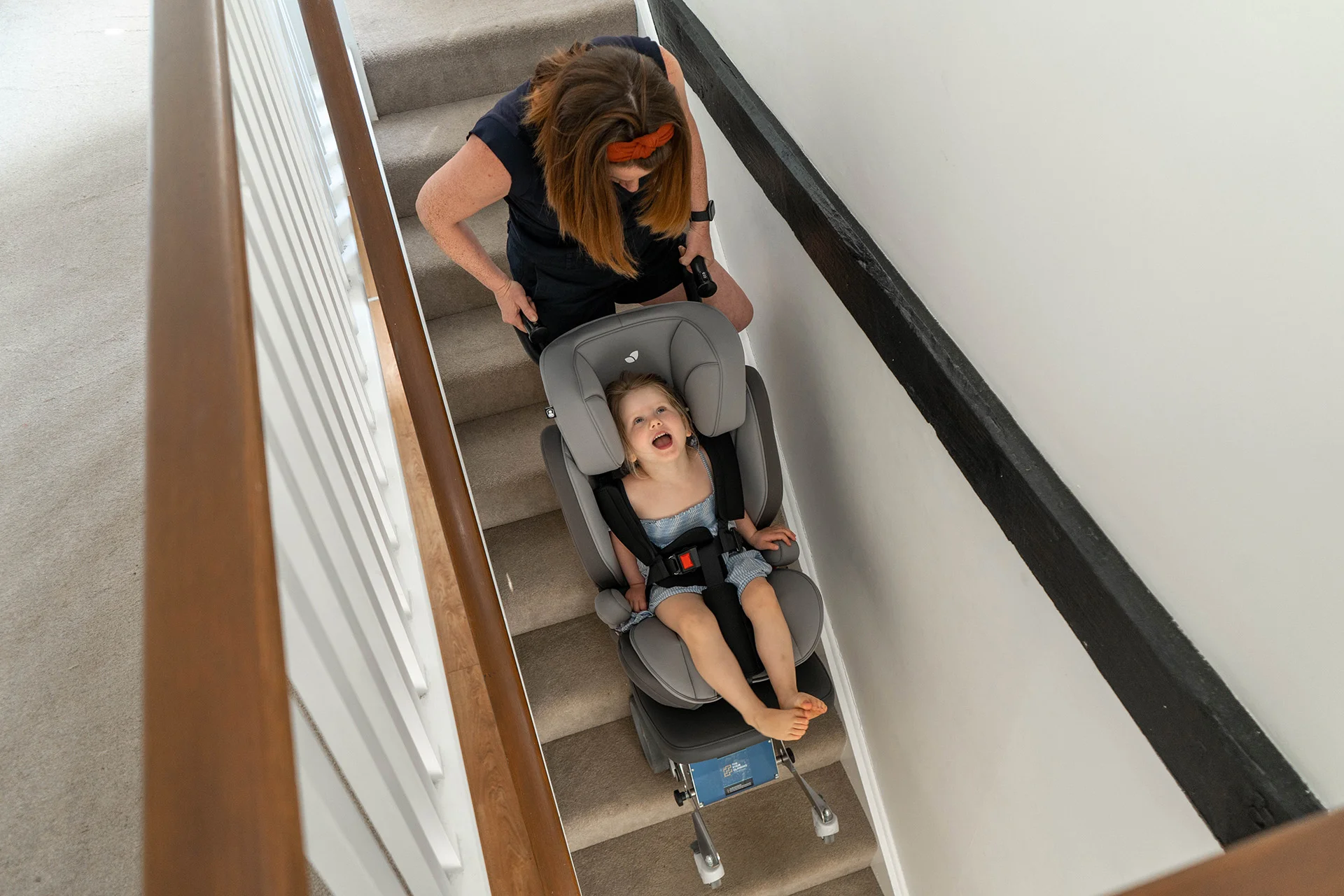
Children’s Stairclimbers for OTs: A Paediatric Access Guide Children’s stairclimbers for OTs can provide a practical access solution …
Stairclimbers for OTs: Supporting Safe and Practical Access at Home For occupational therapists, resolving a client’s difficulty with stairs …

Stairclimbers for OTs: Creating Safer and More Accessible Homes Occupational therapists regularly support people whose independence, safety and daily routines …
Stairclimbers for OTs: Assessing Safe and Practical Access Around the Home Stairs can affect almost every part of life at …
Estimated reading time: 13 minutes