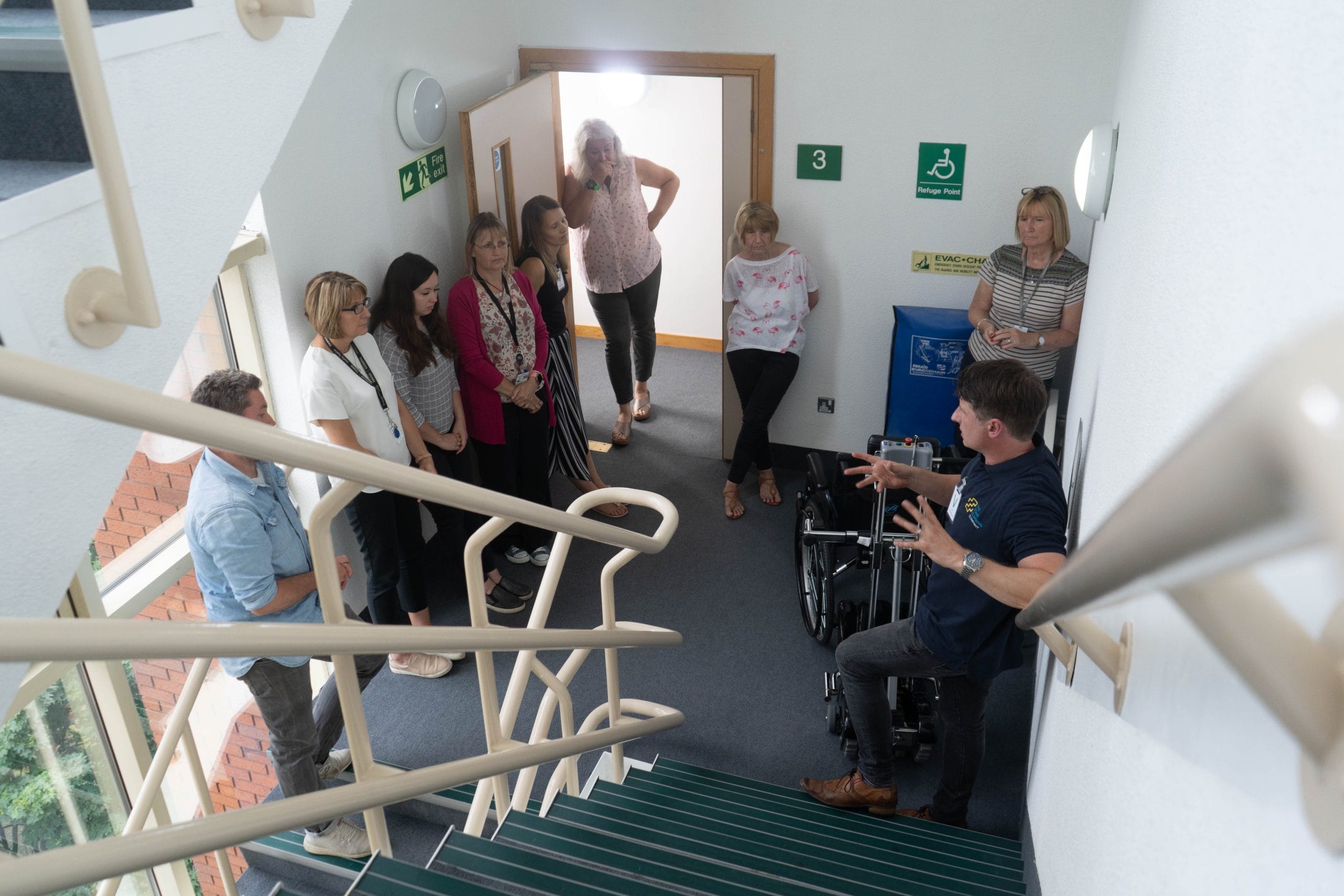
Powered Stair Climbers for Workplace Access: Removing Barriers Without Major Building Work
Powered Stair Climbers for Workplace Access: Removing Barriers Without Major Building Work Need to improve wheelchair access in your workplace? …

For many people with reduced mobility, remaining in their own home is about much more than simply having somewhere to live. Home represents independence, familiarity, routine and connection with family and community.
Yet a relatively small physical barrier can suddenly make that home difficult to use.
Very often, that barrier is the staircase.
For Occupational Therapists working in community settings, housing, social care or hospital discharge, finding a safe way to overcome stairs can become an important part of enabling someone to continue living at home.
A traditional stairlift may immediately come to mind, but it is not always the most suitable option.
A Stair Climber machine, often described by people searching online as a Portable stairlift or Portable stair lift, can provide another approach. Rather than permanently modifying the staircase, a powered stairclimber travels over the existing stairs with the assistance of a trained operator.
For the right person and environment, this can create a flexible solution to an otherwise significant access problem.
For a wider overview of the technology, visit The Stair Climbing Company’s Powered Stairclimber guide.
A home that has worked perfectly for twenty years can become inaccessible remarkably quickly.
A stroke, spinal injury, neurological condition, fall, surgery or deterioration in mobility can change how someone interacts with their surroundings.
The staircase that previously connected two areas of the home can become the very thing that separates them.
An upstairs bedroom may become inaccessible.
A bathroom may no longer be safely reachable.
A wheelchair user may be restricted to one floor.
A family might begin considering whether the person needs to move home simply because there is no obvious way of overcoming a flight of stairs.
This is where Occupational Therapy can make such a significant difference.
The Royal College of Occupational Therapists highlights the importance of suitable housing in enabling people to participate in everyday life. For OTs, the challenge is therefore not simply identifying a person’s mobility limitation. It is understanding what that limitation prevents them from doing and identifying ways of restoring meaningful activity.
When stairs are the problem, the answer does not always need to involve permanently changing the building.
A Stair Climber machine is a powered device designed to transport a person over a suitable staircase.
Unlike a fixed stairlift, the machine is not normally attached to a rail installed along the stairs.
Instead, the equipment itself moves from one level to another.
This is why terms such as Portable stairlift and Portable stair lift are frequently used when people first discover the technology.
Although these terms are useful descriptions, powered stairclimbers operate differently from conventional stairlifts.
Depending upon the model, a stairclimber may use a tracked system or a powered stepping mechanism.
There are also different approaches to passenger seating.
Some stairclimbers have an integrated seat, requiring the user to transfer from their wheelchair before using the equipment.
Other stairclimbers can carry compatible wheelchairs.
This distinction can be particularly important when an OT is assessing someone who relies upon specialist seating or for whom transfers are difficult.
Transfers can sometimes become overlooked when discussing stair access.
A conventional stairlift may appear to solve the problem because it enables travel between floors. But if the person uses a wheelchair, the complete journey may involve considerably more than simply sitting on the stairlift.
The client may need to transfer from their wheelchair onto the stairlift at the bottom of the stairs.
A second wheelchair or mobility aid may then be required at the top.
They may need assistance with both transfers.
For some people this is perfectly manageable.
For others it is not.
Someone using a highly supportive wheelchair may have specific postural, pressure care or seating requirements. Other clients may experience pain during transfers or require substantial moving and handling assistance.
A non-transfer Stair Climber machine capable of accommodating the person’s compatible wheelchair can therefore offer a very different approach.
Rather than asking the person to adapt themselves to the access equipment, it may be possible for the equipment to work around their existing mobility solution.
This should always be assessed individually, but for OTs it is an important option to understand.
The phrase Portable stairlift can suggest that the equipment is simply a smaller or removable version of a conventional stairlift.
In practice, powered stairclimbers should be considered as a separate category of access equipment.
Their principal advantage is flexibility.
There is usually no permanent track attached to the staircase. The equipment can be stored when it is not required and brought into use when needed.
For some homes, this can be particularly useful.
A property may be rented.
The staircase may be unsuitable for significant alteration.
The person may only require assistance for a limited period.
A permanent stairlift might restrict staircase width for other members of the household.
Or the client’s future mobility needs may not yet be clear.
A Portable stair lift can therefore be worth considering alongside fixed adaptations.
The important point is that portability does not automatically make it the correct solution.
It simply creates another possibility.
Good access assessments should not begin with a particular piece of equipment.
They should begin with the person.
What are they currently unable to do?
What do they want to achieve?
Which rooms do they need to access?
How frequently do they need to use the staircase?
What level of assistance is available?
What is likely to change in the future?
The Government’s Disabled Facilities Grant guidance provides a useful wider context for home adaptations and the role they can play in supporting disabled people to live safely and independently.
Government DFG delivery guidance also emphasises a person-centred approach to identifying adaptations, taking account of the needs of the individual and carers rather than simply prescribing a standard solution.
This approach fits naturally with Occupational Therapy.
For one client, independence may mean being able to use a fixed stairlift without assistance.
For another, remaining in their specialist wheelchair while a family member operates a powered stairclimber may provide the better outcome.
The equipment is only successful if it supports what matters to that particular person.
In some properties, providing conventional access between floors can involve considerable work.
A through-floor lift requires suitable space on both floors and structural alterations.
A platform lift may require significant modification.
A conventional stairlift requires a permanently installed rail.
Creating a downstairs bedroom or accessible bathroom can involve extensive adaptation.
There are circumstances where these solutions are entirely justified and provide excellent long-term outcomes.
However, an OT should ideally understand the alternatives before a major adaptation is selected.
A Stair Climber machine may offer a less invasive option because the staircase itself can often remain largely unchanged.
This can be especially relevant in rented accommodation or where the household does not want permanent equipment occupying the staircase.
It may also be useful where the access requirement is temporary.
Someone returning home following surgery, for example, may need help negotiating stairs during rehabilitation without necessarily needing a permanent stairlift for the next decade.
The ability to hire certain types of equipment can potentially provide another route in these circumstances.
Stairs can become a significant barrier when planning discharge from hospital.
The person may be clinically ready to return home but their mobility may have changed considerably since admission.
If their bedroom, bathroom or essential living space is upstairs, returning home safely requires more than simply arranging transport from the hospital.
The NHS guidance on home adaptations explains that assessments can identify adaptations and equipment that help people carry out everyday activities more safely.
For OTs involved in discharge planning, the question is often how the person will function once they actually cross their front door.
A Portable stairlift or powered stairclimber may deserve consideration where stairs are one of the principal barriers preventing safe use of the property.
This does not mean simply delivering a machine to the home.
A proper assessment is essential.
Powered stairclimbers need sufficient space to operate safely.
The staircase itself therefore forms a major part of the assessment.
Width is important, but it is only one measurement.
The assessment should consider the angle of the staircase, tread depth, landings, turns, obstacles and the space available at both the top and bottom.
The approach to the staircase is equally important.
A machine may physically fit on the stairs but still be impractical if there is insufficient room to position it correctly before climbing or to manoeuvre safely after reaching the landing.
This is why real-world assessment is preferable to making decisions from measurements alone.
At The Stair Climbing Company, practical assessments allow the equipment, user and staircase to be considered together.
For an OT, this can provide much more useful information than a technical specification sheet.
For non-transfer stairclimbers, the wheelchair is just as important as the staircase.
Wheelchair designs vary enormously.
Manual chairs, tilt-in-space wheelchairs, paediatric systems and specialist seating can all have very different frame configurations.
Additional equipment may include headrests, lateral supports, trays, oxygen equipment or other accessories.
Compatibility should never be assumed.
Where remaining in the wheelchair is one of the reasons for considering a Stair Climber machine, the specific chair should form part of the assessment and demonstration.
For some clients, avoiding repeated transfers can be one of the strongest arguments for exploring this type of equipment.
Portable stairclimbers generally require an operator.
This is one of the most important differences between them and many conventional fixed stairlifts.
The operator might be a partner, parent, adult child, personal assistant or professional carer.
Their ability and confidence are therefore part of the overall solution.
Can they position the machine correctly?
Can they attach the wheelchair where required?
Can they follow the correct procedure consistently?
Are they available whenever the person needs to change floors?
Would several carers need training?
These questions can determine whether a Portable stair lift is practical for everyday use.
A solution should work at 8pm on a wet Tuesday evening just as effectively as it does during a planned demonstration.
That real-life practicality is fundamental to good OT decision-making.
Powered stairclimbers can also be particularly relevant when considering children and young people with mobility needs.
A child may use specialist supportive seating that has been carefully prescribed around their postural requirements.
Repeatedly transferring that child simply to overcome stairs can introduce additional handling for parents and carers.
As the child grows, manual handling can also become progressively more difficult.
A compatible powered stairclimber may provide an alternative worth assessing.
The long-term picture is particularly important here.
What works for a small child may not remain appropriate as they grow.
The child’s wheelchair may change.
Their home environment may change.
Their ability to participate in transfers may also change.
Portable equipment can sometimes offer useful flexibility within that changing situation.
Home adaptations may potentially be supported through a Disabled Facilities Grant (DFG), depending upon eligibility and the proposed solution.
The Government provides information about Disabled Facilities Grants and eligibility, while local authorities can provide advice regarding individual applications.
OT involvement can be important in establishing the functional outcome an adaptation is intended to achieve.
The focus should remain on the person’s needs.
For example, the outcome might be enabling safe access to an upstairs bathroom rather than simply “providing a stairlift”.
Once the required outcome is understood, different solutions can be considered.
That may include a conventional stairlift, home alteration, lift or, where appropriate, a powered stairclimber.
This should never be treated as a simple product comparison.
Both technologies can be excellent when correctly prescribed.
A fixed stairlift can provide a highly practical solution for someone who can safely transfer and independently operate the equipment.
For that individual, replacing it with an operator-controlled portable machine could actually reduce independence.
Conversely, a wheelchair user who cannot transfer comfortably may find that a conventional stairlift creates additional challenges.
The best solution depends upon the person.
For OTs, useful questions include:
Can the person transfer safely?
Do they need to remain in their wheelchair?
How many times will they use the stairs each day?
Will an operator always be available?
Is the requirement permanent or temporary?
Could the person’s needs change?
Is the property suitable for permanent adaptation?
What does the client actually want to achieve?
Answering those questions is far more valuable than simply asking which machine has the best specification.
Overcoming the staircase is only one part of home access.
Imagine a wheelchair user successfully travelling upstairs using a Portable stairlift.
If their wheelchair cannot turn on the landing or fit through the bedroom doorway, the primary occupational goal has still not been achieved.
Likewise, reaching an upstairs bathroom has limited value if the bathroom itself is inaccessible.
An OT can therefore consider the complete journey.
That could begin at the front entrance, continue through the hallway, involve the staircase and finish with access to the bedroom or bathroom.
Every stage matters.
The purpose of the Stair Climber machine is not to climb stairs for the sake of climbing stairs.
It is to enable the person to reach somewhere that matters.
OTs need options.
There will rarely be one access solution suitable for every person, property or family.
Powered stairclimbers expand the range of options available.
For some clients, the best recommendation will remain a fixed stairlift.
For others it may be a ramp, through-floor lift, platform lift or significant home adaptation.
But where permanent alterations are difficult, transfers are problematic or flexibility is particularly valuable, a Stair Climber machine can be worth assessing.
The important word is assessing.
A stairclimber should never be recommended simply because it appears to fit the staircase.
The passenger, wheelchair, operator, environment and required occupational outcome all need to work together.
The Stair Climbing Company works with Occupational Therapists, local authorities, families and healthcare professionals to explore powered stair climbing solutions within real environments.
Our approach is based around practical assessment rather than simply supplying equipment.
This allows an OT to see how a proposed machine performs with the actual client, actual wheelchair and actual staircase.
Solutions can include different types of powered stairclimber depending upon the requirement.
Tracked machines such as the Skyline can provide a stable stair climbing platform while accommodating compatible wheelchairs.
The Skyclimber uses a powered stepping action and can provide another highly adaptable approach to negotiating stairs.
Paediatric requirements can also be considered where children rely upon specialist seating and wheelchair systems.
You can explore the different technologies in The Stair Climbing Company’s Powered Stairclimber pillar guide.
The best home access solution is not necessarily the largest, most permanent or most expensive adaptation.
It is the solution that enables the individual to do what matters to them safely and sustainably.
Sometimes that will involve altering the property.
Sometimes it will involve a fixed stairlift.
And sometimes a Portable stair lift or Stair Climber machine can provide the flexibility required to make an existing home work again.
For Occupational Therapists, powered stairclimbers are therefore valuable to understand even when they are not ultimately selected.
They provide another option when conventional solutions do not quite fit the person, property or circumstances.
Most importantly, they can shift the conversation away from the staircase itself.
The real objective might be returning home from hospital.
Sleeping in a familiar bedroom.
Accessing the bathroom with dignity.
Remaining with family.
Reducing unnecessary transfers.
Or allowing someone to continue living in a home filled with memories rather than moving because of a flight of stairs.
That is where a Stair Climber machine, Portable stairlift or Portable stair lift can become much more than a piece of mobility equipment.
It can become part of a wider Occupational Therapy solution designed around keeping people safely connected to their homes, routines and everyday lives.
To explore the technology in more detail, visit The Stair Climbing Company’s Powered Stairclimber guide or arrange a practical assessment to determine whether a powered stairclimber could be appropriate for your client.
Powered Stair Climbers for Workplace Access: Removing Barriers Without Major Building Work Need to improve wheelchair access in your workplace? …

Powered Stair Climbers for Wheelchair Access: A Flexible Way to Overcome Stairs Need to create wheelchair access where stairs are …

Part M Stair Climbers for London Buildings: Accessible Retrofit Without Major Structural Change Improving accessibility in an existing London building? …

Part M Stair Climbers for Retrofit Buildings: Creating Accessible Buildings Without Major Structural Change Retrofitting an existing building and struggling …
Part M Stair Climbers for London Retrofit Buildings: Practical Access in Constrained Spaces Discuss a London Access Assessment Retrofitting a …

Part M Stair Climber Access: Creating More Inclusive Buildings Without Losing Flexibility Creating an accessible building is rarely about a …
Estimated reading time: 13 minutes