Powered Stairclimber: The Complete Guide to Safe and Flexible Access
The Complete Guide to Safe and Flexible Access
Stairs remain one of the most common barriers faced by wheelchair users and people with limited mobility. Although modern buildings are generally designed with accessibility in mind, thousands of homes, schools, hotels, workplaces, universities and public buildings across England still contain steps and staircases that restrict access.
Installing a permanent passenger lift, platform lift or stair lift is not always possible. The cost can be prohibitive, the building may not have enough space, or planning and conservation restrictions may prevent major alterations. A permanent installation may also be unnecessary when access is only required occasionally or at different locations.
A powered stairclimber can provide an effective alternative.
Powered stairclimbers are battery-operated mobility devices designed to transport people safely up and down stairs with the assistance of a trained operator. Depending on the model, the passenger can either travel in an integrated seat or remain in their own wheelchair.
This detailed pillar post explains how powered stairclimbers work, the different models available, where they can be used and how to choose a suitable solution. It also considers training, assessments, accessibility responsibilities and the differences between a powered stair climber, a fixed stair lift, a ramp and a platform lift.
At The Stair Climbing Company, we provide powered stairclimber assessments, demonstrations, hire, purchase, training and ongoing support throughout England. Our objective is simple: Creating Accessible Places.
Part One: Understanding Powered Stairclimbers
What is a powered stairclimber?
A powered stairclimber is a portable mobility device that uses a battery-powered motor to transport a person up or down a staircase.
The electric motor controls the climbing movement and reduces the physical effort required from the operator. Rather than lifting or carrying the passenger, the trained operator guides the stairclimber and controls its movement.
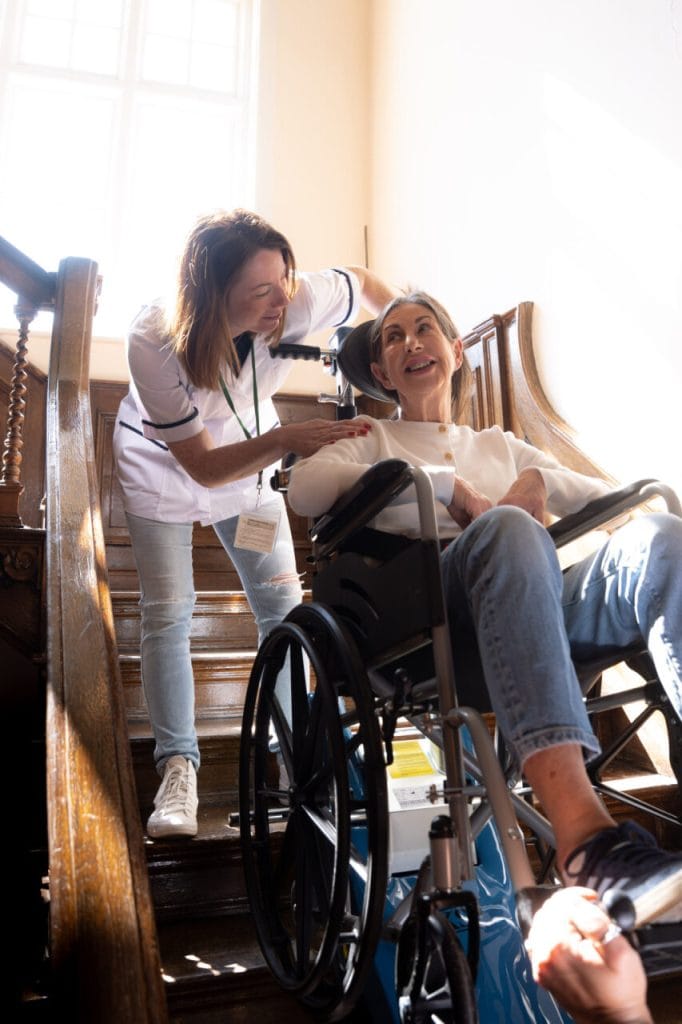
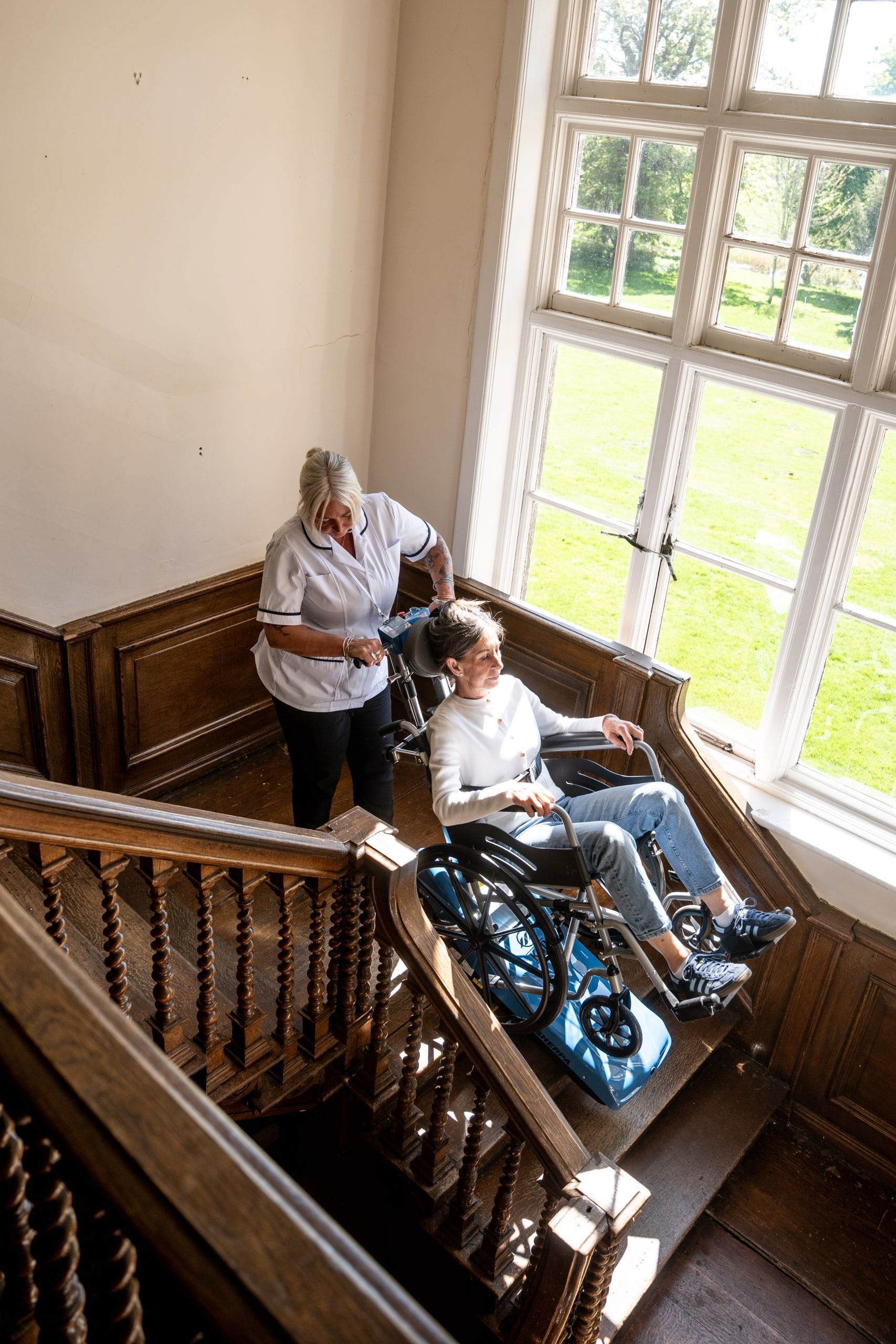
A powered stair climber may have an integrated passenger seat or a system that attaches to a compatible wheelchair. Non-transfer wheelchair models allow the passenger to remain in their own chair throughout the journey.
This can provide a more comfortable and dignified experience, particularly for someone who cannot transfer independently or who uses specialist wheelchair seating.
Unlike a conventional stair lift, the equipment is not normally fixed to the staircase. It can be stored when it is not in use and, where the environment is suitable, moved between different staircases or locations.
How does an electric stairclimber work?
An electric stairclimber uses a rechargeable battery to power either a tracked or stepping climbing mechanism.
The operator positions the machine correctly at the staircase and secures the passenger or wheelchair according to the manufacturer’s instructions. The powered system then moves the stairclimber between one level and another at a controlled speed.
The operator remains responsible for guiding the equipment, monitoring the passenger and maintaining the correct operating position. The motor provides the climbing power, but safe use still depends on proper assessment and training.
Modern powered stairclimbers can include adjustable operating speeds, safety brakes, secure passenger restraints, wheelchair attachment systems and battery indicators. The exact features depend on the model selected.
The battery should be kept charged and maintained in line with the manufacturer’s guidance. The machine should also be checked before use so that any damage, low battery level or operating problem can be identified.
Tracked powered stairclimbers
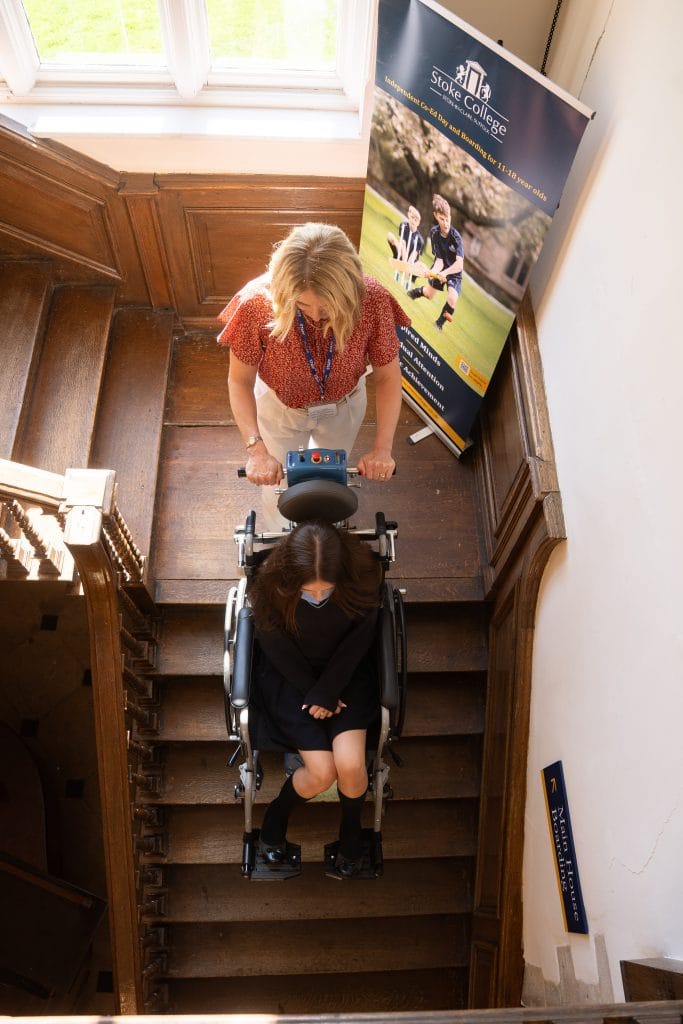
Tracked stairclimbers use powered caterpillar-style tracks that maintain contact with several steps at the same time.
Once positioned on a suitable staircase, the tracks allow the machine to travel smoothly along the flight. This creates a controlled movement and can make tracked models particularly suitable for straight staircases with sufficient landing space.
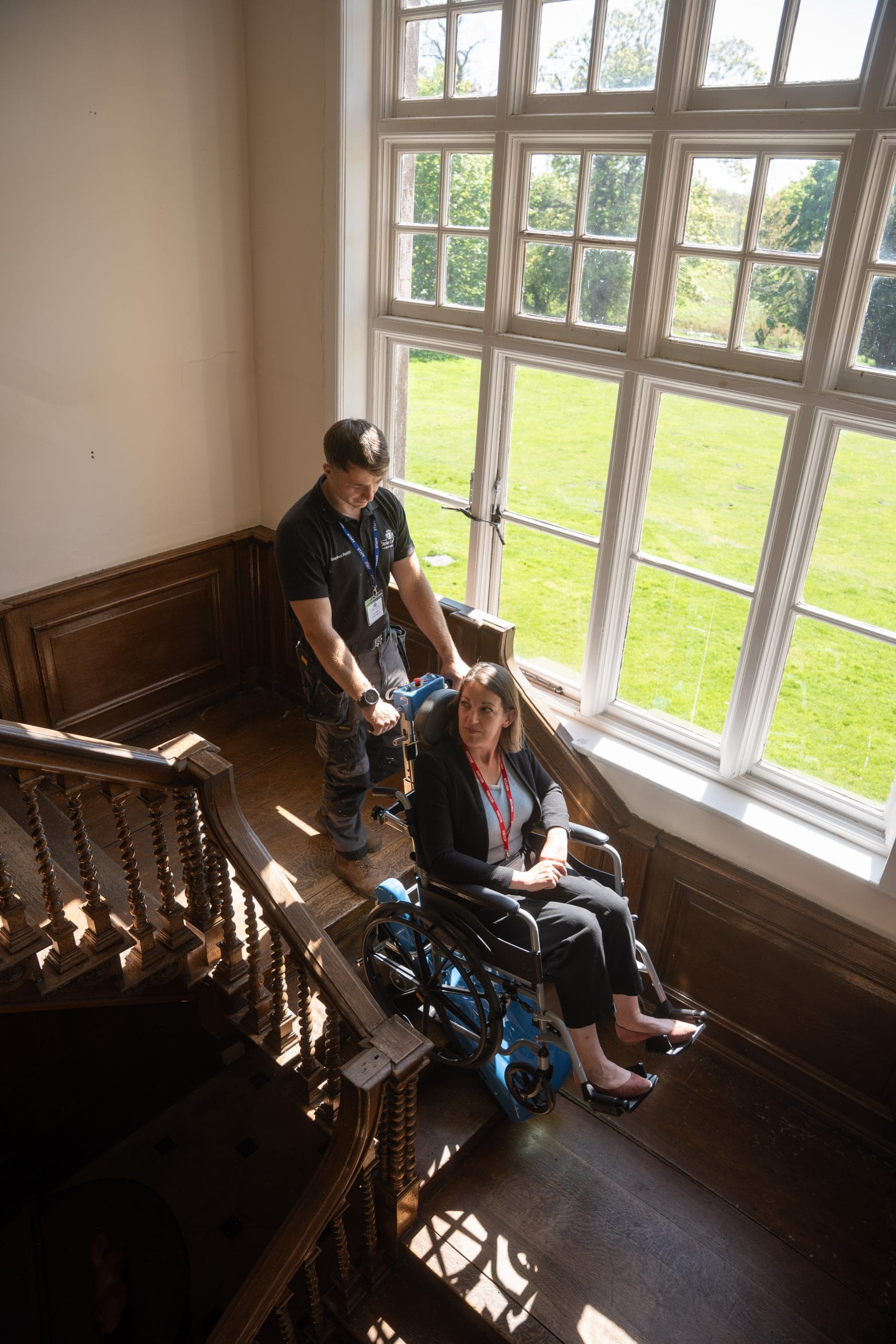
Tracked machines are frequently used as non-transfer wheelchair stairclimbers. The user’s wheelchair is attached securely to the equipment so the individual can travel without moving into another seat.
This makes tracked models valuable for people who use tilt-in-space wheelchairs, supportive seating systems or other wheelchairs selected around their individual postural needs.
A tracked stairclimber requires enough space at the top and bottom of the stairs. The operator must be able to approach the staircase, position the equipment and complete the transition safely.
The staircase angle, step dimensions, landing depth, floor surface, handrails and surrounding obstructions all need to be assessed. Tracked equipment is generally intended for straight flights rather than spiral or sharply turning staircases.
The Skyline powered stairclimber range supplied by The Stair Climbing Company provides non-transfer access for a range of compatible wheelchairs.
Stepping powered stairclimbers
A stepping stairclimber uses a powered mechanism that moves the equipment from one step to the next.
These models can be more compact than tracked machines and may require less landing space. They can therefore be useful in homes and buildings with narrow stairs, smaller landings or turning staircases.
Some stepping stairclimbers have an integrated seat. Others can connect to a compatible wheelchair. The most appropriate configuration depends on the passenger’s mobility, transfer ability, wheelchair and postural support requirements.
Although stepping models can negotiate staircases that are unsuitable for a tracked machine, each individual route still needs to be assessed. Winder steps, tight corners, low ceilings and uneven dimensions can affect suitability.
The operator must be trained to maintain control throughout the movement. The powered mechanism reduces physical exertion, but correct positioning remains essential.
Seated powered stair climbers
A seated powered stair climber includes its own passenger seat. It may be suitable for someone who can transfer safely from a wheelchair, walking aid or ordinary chair.
Seated models are often compact, making them useful in domestic properties and other environments where space is limited. They can also be easier to transport and store.
However, the person’s ability to transfer must be assessed carefully. A transfer that appears straightforward in a showroom may be much more difficult at home, particularly where space is restricted or the person experiences pain, fatigue, poor balance or muscle weakness.
The passenger also needs to maintain an appropriate seated position throughout the journey. Additional head, trunk, foot or leg support may be required for some users.
A seated stair climber should only be selected when it meets the passenger’s complete needs. Compact size alone does not make a machine suitable.
Non-transfer wheelchair stairclimbers
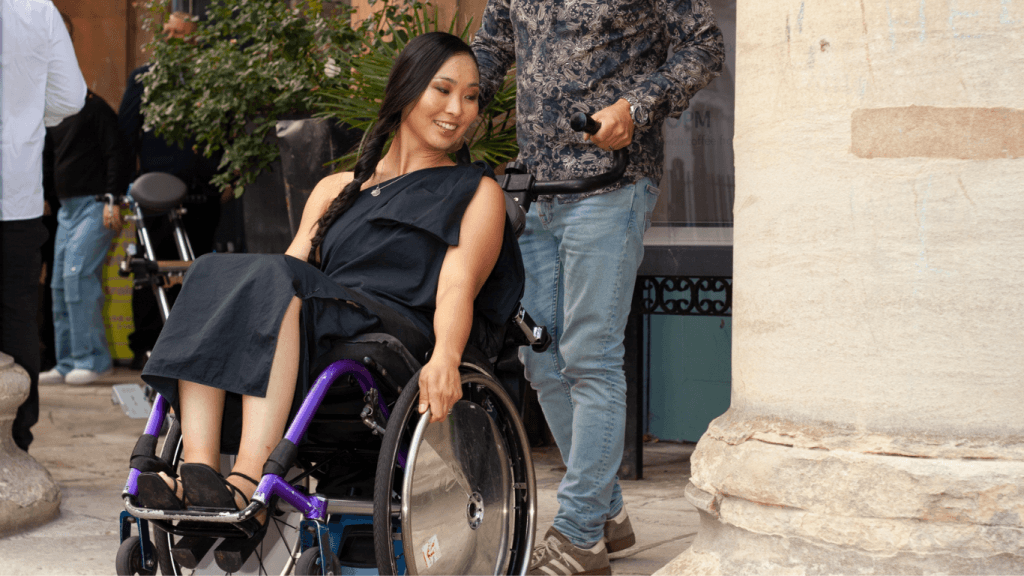
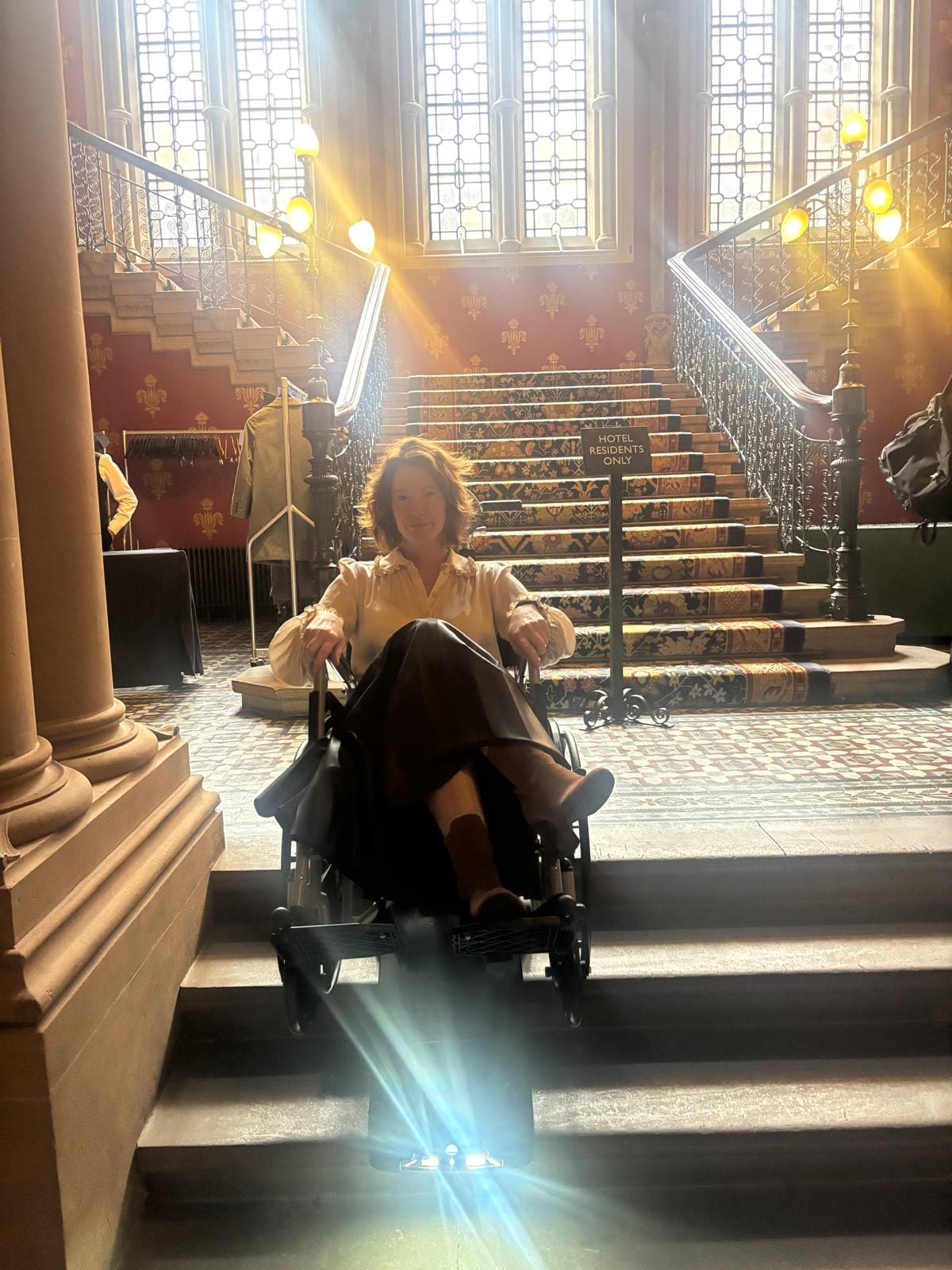
A non-transfer powered stairclimber allows a person to remain in their own wheelchair while travelling on the stairs.
For many people, this is one of the most important benefits of powered stairclimber technology.
Wheelchair users may have seating systems designed around their posture, muscle tone, pressure care and medical requirements. Moving into a standard seat could reduce this support or create unnecessary discomfort.
Some individuals require a hoist or assistance from several carers to transfer. Avoiding that transfer can make access simpler, safer and more dignified.
Wheelchair compatibility must always be confirmed. The assessment should consider the type of chair, its dimensions, total combined weight and available attachment points.
Manual wheelchairs, transit chairs, self-propelled wheelchairs, tilt-in-space chairs, paediatric seating and powered wheelchairs can all have very different frames and weight distributions.
The correct stairclimber and attachment system must be selected for the specific wheelchair rather than relying on a general assumption that every chair will fit.
Can a powered stairclimber be called a portable stair lift?
People frequently use the phrase portable stair lift when searching for a non-fixed solution to stairs.
A powered stairclimber can perform a similar practical role because it transports a person between levels without requiring a permanent rail. However, it is technically different from a conventional stair lift.
A fixed stair lift usually travels along a rail attached to the staircase. The passenger sits on the stair lift and may be able to operate it independently.
A powered stairclimber is portable equipment controlled by a trained operator. It does not normally require permanent installation and can be removed from the staircase after use.
Describing a stairclimber as a portable stair lift can help people understand its purpose, but the difference in operation is important. A stairclimber is an assisted access solution and must have a trained person available whenever it is used.
Ascending and descending stairs
A suitable powered stairclimber can transport a person both upstairs and downstairs.
The equipment is designed to control movement in both directions. The operator follows the procedure for the particular model and maintains communication with the passenger throughout the journey.
Descending is not simply a reversal of ascending. The operator needs to understand the correct positioning, controls and balance points in each direction.
This is one of the reasons that informal demonstrations or written instructions alone are not enough. Operators need practical training on the actual machine they will use.
The stairs must also be kept clear. Bags, furniture, temporary displays and other obstructions can interfere with the operating route and should be removed before the equipment is used.
Part Two: Where Powered Stairclimbers Can Be Used
Powered stairclimbers in the home
A staircase can become a major barrier following an illness, injury, disability or change in mobility.
Someone may be able to move around independently on one floor but be unable to reach a bedroom, bathroom or entrance because of stairs. Moving home or carrying out substantial building work may not be desirable or affordable.
A powered stair climber can sometimes provide an alternative to a fixed stair lift or through-floor lift.
The equipment can be used to overcome internal stairs, external entrance steps or changes in level around the property. Because it is portable, it can usually be stored away when it is not required.
This may be particularly useful in a shared home where other family members still need the full width of the staircase. It can also help in rented accommodation where permanent alterations are restricted.
The person’s care arrangements need to be considered. A suitable operator must be present, trained and physically capable of controlling the equipment. If several carers or family members will operate it, each person should complete practical training.
The route should be considered as a complete journey. It is not enough to confirm that the machine fits on the stairs. The user must be able to reach the stairclimber, be attached or transferred safely and move away from it at the destination.
Working with occupational therapists
Occupational therapists play an important part in identifying suitable access solutions.
An occupational therapist may consider the individual’s mobility, strength, posture, transfer ability, home environment, care support and future needs. This broader perspective helps ensure that equipment supports meaningful everyday activity.
The Stair Climbing Company works with community occupational therapists, housing teams, case managers, local authorities, schools and private clients.
A joint assessment allows the person, therapist and equipment specialist to examine the practical advantages and limitations of each option. It also creates an opportunity to trial the stairclimber with the intended wheelchair and operator.
Powered stairclimbers should not be viewed as products selected solely from a brochure. Their success depends on how well they fit into the individual’s daily routine.
Stairclimbers for children and young people
Children with reduced mobility may use highly specialised wheelchairs or seating systems. These can include lateral supports, headrests, harnesses, foot supports and tilt functions.
Transferring a child from this equipment into a basic stairclimber seat may remove essential postural support. A non-transfer stairclimber can allow the child to remain in their prescribed seating where compatibility has been confirmed.
Paediatric access also needs to consider growth and changing needs. A solution that works today must be reviewed as the child becomes taller, heavier or receives a different wheelchair.
The route may include steps at home, school, a family member’s property or a community venue. If the equipment will be transported between locations, every staircase should be assessed individually.
Parents, carers, therapists and education staff should be involved in planning. Everyone responsible for operating the equipment should understand the child’s communication, positioning and support needs.
Powered stairclimbers for schools
Schools often occupy buildings developed over many years. A site may combine older classrooms, newer teaching blocks, temporary buildings, raised stages and split-level areas.
Installing a lift to every level may be unrealistic. A powered stairclimber can help a school provide access to areas that would otherwise remain unavailable to a pupil, parent, member of staff or visitor.
A non-transfer model can be particularly valuable for a pupil who uses specialist wheelchair seating. Remaining in their own chair can maintain posture and reduce disruption during the school day.
The school should develop a clear operating procedure. It should identify where the equipment is stored, who is trained, how assistance is requested and how the machine is checked.
Staffing arrangements must be realistic. A stairclimber does not improve access if the only trained operator is unavailable when the pupil needs to change classrooms.
Everyday access and emergency evacuation should also be considered separately. An access stairclimber should not automatically be assumed to be suitable for emergency use. Evacuation equipment and procedures require their own professional assessment.
Powered stairclimbers for universities
Universities can present complex accessibility challenges. Campuses frequently include listed buildings, historic lecture theatres, student accommodation, libraries and modern teaching facilities.
A student may need access to several buildings during the same day. The solution must therefore consider timetabling, storage, staffing and the distance between locations.
A portable electric stairclimber may be used across different suitable routes, but each staircase needs to be assessed. A machine approved for one lecture building should not be moved to another staircase without confirming suitability.
Universities should involve the disabled student in the decision. Access should support genuine participation rather than offering a restricted or inconvenient alternative.
The individual should be able to reach teaching rooms, social spaces and facilities in a dignified way. Staff should know how the equipment is requested and operated without drawing unnecessary attention to the user.
Heritage and listed buildings
Heritage buildings are among the most challenging environments in which to create physical access.
Historic staircases, narrow entrances and protected architectural details can make permanent alterations difficult. Installing a platform lift may affect the appearance or fabric of the property, while a permanent ramp may require more space than is available.
A powered stairclimber can provide access with little or no alteration to the building. The equipment can be positioned when required and stored away at other times.
This makes stairclimbers relevant to museums, historic houses, churches, castles, galleries, theatres and visitor attractions.
The staircase surface must be examined carefully. Historic stone, timber and decorative finishes may be uneven or vulnerable to damage. The proposed equipment should be demonstrated on site to confirm that it operates safely without harming the property.
Accessibility and conservation should not be treated as competing objectives. With careful assessment, a portable stair lift alternative can help a historic venue welcome more visitors while respecting the character of the building.
Hotels and hospitality venues
Hotels need to accommodate guests with a wide range of mobility requirements.
Even where bedrooms and principal facilities are accessible, entrance steps, older function rooms, terraces and split-level restaurants can create barriers.
A powered stairclimber may provide access to areas that cannot be reached by the main passenger lift. It may also support a temporary arrangement during maintenance or a lift breakdown.
The guest experience must remain central. Assistance should be offered respectfully, and the venue should provide clear information before the guest arrives.
Staff need more than a machine stored in a cupboard. There should be trained operators available during opening hours, a reliable charging routine and a process for reporting defects.
A powered stair climber can improve access, but only when it is in
Stair Climber
Part Two: Where Powered Stairclimbers Can Be Used
Powered stairclimbers in the home
A staircase can become a major barrier following an illness, injury, disability or change in mobility.
Someone may be able to move around independently on one floor but be unable to reach a bedroom, bathroom or entrance because of stairs. Moving home or carrying out substantial building work may not be desirable or affordable.
A powered stair climber can sometimes provide an alternative to a fixed stair lift or through-floor lift.
The equipment can be used to overcome internal stairs, external entrance steps or changes in level around the property. Because it is portable, it can usually be stored away when it is not required.
This may be particularly useful in a shared home where other family members still need the full width of the staircase. It can also help in rented accommodation where permanent alterations are restricted.
The person’s care arrangements need to be considered. A suitable operator must be present, trained and physically capable of controlling the equipment. If several carers or family members will operate it, each person should complete practical training.
The route should be considered as a complete journey. It is not enough to confirm that the machine fits on the stairs. The user must be able to reach the stairclimber, be attached or transferred safely and move away from it at the destination.
Working with occupational therapists
Occupational therapists play an important part in identifying suitable access solutions.
An occupational therapist may consider the individual’s mobility, strength, posture, transfer ability, home environment, care support and future needs. This broader perspective helps ensure that equipment supports meaningful everyday activity.
The Stair Climbing Company works with community occupational therapists, housing teams, case managers, local authorities, schools and private clients.
A joint assessment allows the person, therapist and equipment specialist to examine the practical advantages and limitations of each option. It also creates an opportunity to trial the stairclimber with the intended wheelchair and operator.
Powered stairclimbers should not be viewed as products selected solely from a brochure. Their success depends on how well they fit into the individual’s daily routine.
Stairclimbers for children and young people
Children with reduced mobility may use highly specialised wheelchairs or seating systems. These can include lateral supports, headrests, harnesses, foot supports and tilt functions.
Transferring a child from this equipment into a basic stairclimber seat may remove essential postural support. A non-transfer stairclimber can allow the child to remain in their prescribed seating where compatibility has been confirmed.
Paediatric access also needs to consider growth and changing needs. A solution that works today must be reviewed as the child becomes taller, heavier or receives a different wheelchair.
The route may include steps at home, school, a family member’s property or a community venue. If the equipment will be transported between locations, every staircase should be assessed individually.
Parents, carers, therapists and education staff should be involved in planning. Everyone responsible for operating the equipment should understand the child’s communication, positioning and support needs.
Powered stairclimbers for schools
Schools often occupy buildings developed over many years. A site may combine older classrooms, newer teaching blocks, temporary buildings, raised stages and split-level areas.
Installing a lift to every level may be unrealistic. A powered stairclimber can help a school provide access to areas that would otherwise remain unavailable to a pupil, parent, member of staff or visitor.
A non-transfer model can be particularly valuable for a pupil who uses specialist wheelchair seating. Remaining in their own chair can maintain posture and reduce disruption during the school day.
The school should develop a clear operating procedure. It should identify where the equipment is stored, who is trained, how assistance is requested and how the machine is checked.
Staffing arrangements must be realistic. A stairclimber does not improve access if the only trained operator is unavailable when the pupil needs to change classrooms.
Everyday access and emergency evacuation should also be considered separately. An access stairclimber should not automatically be assumed to be suitable for emergency use. Evacuation equipment and procedures require their own professional assessment.
Powered stairclimbers for universities
Universities can present complex accessibility challenges. Campuses frequently include listed buildings, historic lecture theatres, student accommodation, libraries and modern teaching facilities.
A student may need access to several buildings during the same day. The solution must therefore consider timetabling, storage, staffing and the distance between locations.
A portable electric stairclimber may be used across different suitable routes, but each staircase needs to be assessed. A machine approved for one lecture building should not be moved to another staircase without confirming suitability.
Universities should involve the disabled student in the decision. Access should support genuine participation rather than offering a restricted or inconvenient alternative.
The individual should be able to reach teaching rooms, social spaces and facilities in a dignified way. Staff should know how the equipment is requested and operated without drawing unnecessary attention to the user.
Heritage and listed buildings
Heritage buildings are among the most challenging environments in which to create physical access.
Historic staircases, narrow entrances and protected architectural details can make permanent alterations difficult. Installing a platform lift may affect the appearance or fabric of the property, while a permanent ramp may require more space than is available.
A powered stairclimber can provide access with little or no alteration to the building. The equipment can be positioned when required and stored away at other times.
This makes stairclimbers relevant to museums, historic houses, churches, castles, galleries, theatres and visitor attractions.
The staircase surface must be examined carefully. Historic stone, timber and decorative finishes may be uneven or vulnerable to damage. The proposed equipment should be demonstrated on site to confirm that it operates safely without harming the property.
Accessibility and conservation should not be treated as competing objectives. With careful assessment, a portable stair lift alternative can help a historic venue welcome more visitors while respecting the character of the building.
Hotels and hospitality venues
Hotels need to accommodate guests with a wide range of mobility requirements.
Even where bedrooms and principal facilities are accessible, entrance steps, older function rooms, terraces and split-level restaurants can create barriers.
A powered stairclimber may provide access to areas that cannot be reached by the main passenger lift. It may also support a temporary arrangement during maintenance or a lift breakdown.
The guest experience must remain central. Assistance should be offered respectfully, and the venue should provide clear information before the guest arrives.
Staff need more than a machine stored in a cupboard. There should be trained operators available during opening hours, a reliable charging routine and a process for reporting defects.
A powered stair climber can improve access, but only when it is incorporated into everyday hospitality procedures.
Workplaces and commercial buildings
Employers and service providers may need to make reasonable adjustments for disabled people under the Equality Act 2010.
What is reasonable depends on the circumstances. The needs of the individual, the nature of the building, practicability and available resources may all be relevant.
A powered stairclimber can form part of an access solution where a permanent lift is not feasible. It may help an employee reach a workspace, meeting room, training area or staff facility.
The person should be involved in the planning process. An adjustment should not be selected without considering how they feel about using the equipment and whether it supports their actual working pattern.
Powered stairclimbers used in workplaces are work equipment and should be managed appropriately. This includes risk assessment, training, maintenance and records.
Events and temporary structures
Temporary events can create unusual access problems. Exhibition stands, hospitality platforms, stages and outdoor structures may include steps even when the main venue is accessible.
Installing a permanent lift for a short event is rarely practical. A hired powered stairclimber can provide a flexible alternative where the route and equipment have been assessed.
Planning should happen before the event opens. The organiser needs to know where the equipment will be stored, who will operate it and how visitors can request assistance.
Outdoor use requires additional consideration. Wet surfaces, loose coverings, temporary steps and uneven ground can affect safety.
The stairclimber must be suitable for the exact structure. Event deadlines should never replace proper assessment and training.
Lift breakdowns and temporary access
A passenger lift breakdown can immediately remove access to part of a building.
Hotels, residential blocks, workplaces and education facilities may need a temporary solution while repairs are completed. A powered stairclimber hire service may help maintain access during this period.
However, an urgent requirement does not mean any machine can be delivered and used safely. The passenger, wheelchair, staircase and operators still need to be considered.
Organisations responsible for buildings with only one accessible lift should consider contingency arrangements before a failure happens. Planning in advance can reduce disruption and prevent unsuitable last-minute decisions.
The stairclimber hire service from The Stair Climbing Company can support temporary and planned access requirements across England.
Part Three: Comparing Powered Stairclimbers with Other Access Solutions
Powered stairclimber or fixed stair lift?
A fixed stair lift travels along a rail installed on a staircase. It can be suitable for someone who uses the same flight regularly and can transfer safely onto its seat.
Some users can operate a stair lift independently. This is an important advantage when the person does not want to rely on assistance.
However, a fixed stair lift remains on the staircase. Its rail and parked seat can reduce the available width, and it normally serves only one route.
A powered stairclimber is mobile and does not require a permanent rail. It can be stored when it is not required and potentially moved between suitable staircases.
Non-transfer models allow compatible wheelchair users to remain in their own chairs. This can be a major advantage where transferring onto a stair lift is unsafe or impractical.
The main limitation is that a stairclimber requires a trained operator. It is therefore not usually an independent solution.
The correct decision depends on the person, property and intended frequency of use. Neither solution should be selected without understanding the complete access requirement.
Powered stairclimber or platform lift?
A platform lift can transport a wheelchair user between levels while they remain in their chair. In a suitable building, it can provide independent and frequently available access.
However, platform lifts require a permanent location, structural work and ongoing maintenance. Planning permission, listed-building consent or landlord approval may also be needed.
The installation can be expensive and may take considerable time. Some buildings do not have enough space for the lift, doors and approach areas.
A powered stairclimber is normally quicker to introduce and requires little or no structural alteration. It can be useful when access is occasional, the building is protected or a permanent lift is not currently affordable.
A platform lift may be preferable for frequent independent access. A stairclimber may be more appropriate when flexibility and minimal alteration are the priorities.
In some properties, the two solutions can complement each other. The platform lift may serve the main public route, while a portable stair climber provides access to a secondary area.
Powered stairclimber or ramp?
Ramps are familiar and can provide independent access when designed correctly. However, they require significantly more length than many people expect.
A shallow gradient creates a long ramp, particularly when the vertical rise is substantial. Landings, handrails, edge protection and manoeuvring space may also be required.
Portable ramps can be useful for small numbers of steps, but they are not automatically suitable for every wheelchair or environment. A ramp that is too steep can be difficult or unsafe.
A powered stairclimber uses the existing staircase and may require less surrounding space. It can therefore be considered where a compliant ramp cannot fit.
However, a ramp may offer independent access while a powered stair climber requires assistance. Independence, frequency of use and the user’s preferences should form part of the decision.
Guidance on accessibility in buildings is contained within Approved Document M. Building owners should obtain appropriate professional advice before making permanent alterations.
Powered stairclimber or carrying chair?
A carrying chair relies on members of staff or carers physically supporting the chair and passenger on the stairs.
This can place considerable strain on the operators and may require more than one person. The operators need to coordinate their movement while managing the passenger’s weight and the staircase.
A powered stairclimber uses an electric motor to control the climbing movement. This can significantly reduce physical effort and provide a more controlled journey.
A carrying chair and a powered stairclimber should not be treated as interchangeable. They have different purposes, operating methods and training requirements.
Where a person needs everyday access, manually carrying them may be undignified, physically demanding and unsustainable. A properly assessed electric stairclimber can create a more consistent solution.
The benefits of a powered stairclimber
The main advantage is flexibility. Powered stairclimbers do not usually require permanent installation and can be stored when not in use.
They can provide access in homes, rented properties, historic buildings and temporary venues where structural alterations are difficult.
Non-transfer models can allow wheelchair users to remain in their own chairs. This may reduce unnecessary transfers and maintain specialist postural support.
The electric motor reduces physical effort compared with carrying a person or using wholly manual equipment. A suitable powered system provides controlled movement both upstairs and downstairs.
A stairclimber may also be used on more than one compatible staircase. This can make it a cost-effective option for organisations that manage several occasional access barriers.
The limitations of powered stairclimbers
A powered stairclimber is not suitable for every person or staircase.
The equipment needs enough room to approach, operate and turn. Very narrow stairs, restricted landings or unusual step shapes may prevent safe use.
A trained operator must be available. This can limit independence and requires organisations to maintain sufficient staff coverage.
Wheelchair compatibility can also affect the available options. Heavy powered wheelchairs, unusual frames or specialist accessories may require a specific model.
The equipment must be charged, maintained and stored correctly. A machine with a flat battery or overdue service cannot provide reliable access.
Acknowledging these limitations is important. The objective is not to sell a stairclimber for every staircase. It is to identify where the technology provides an appropriate and sustainable solution.
Accessibility and reasonable adjustments
Powered stairclimbers can support accessibility, but purchasing a machine does not automatically satisfy every responsibility.
Organisations need to consider whether the solution is suitable for the people who may use it, how assistance will be requested and whether trained operators will be consistently available.
The user should be consulted. Some people may be comfortable using a stairclimber, while others may have concerns relating to posture, pain, anxiety or previous experiences.
Accessibility arrangements should be communicated clearly. A visitor should not arrive at a venue only to discover that no trained operator is present.
A powered stair climber works best as part of a wider access plan that considers the complete visitor, employee, student or resident journey.
Part Four: Assessment, Training and Choosing a Provider
Why a powered stairclimber assessment is essential
No two access situations are exactly the same.
A staircase may look straightforward but still contain features that affect operation. These could include a short landing, low handrail, protruding radiator, doorway, uneven step or change in floor surface.
A professional assessment examines the complete environment. The assessor should measure the stair width, angle, step height, tread depth and landing space. Turns, doors, handrails and overhead clearance should also be considered.
The passenger’s requirements are equally important. Their mobility, weight, posture, transfer ability, wheelchair and communication needs must form part of the decision.
The proposed operators should be involved wherever possible. The assessment provides an opportunity to discuss staffing, storage, charging and frequency of use.
A brochure can explain dimensions and features, but it cannot show exactly how a stairclimber will work in a particular building.
A practical demonstration allows the client to see the equipment on the intended staircase. It can confirm manoeuvring space, passenger positioning and wheelchair attachment.
The person who may use the stairclimber should be involved, where appropriate and with their consent. Their comfort and confidence matter just as much as the technical fit.
Potential operators can also experience how the machine moves and understand what will be expected of them.
If the demonstration identifies a problem, a different model or access method can be explored before money is committed.
Powered stairclimber training
Training converts equipment into a usable access solution.
Operators should understand how to inspect the stairclimber, position it correctly, secure the passenger and operate it in both directions.
They need to recognise the correct balance point and know how to respond if the passenger becomes uncomfortable. Clear communication should be maintained throughout the journey.
Training should take place on the model and staircase the operators will use whenever possible. Generic online information cannot replace supervised practical instruction.
Operators should initially practise without a passenger. Once they are confident with the controls and movement, they can progress to supervised passenger use.
Refresher training may be required when staff change, the equipment is used infrequently or the access route is altered.
Managing work equipment safely
Where a powered stairclimber is used at work, the organisation responsible for the equipment should ensure that it is suitable, maintained and used by properly trained people.
The Health and Safety Executive explains that work equipment must be safe and that risks associated with powered equipment should be managed. Further information is available from the HSE guidance on safe lifting and work equipment.
The applicable inspection requirements can depend on the equipment and how it is used. Organisations should seek competent advice rather than assuming that a basic visual check is sufficient.
Training records, service documents and pre-use checks should be retained. Any reported defect should be investigated, and equipment should be removed from service when its safety is uncertain.
Charging and battery care
The battery is central to the reliability of an electric stairclimber.
Equipment should be stored where it can be charged safely and accessed easily. Leaving a machine in an unsuitable cupboard without a charging routine can result in it being unavailable when needed.
The manufacturer’s charging instructions should be followed. Staff should understand the battery indicator and know how to report reduced performance.
Long periods without use can still affect a battery. Equipment kept as a contingency solution therefore needs regular checks, even if it has not recently transported a passenger.
A planned routine is far more reliable than expecting someone to remember to charge the machine after occasional use.
Servicing and maintenance
Powered stairclimbers contain motors, batteries, tracks or climbing mechanisms, controls and safety components. These parts need appropriate inspection and maintenance.
A service should examine the operation of the machine, condition of attachments, restraint systems and other critical features. Worn or damaged components should be replaced using appropriate parts.
The frequency of servicing depends on the manufacturer’s recommendations, usage and operating environment.
Equipment used outside or transported regularly may experience different wear from a machine stored permanently inside a home.
Maintenance should be planned from the beginning. The cost of ownership includes keeping the equipment safe, reliable and ready for use.
Choosing the right powered stairclimber
The best powered stairclimber is not necessarily the most expensive, most compact or most powerful model.
It is the machine that works for the user, wheelchair, operator and staircase.
A compact seated model may be appropriate for a person who can transfer and has a narrow domestic staircase. A tracked non-transfer machine may be more suitable for a wheelchair user on a wide, straight staircase.
A paediatric user may need specialist seating compatibility. A historic venue may prioritise protection of the staircase and discreet storage. A school may need several trained operators and a plan for equipment use throughout the day.
The decision should be based on evidence from the assessment and demonstration. Price can then be considered in relation to suitability, training, warranty and ongoing support.
Buying or hiring a stairclimber
Purchasing may be the most suitable option when the equipment will be used regularly over a long period.
Ownership gives the household or organisation permanent access to the machine, but it also creates responsibility for charging, servicing, training and safe storage.
Hiring may suit short-term injuries, temporary events, lift breakdowns or trial periods. It can provide access without the full commitment of purchasing.
The hire period should include suitable equipment, clear operating arrangements and training where required. The machine must still be matched to the user and staircase.
The right choice depends on frequency, duration, budget and how quickly the access requirement may change.
Why choose The Stair Climbing Company?
The Stair Climbing Company specialises in creating access where stairs have become a barrier.
We provide a range of powered stairclimbers, including compact seated machines and non-transfer models that attach to compatible wheelchairs.
Our team supports private individuals, families, occupational therapists, schools, universities, local authorities, hotels, heritage organisations, workplaces and event providers throughout England.
We do not believe that a successful access solution begins with choosing a product. It begins with understanding the person and the environment.
Our service can include initial advice, site assessment, equipment demonstration, purchase or hire, operator training and ongoing aftercare.
This complete approach helps ensure that the selected powered stair climber works safely and confidently in real life.
Frequently asked questions about powered stairclimbers
Can a powered stairclimber be used on every staircase?
No. Suitability depends on the staircase dimensions, angle, landings, turns, surfaces and surrounding space. An assessment is needed before use.
Can someone remain in their wheelchair?
Yes, certain non-transfer stairclimbers attach to compatible wheelchairs. The chair, combined weight and attachment points must be checked.
Can a stairclimber carry a powered wheelchair?
Some models are designed for compatible powered wheelchairs. These chairs are heavier, so the correct model and weight capacity are essential.
Is a powered stairclimber suitable for curved stairs?
Certain stepping models can negotiate some turning or curved staircases. Tracked models are generally intended for straight flights. Every route must be assessed.
Can a powered stair climber be used outside?
Some models can be used on suitable outdoor steps. The surface, gradient, weather conditions and manufacturer’s guidance must be considered.
Does the passenger operate the stairclimber?
Normally, no. A powered stairclimber is controlled by a trained operator who guides the equipment and communicates with the passenger.
Is it an alternative to a stair lift?
It can be a practical portable stair lift alternative, particularly where permanent installation is not possible or the person needs to remain in their wheelchair.
Does a stairclimber require building work?
Powered stairclimbers do not normally require permanent building work or a fixed rail. The equipment uses the existing staircase.
How much does a powered stairclimber cost?
Cost depends on the model, weight capacity, attachments, seating and support package. A professional assessment allows an accurate recommendation and quotation.
Can a powered stairclimber be hired?
Yes. Hire can be suitable for events, temporary access, lift breakdowns and short-term mobility requirements.
How many operators need training?
Every person expected to operate the machine should receive practical training. Organisations should train enough people to provide reliable cover.
Is a stairclimber suitable for emergency evacuation?
An everyday access stairclimber should not automatically be treated as evacuation equipment. Emergency arrangements require a separate assessment, appropriate equipment and documented procedures.
Creating accessible places
A powered stairclimber can provide a safe, flexible and dignified way to overcome stairs.
It can allow a person to remain in their own wheelchair, support access without permanent construction and provide an effective alternative where a stair lift, platform lift or ramp is impractical.
However, the equipment must be selected carefully. The passenger, wheelchair, operator, staircase and wider journey all need to be considered.
Professional assessment, practical demonstration, operator training and ongoing maintenance are the foundations of a successful solution.
If you are looking for a powered stairclimber, powered stair climber, portable stair lift alternative or electric stairclimber, contact The Stair Climbing Company.
Our team can assess your staircase, demonstrate suitable equipment and help you create an access solution that works for the individual and the building.
Stair Lift Alternative for London Buildings: Flexible Access Without Permanent Installation Providing accessible routes through London buildings is rarely a …