Powered Stair Climbers for Workplace Access: Removing Barriers Without Major Building Work
Powered Stair Climbers for Workplace Access: Removing Barriers Without Major Building Work Need to improve wheelchair access in your workplace? …

School evacuation is one of the most important responsibilities placed on education leaders. Every headteacher, responsible person, school business manager and trust estates team understands the importance of having robust fire procedures, regular evacuation drills and clear emergency plans. However, one area that continues to evolve is how schools plan for pupils, staff and visitors with reduced mobility.
Creating a truly inclusive evacuation strategy means considering everyone who may be in the building when an emergency occurs. For many schools, this has traditionally involved the purchase of evacuation chairs together with Personal Emergency Evacuation Plans. While evacuation chairs continue to play an important role, advances in technology mean there is now another solution that deserves serious consideration. Powered stair climbers are changing the conversation around school evacuation by providing a safer, more flexible and more practical way of moving wheelchair users over stairs.
As schools continue to improve accessibility and inclusion, powered stair climbers are becoming an increasingly valuable part of emergency planning.
The education sector has changed significantly over the last decade. Schools now welcome pupils with a wider range of physical needs than ever before, reflecting a commitment to inclusive education. At the same time, many school buildings remain unchanged. Victorian schools, split level campuses and multi storey teaching blocks continue to present challenges that cannot always be solved through permanent building alterations.
When lifts cannot be used during an emergency, staircases become the only available escape routes. This is where planning becomes critical.
Guidance from the Department for Education continues to encourage schools to create safe, inclusive learning environments where accessibility is considered from the earliest stages of planning. Information can be found at https://www.gov.uk/government/organisations/department-for-education.
Fire safety legislation also places clear responsibilities on those managing educational premises. The National Fire Chiefs Council provides valuable guidance on evacuation planning and fire safety responsibilities through https://www.nationalfirechiefs.org.uk, while the Fire Industry Association offers further technical guidance at https://www.fia.uk.com.
For schools, compliance is only one part of the picture. Parents expect reassurance that their children can be evacuated safely. Staff need confidence that suitable equipment is available should an emergency occur. Governors and academy trusts want to know that investments in accessibility provide long term value rather than simply satisfying minimum legal requirements.
This is why powered stair climbers are becoming an increasingly important topic within education.
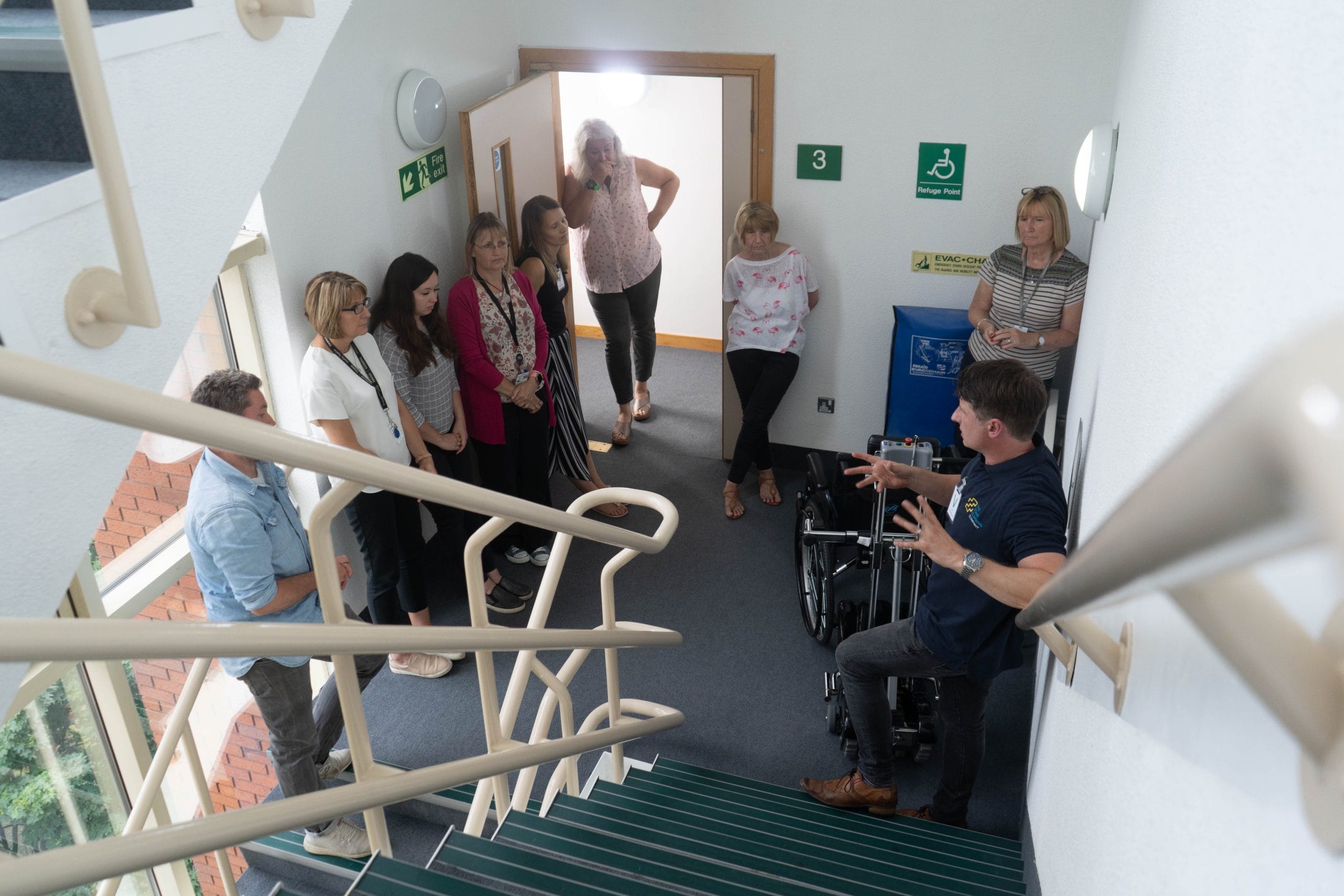
Unlike traditional manual evacuation equipment, a powered stair climber uses battery powered technology to assist movement over stairs. This significantly reduces the physical effort required from trained operators while providing a smoother and more controlled journey for the wheelchair user.
For many schools, this creates several important advantages.
Members of staff often have varying levels of physical strength and experience. During an emergency, stress levels naturally increase and manual handling becomes more demanding. Powered stair climbers help reduce those demands, allowing operators to concentrate on communication, reassurance and maintaining safe control throughout the evacuation.
The experience for the wheelchair user also changes dramatically. A smooth powered descent is generally more reassuring than manual movement, particularly for children and young people who may already feel anxious during an emergency.
Perhaps the greatest benefit is versatility.
Many powered stair climbers are not simply evacuation products. They can also improve everyday accessibility throughout the school. During lift maintenance, refurbishment projects or temporary access restrictions, the same equipment can continue supporting pupils and staff.
This means schools invest in equipment that provides value every day rather than remaining stored away until an emergency occurs.
Accessibility and evacuation should never be considered separately.
The Equality Act encourages education providers to make reasonable adjustments that allow disabled pupils to participate fully in school life. Guidance from the Equality and Human Rights Commission explains these responsibilities in greater detail at https://www.equalityhumanrights.com.
When accessibility equipment is used regularly, staff become more familiar with its operation. Confidence increases naturally because the equipment forms part of everyday school life rather than existing solely for emergency situations.
This familiarity becomes particularly valuable during an evacuation.
Schools also need to consider how their estates continue to evolve. Buildings are refurbished, classrooms change purpose and pupil numbers increase. Fixed accessibility solutions do not always adapt easily to these changes.
Powered stair climbers provide much greater flexibility.
Instead of serving one staircase, they can often be deployed throughout different areas of the school depending on operational requirements. This allows accessibility resources to move with the needs of the school rather than remaining permanently attached to one location.
For larger academy trusts operating multiple buildings, this flexibility represents a significant advantage.
Occupational therapists increasingly recognise the value of powered stair climbers because they support individual mobility needs while reducing manual handling risks for staff. School leaders are beginning to appreciate that accessibility should support independence wherever possible while maintaining the highest standards of safety.
The Health and Safety Executive continues to emphasise the importance of effective risk assessment and safe manual handling within workplaces. Further information is available through https://www.hse.gov.uk.
When evacuation equipment reduces physical effort, it also contributes to safer working practices for school employees.
Every school environment presents unique challenges.
Primary schools often have younger pupils who may require additional reassurance during an emergency. Secondary schools may operate across several teaching blocks connected by multiple staircases. Special schools frequently support pupils with complex mobility requirements, specialist seating systems and powered wheelchairs.
No single solution will suit every building.
This is why professional assessment is so important.
The Stair Climbing Company works with schools across England to assess buildings, understand pupil requirements and recommend powered stair climber solutions that reflect the specific needs of each educational environment. Rather than recommending equipment in isolation, assessments consider accessibility, emergency planning, wheelchair compatibility and long term operational requirements together.
More information about powered stair climbers for schools can be found at https://thestairclimbingcompany.com.
School evacuation planning is no longer simply about responding to a fire alarm. It is about creating confidence for pupils, staff, parents and governors that every individual can be supported safely if the unexpected happens.
Powered stair climbers are helping schools move beyond minimum compliance towards genuinely inclusive emergency planning.
As expectations surrounding accessibility continue to rise, more schools are recognising that investing in modern evacuation technology strengthens both everyday inclusion and emergency preparedness.
This change in thinking is already influencing how many educational establishments across England approach their future accessibility strategies.
Powered Stair Climbers for Workplace Access: Removing Barriers Without Major Building Work Need to improve wheelchair access in your workplace? …

Powered Stair Climbers for Wheelchair Access: A Flexible Way to Overcome Stairs Need to create wheelchair access where stairs are …

Part M Stair Climbers for London Buildings: Accessible Retrofit Without Major Structural Change Improving accessibility in an existing London building? …

Part M Stair Climbers for Retrofit Buildings: Creating Accessible Buildings Without Major Structural Change Retrofitting an existing building and struggling …
Part M Stair Climbers for London Retrofit Buildings: Practical Access in Constrained Spaces Discuss a London Access Assessment Retrofitting a …

Part M Stair Climber Access: Creating More Inclusive Buildings Without Losing Flexibility Creating an accessible building is rarely about a …
Estimated reading time: 6 minutes