Powered Stair Climbers for Workplace Access: Removing Barriers Without Major Building Work
Powered Stair Climbers for Workplace Access: Removing Barriers Without Major Building Work Need to improve wheelchair access in your workplace? …

The NHS cares for millions of people every year, many of whom rely on hospitals and healthcare facilities that operate around the clock. From major acute hospitals and community hospitals to outpatient clinics, rehabilitation centres and specialist treatment units, every NHS building has a responsibility to ensure patients, staff and visitors can be evacuated safely during an emergency.
Healthcare environments are among the most challenging buildings to evacuate. Patients may have reduced mobility, complex medical conditions or be unable to self-evacuate without assistance. Staff must continue delivering care while responding quickly to an emergency, often in busy and demanding environments.
For this reason, effective evacuation planning is a fundamental part of patient safety, clinical governance and operational resilience.
The Evacuation Company works with NHS Trusts and healthcare organisations across the UK to develop robust Personal Emergency Evacuation Plans (PEEPs), Generic Emergency Evacuation Plans (GEEPs) and Building Emergency Evacuation Plans (BEEPs). Supported by specialist powered stairclimbers from The Stair Climbing Company, these solutions help healthcare providers improve emergency preparedness while supporting safe patient care.
No two healthcare buildings are identical.
Large teaching hospitals, district general hospitals, mental health facilities, rehabilitation centres and community hospitals all present different evacuation challenges. Many NHS sites combine older buildings with modern clinical facilities, creating complex estates with multiple levels, specialist departments and high patient occupancy.
During a fire or other emergency, passenger lifts are generally unavailable. Staircases become essential escape routes, yet many patients cannot use stairs independently because of illness, disability, injury or age.
Healthcare providers therefore require evacuation procedures that are practical, inclusive and capable of supporting a wide range of clinical needs.
A Personal Emergency Evacuation Plan provides an individual evacuation strategy for a patient, employee or regular visitor who requires assistance during an emergency.
Within the NHS this may include wheelchair users, patients with neurological conditions, people recovering from surgery, individuals receiving rehabilitation, maternity patients, staff with disabilities or long-term health conditions and patients attending regular outpatient appointments.
Each PEEP should consider the individual’s mobility, clinical condition, available evacuation routes, staffing requirements and the most appropriate evacuation equipment.
The Evacuation Company works alongside NHS estates teams, fire safety managers and clinical departments to develop practical PEEPs that integrate into existing emergency procedures.
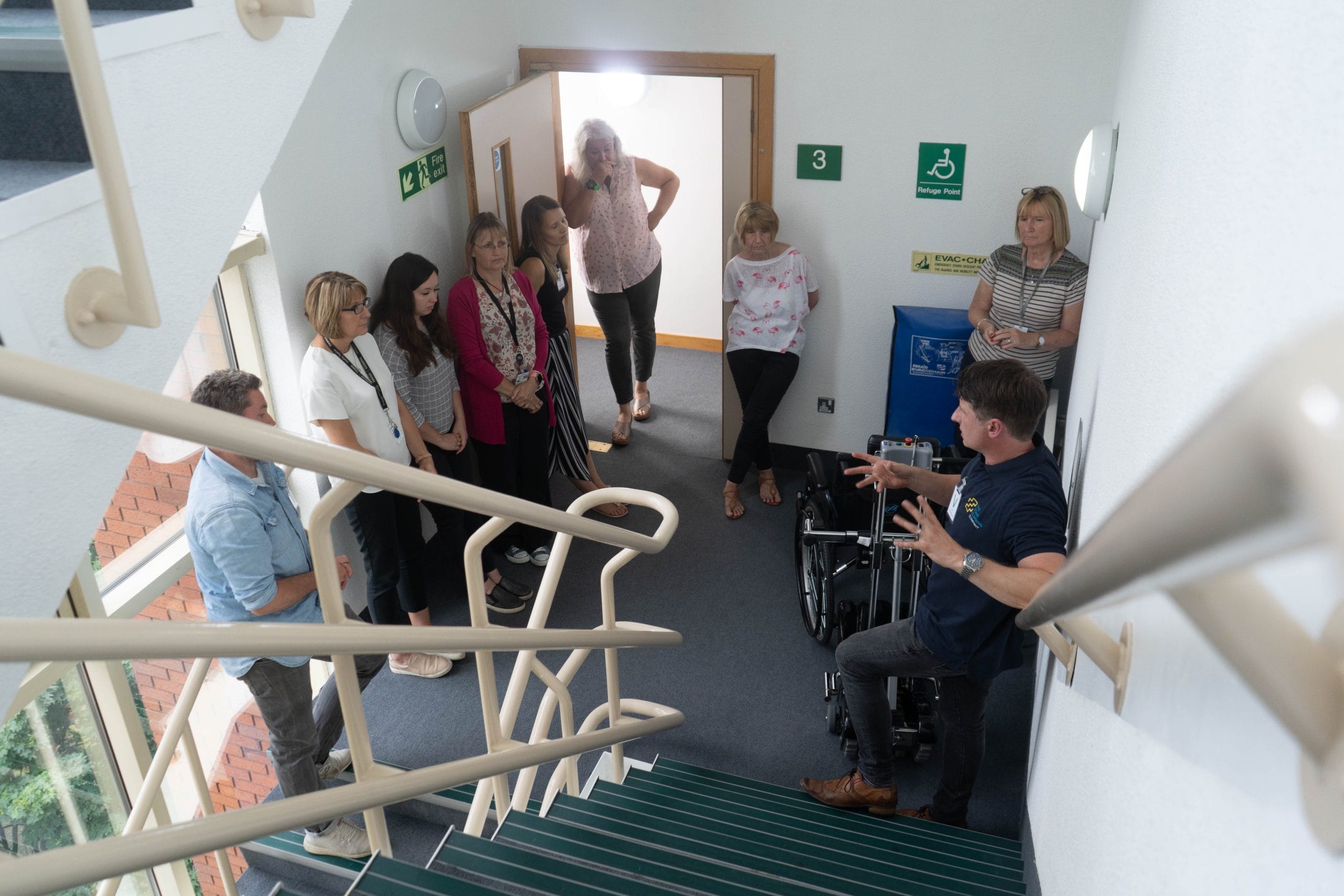
Powered stairclimbers play an important role within many PEEPs because they provide a safe and controlled method of evacuating wheelchair users and people with reduced mobility when lifts are unavailable.
NHS buildings welcome thousands of visitors every day.
Family members, carers, contractors, volunteers, agency staff, students and members of the public all use healthcare facilities. Some may require assistance during an emergency, despite not having an individual evacuation plan.
Generic Emergency Evacuation Plans ensure healthcare organisations are prepared to support anyone who requires assistance while visiting an NHS site.
Powered stairclimbers allow trained staff to respond quickly and safely, helping ensure evacuation procedures remain inclusive regardless of who is in the building.
A Building Emergency Evacuation Plan provides the overall strategy for safely evacuating an NHS facility.
Healthcare BEEPs often need to account for inpatient wards, operating departments, outpatient clinics, imaging suites, maternity units, intensive care areas, rehabilitation facilities and administrative offices. They must also consider compartmentation, progressive horizontal evacuation where appropriate, refuge areas, staffing arrangements and emergency coordination.
The Evacuation Company supports NHS Trusts by reviewing existing evacuation procedures and developing BEEPs that reflect the operational demands of modern healthcare.
Powered evacuation chairs and powered stairclimbers strengthen these plans by providing a dependable evacuation solution whenever staircases become the primary escape route.
Powered stairclimbers represent a significant advancement in patient evacuation technology.
Using advanced motorised systems, powered stair climbers transport wheelchair users and individuals with reduced mobility safely along staircases while reducing the physical effort required by healthcare staff.
Compared with traditional manual evacuation techniques, powered stairclimbers offer improved stability, smoother movement and greater confidence for both patients and operators.
Many NHS organisations also recognise that powered stairclimbers have value beyond emergency evacuation. They can assist during lift failures, building maintenance, patient transfers between departments and temporary access challenges, making them a practical investment for busy healthcare environments.
Manual handling remains one of the most significant occupational risks within healthcare.
During an emergency evacuation, clinical teams, porters, estates personnel and fire response staff may need to move patients quickly through stairwells while maintaining safety and dignity.
Powered stairclimbers reduce physical strain by providing controlled motorised movement throughout the evacuation process. This helps minimise manual handling risks while allowing healthcare professionals to concentrate on patient care.
Supporting staff wellbeing while improving patient safety makes powered evacuation chairs an increasingly valuable part of NHS emergency planning.
NHS organisations operate within a comprehensive framework of fire safety, health and safety and equality legislation.
The Regulatory Reform (Fire Safety) Order requires responsible persons to assess fire risks and implement appropriate evacuation procedures.
The Equality Act 2010 requires reasonable adjustments for disabled patients, employees and visitors.
Healthcare organisations also work within NHS fire safety guidance and Health Technical Memoranda, alongside advice from the National Fire Chiefs Council and the Health and Safety Executive.
The Evacuation Company helps NHS Trusts meet these responsibilities through professional evacuation assessments, PEEP development, GEEP implementation, BEEP reviews, evacuation chair training, powered stairclimber demonstrations and specialist consultancy.
Every healthcare facility presents different operational challenges.
A major trauma centre has different evacuation requirements from a community hospital. A mental health facility requires a different approach from an outpatient clinic or rehabilitation unit.
The Evacuation Company works closely with estates teams, fire safety managers, moving and handling leads and clinical departments to recommend evacuation solutions that reflect the needs of each site.
Powered stairclimbers supplied by The Stair Climbing Company provide reliable, high-quality solutions trusted by healthcare organisations throughout the UK.
For expert advice on PEEPs, GEEPs, BEEPs, evacuation planning, evacuation training and powered evacuation chairs, visit https://www.evacuationcompany.co.uk.
To learn more about powered stairclimbers, powered stair climbers and specialist accessibility solutions, visit https://www.stairclimbingcompany.com.
Healthcare continues to evolve, with increasing patient demand, ageing populations and greater expectations around accessibility and inclusion.
Emergency evacuation planning must evolve alongside these changes.
Powered stairclimbers help NHS organisations strengthen patient safety, improve operational resilience and reduce manual handling risks while supporting inclusive evacuation procedures.
By integrating powered stair climbers and powered evacuation chairs into PEEPs, GEEPs and BEEPs, NHS Trusts can create evacuation strategies that protect patients, staff and visitors while demonstrating a commitment to safe, person-centred care.
With expert guidance from The Evacuation Company and specialist equipment from The Stair Climbing Company, NHS organisations across the UK can build emergency evacuation plans that are practical, compliant and ready to perform when every second matters.
Powered Stair Climbers for Workplace Access: Removing Barriers Without Major Building Work Need to improve wheelchair access in your workplace? …

Powered Stair Climbers for Wheelchair Access: A Flexible Way to Overcome Stairs Need to create wheelchair access where stairs are …

Part M Stair Climbers for London Buildings: Accessible Retrofit Without Major Structural Change Improving accessibility in an existing London building? …

Part M Stair Climbers for Retrofit Buildings: Creating Accessible Buildings Without Major Structural Change Retrofitting an existing building and struggling …
Part M Stair Climbers for London Retrofit Buildings: Practical Access in Constrained Spaces Discuss a London Access Assessment Retrofitting a …

Part M Stair Climber Access: Creating More Inclusive Buildings Without Losing Flexibility Creating an accessible building is rarely about a …
Estimated reading time: 6 minutes