Powered Stairclimbers in UK Universities: Creating More Accessible Campuses
University should be a place where students can learn, participate and build their future. Yet for wheelchair users and people …

Estimated reading time: 11 minutes
University should be a place where students can learn, participate and build their future. Yet for wheelchair users and people with reduced mobility, something as ordinary as a staircase can restrict access to a lecture, laboratory, library or social event.
Many UK campuses include an awkward mixture of buildings. A modern teaching block may stand beside a listed hall, a converted townhouse or a residence built before step-free access was expected. Even buildings with passenger lifts can have isolated rooms, split levels or emergency routes that remain difficult to navigate.
Major building work is often the best long-term answer, particularly where it creates independent step-free access. It is not always immediately practical, however. A powered stairclimber can sometimes provide a flexible way to overcome a specific barrier while reducing the need to lift or carry a person manually.
The key word is “specific”. No stairclimber suits every staircase, wheelchair or student. A university needs to assess the complete journey and develop an arrangement that is safe, reliable and respectful. When that work is done properly, powered stairclimbers can form a useful part of a wider inclusive-campus strategy.
A campus is not one environment. It can contain lecture theatres, laboratories, workshops, libraries, offices, sports facilities, performance spaces, student accommodation and historic ceremonial buildings. Each presents different access demands.
A student may move between several sites in a single day. They might attend a seminar in a converted house, cross campus for a laboratory session and then join a society event in an older hall. An access solution that works in one building does not necessarily make the whole timetable accessible.
Common barriers include split levels, narrow stairs, small landings, stepped lecture theatres, basement rooms, lift outages and long routes to an alternative entrance.
These barriers affect more than entry. They can influence which modules a student chooses, whether they arrive on time, where they can study and whether they can take part in the wider life of the university.
Accessibility planning should follow the student journey through teaching, accommodation, facilities, events and evacuation rather than treating each staircase as an isolated problem.
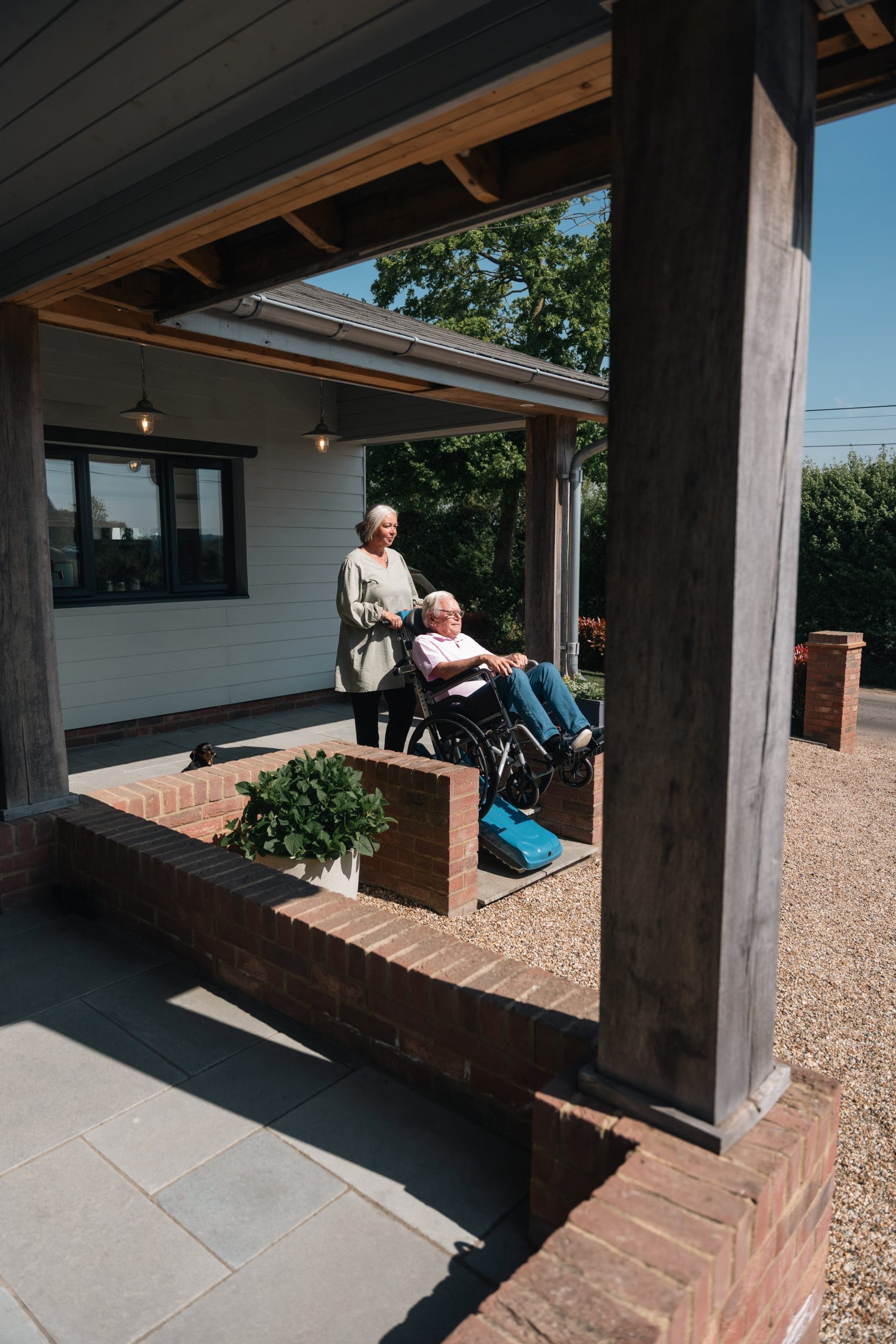
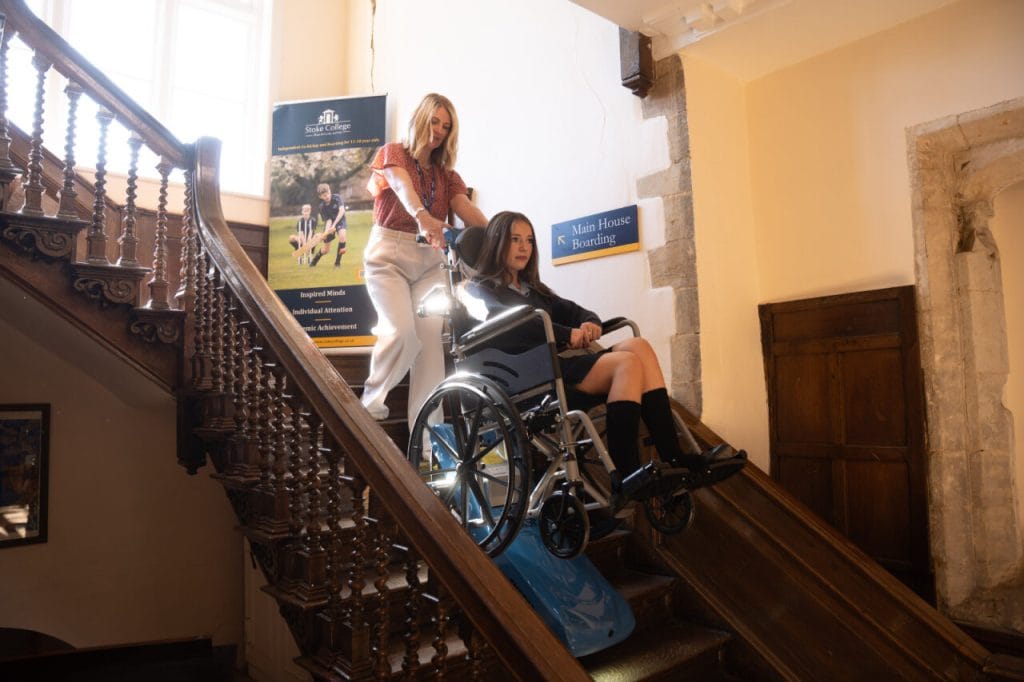
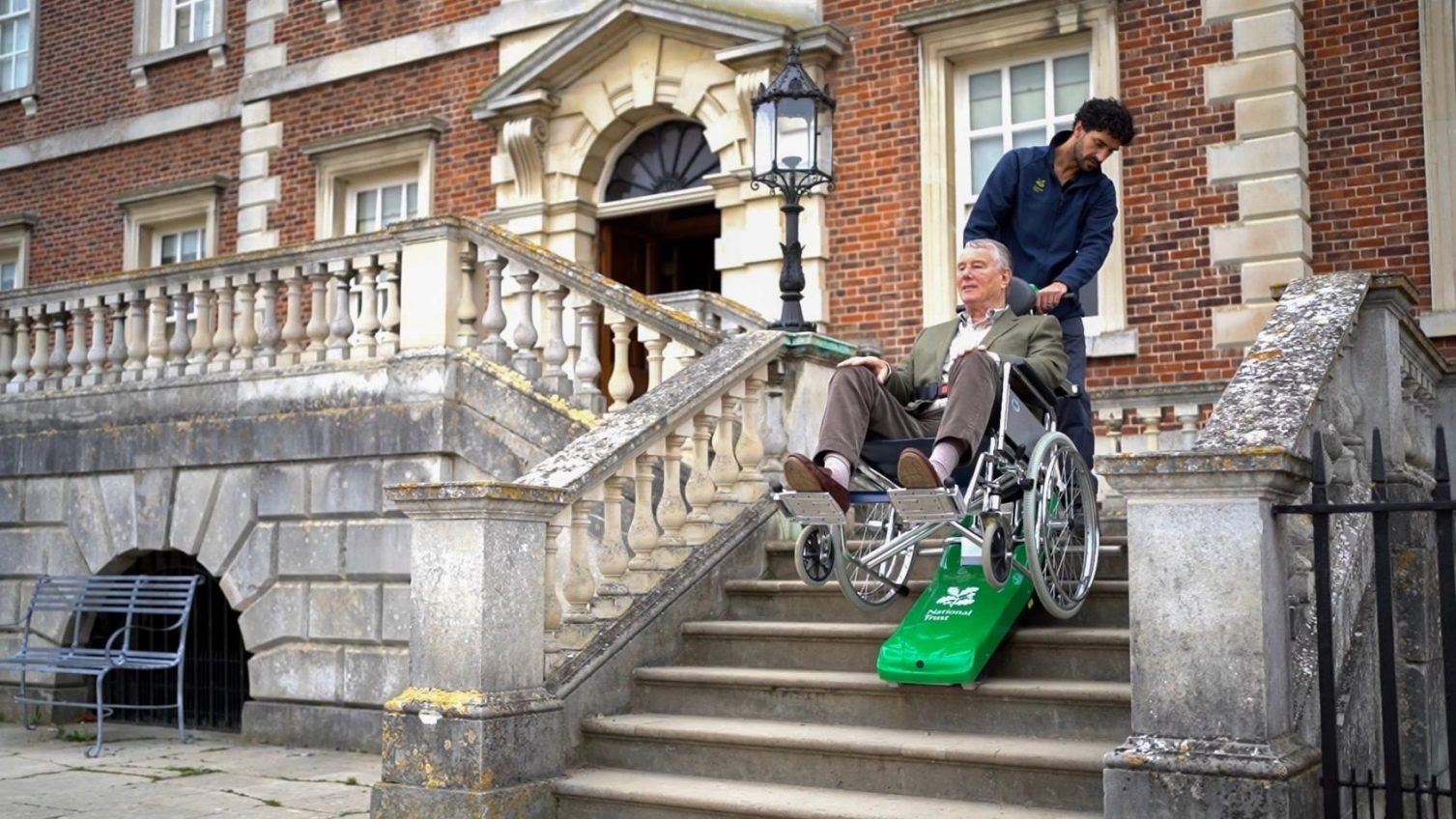
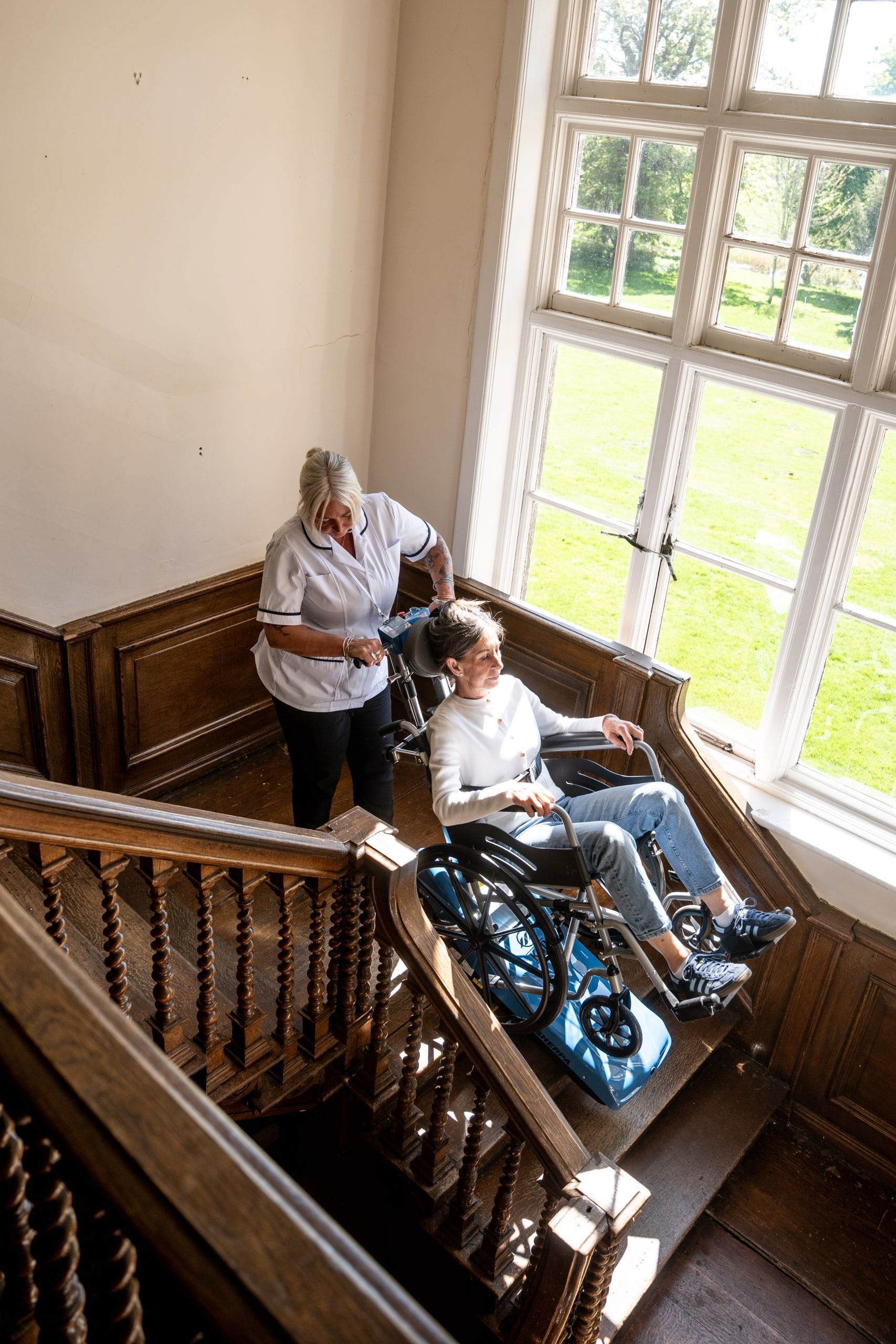
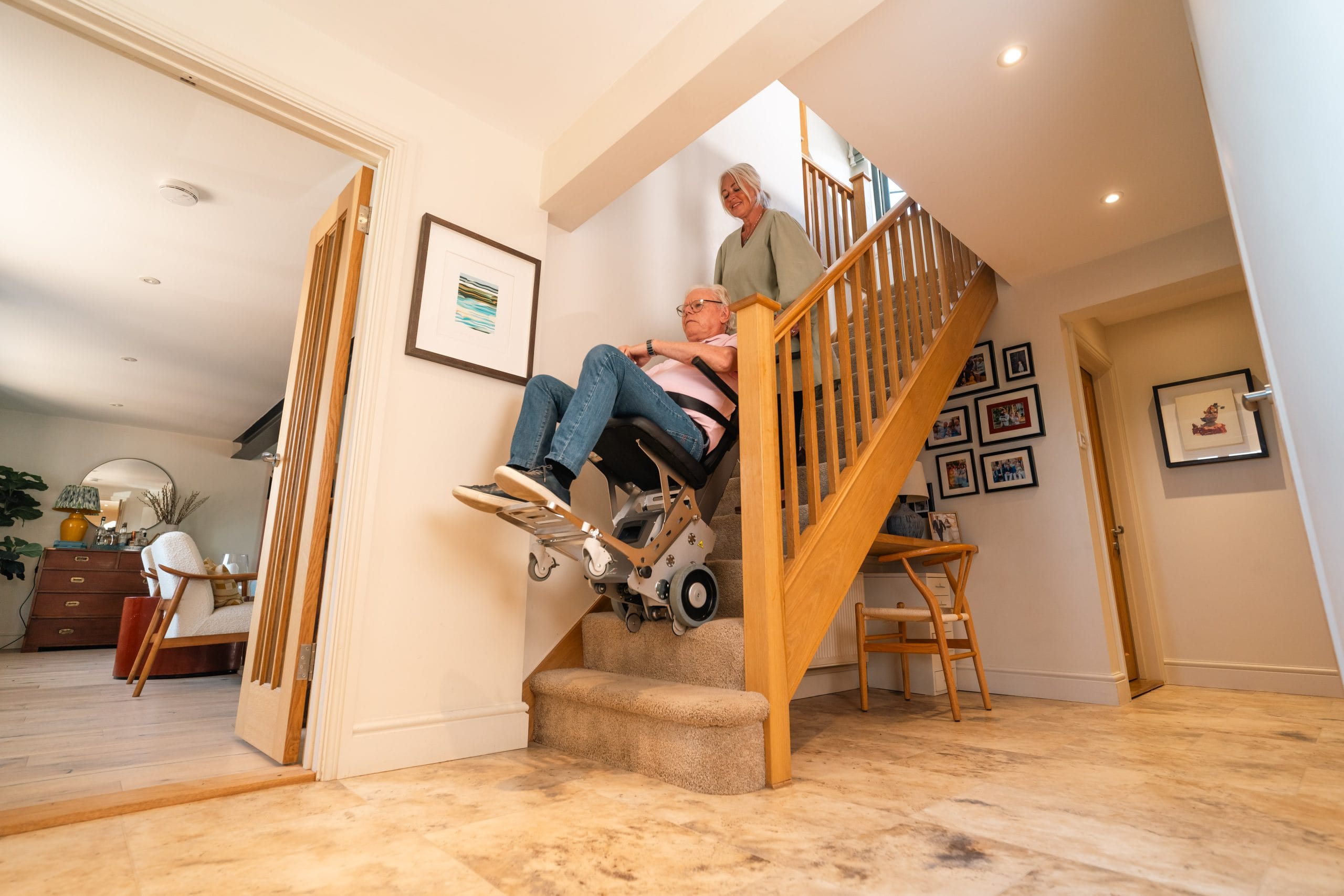
A powered stairclimber is a motorised device that helps move a person on stairs. Some models attach to a compatible manual wheelchair, allowing the user to remain in their chair. Others have an integrated seat and require the person to transfer.
Tracked stairclimbers travel over stair treads using powered tracks. Other machines use wheels or a stepping action. In each case, motorised assistance helps the trained operator control movement and can reduce the physical effort involved.
This does not mean the machine can be used on any staircase. Each model has limits involving user weight, wheelchair compatibility, stair width, gradient, tread dimensions, nosings and landing space. Curves, winders and tight turns can rule out equipment that works well on a straight flight.
The university must also consider the user’s posture, comfort and medical needs. A technically compatible chair and machine may still be unsuitable for a particular individual.
A powered stairclimber can be particularly useful where a defined route has no permanent step-free option and structural alterations are not currently feasible. Examples might include an occasional seminar in a listed building, a short internal flight in a split-level department or access to a specialist room that cannot easily be relocated.
The equipment may also provide a temporary contingency during a planned lift refurbishment or an unexpected outage. This requires advance planning. Ordering a machine after the lift has failed is unlikely to create an immediate safe solution because site assessment, compatibility checks and operator training are still needed.
One device may serve several assessed staircases, but moving it takes time. A timetable that depends on transporting a machine across campus in ten minutes is unlikely to be robust.
Powered assistance can also help reduce manual handling risk for staff. HSE guidance requires employers to avoid hazardous manual handling where reasonably practicable, assess unavoidable operations and reduce risk. A stairclimber may support that approach, but it does not replace suitable staffing, task-specific assessment or training.
Most importantly, a planned powered solution can be safer and more dignified than improvised carrying. Students should never be expected to accept unsafe assistance simply to reach their teaching.
Universities have duties under the Equality Act 2010 in relation to disabled students, applicants and others who use their services. Equality and Human Rights Commission guidance explains the duty to make reasonable adjustments in further and higher education and discusses physical features, auxiliary aids and reasonable ways of avoiding a disadvantage.
The duty is anticipatory in important respects. Universities should consider barriers experienced by disabled people generally rather than waiting until a student arrives at the bottom of an inaccessible staircase.
Estate information should allow admissions teams, disability services, timetablers and students to understand what a room actually offers. A building with a lift may still contain a stepped teaching area or inaccessible toilet.
The Office for Students says supporting disabled students requires an effective, collaborative response across the higher education sector. A stairclimber can be part of that response, but it should not become a reason to defer every permanent improvement or place the burden of arranging access on the individual student.
Where a powered stairclimber is proposed as a reasonable adjustment, the student should be involved in the decision. Their preferred approach, wheelchair, timetable, transfer needs and experience of the equipment all matter.
The most reliable process begins with the required journey. Where does it start? Which entrance will be used? Are doors, slopes, surfaces and thresholds manageable? Is there sufficient space at both ends of the stair? Can the student enter the destination room and use its facilities?
A professional assessment should record the narrowest point, pitch, tread dimensions, turns, landings, headroom and stair condition. It must also cover doorways, wheelchair compatibility, the student’s support needs, storage, charging and operator availability.
Measurements alone are not enough. An on-site demonstration can show whether the machine approaches the staircase correctly, clears the landings and remains controlled throughout the route. It also gives the student an opportunity to experience the proposed solution and provide informed feedback.
Some powered stairclimbers attach directly to compatible manual wheelchairs. This can avoid a transfer and allow the student to continue using the seating and support configured for them.
Not every manual wheelchair has suitable attachment points. Wheelchair width, frame design, anti-tip devices, removable components and total weight can all affect compatibility. Powered wheelchairs are often heavier and may not be suitable for a particular stairclimber.
An integrated-seat model may be more compact, but it requires a safe transfer. For some students, transferring introduces discomfort, loss of postural support or additional risk. Staff also need the right moving-and-handling assessment, equipment and competence.
Compatibility should be confirmed for the actual wheelchair and user, not inferred from a similar chair. If a student changes wheelchair, the arrangement must be reviewed before use continues.
Universities control room allocation, and that can sometimes remove a barrier more effectively than equipment. Moving a weekly seminar to an accessible room may provide greater independence and reliability than deploying a stairclimber every Tuesday.
Relocation may be difficult where a laboratory contains fixed equipment or a specialist collection is available in only one place. A powered stairclimber may then provide access that room changes cannot.
The decision should be based on educational participation rather than convenience alone. A student should not routinely receive a remote or inferior version of teaching because the preferred room is inaccessible.
Where equipment is used, time must be built into the schedule. It should be ready, charged and staffed without repeatedly making the student arrive early or wait behind.
A powered stairclimber used for routine access is not automatically an evacuation device. Normal access is planned and controlled. A fire or other emergency may involve alarm noise, congestion, smoke, restricted routes and significant time pressure.
Government fire-safety guidance for educational premises supports a suitable fire risk assessment, while the supplementary guidance on means of escape addresses disabled people. The building’s responsible person must plan for everyone likely to be present. An evacuation arrangement should not depend on the Fire and Rescue Service arriving to make it work.
A Personal Emergency Evacuation Plan, or PEEP, may be required for a student or employee who regularly uses the building. Visitors, conference delegates and prospective students also need workable arrangements, even when their individual needs are not known in advance.
If a powered stairclimber is considered for evacuation, it must be assessed for that purpose and integrated into the fire strategy. Questions include whether the escape route is suitable, whether the machine can move in the required direction, who will operate it, how stairs will be shared with others and what happens if the equipment is unavailable.
Regular drills should test the procedure under realistic but safe conditions. A written plan that has never been practised may fail when it is needed most.
Powered stairclimbers are operator-controlled equipment. Safe use depends on people who understand the machine, the route and the student’s needs.
Training should take place on the actual staircase wherever possible. Operators need supervised practice in attaching the wheelchair, positioning the user, approaching the stairs, managing landings and responding to a stop or unexpected problem.
One trained staff member is rarely a resilient campus solution. The university needs enough competent operators to cover teaching hours, evenings where relevant, sickness, annual leave and staff turnover. Responsibilities must be clear between estates, security, portering, disability services and departmental teams.
Refresher training is particularly important when the machine is used infrequently. Records should show who is authorised and when competence was reviewed.
The equipment must also be stored securely, kept accessible and maintained in line with the manufacturer’s instructions. Pre-use checks should cover battery charge, controls, restraints, tracks or wheels, attachments and visible damage. A clear reporting process is needed if a fault is found.
Begin by auditing barriers and identifying where permanent step-free access is planned, possible or already available nearby. Prioritise changes that offer independence and benefit many campus users.
For remaining barriers, involve the student, disability service, estates team, safety staff, timetabler and supplier. Compare relocation, alterations, lifts, ramps and stairclimbers on effectiveness, dignity and reliability.
If a stairclimber appears appropriate, arrange a site assessment and demonstration using the relevant route and wheelchair. Document compatibility, residual risks, staffing, storage, charging, maintenance and contingency measures.
Then train enough operators and test the day-to-day process before it becomes essential. Review the arrangement at agreed intervals and whenever the user, wheelchair, timetable, route or building changes.
Powered stairclimbers will not solve every access problem in higher education. They cannot replace thoughtful campus design, accurate accessibility information or investment in permanent step-free routes.
They can, however, provide a valuable solution to a clearly defined barrier. Motorised assistance may reduce operator effort, improve control and help a wheelchair user reach a part of the university that would otherwise remain inaccessible.
The Stair Climbing Company works with universities to assess real routes, wheelchairs and operating requirements. Our team can demonstrate suitable powered stairclimbers on site, explain their limitations and provide the training needed for safe, confident use.
If your university is reviewing campus access, planning for a lift outage or trying to make a specialist teaching space more inclusive, contact The Stair Climbing Company to arrange an assessment. The right solution should work for the student, the staircase and the people responsible for delivering access every day.
No. Suitability depends on the staircase, landings, route, wheelchair, user and operating arrangements. An on-site assessment is essential.
Some stairclimbers work with compatible manual wheelchairs. Compatibility must be confirmed for the specific chair and user. Other models require a transfer to an integrated seat.
Potentially, but transport time, storage, battery charging and operator availability must make the arrangement reliable. Separate assessments are needed for every route.
A stairclimber can form part of a pre-assessed lift-outage plan. It is not an instant substitute. The route, equipment, user and operators must already have been assessed and prepared.
Only if it has been specifically assessed for emergency use and included in the building’s fire risk assessment, evacuation strategy and relevant PEEP. Routine access does not establish evacuation suitability.
University should be a place where students can learn, participate and build their future. Yet for wheelchair users and people …
A Complete Guide to Powered Stairclimbers Creating accessible places is not always as simple as installing a ramp, passenger lift …

Alternatives to Stairlifts and Platform Lifts for London Universities An accessible university campus is more than an accessible main entrance. …
Alternatives to Stairlifts and Platform Lifts in London Buildings London buildings rarely present a simple access problem. A Georgian townhouse …
Alternatives to Stairlifts and Platform Lifts at Home: A Practical Guide for Community OTs When a person can no longer …