A Complete Guide to Safe and Flexible Stair Access
Creating accessible places is not always as simple as installing a ramp, passenger lift or traditional stair lift. Buildings can have narrow staircases, limited landing space, planning restrictions or architectural features that make permanent alterations difficult or unaffordable.
A powered stairclimber can provide a practical solution.
Powered stairclimbers are designed to transport people with reduced mobility safely up and down stairs. Depending on the model selected, the person may travel in an integrated seat or remain in their own wheelchair throughout the journey.
This flexibility makes a powered stair climber suitable for homes, schools, universities, hotels, heritage properties, workplaces, public buildings and temporary events. It can provide access without requiring major structural work, making it an increasingly important alternative to fixed access equipment.
At The Stair Climbing Company, we specialise in powered stairclimber solutions throughout England. We provide professional assessments, demonstrations, training, hire, purchase and ongoing support. Our approach is based on finding a solution that works for the individual, the operator and the building.
What is a powered stairclimber?
A powered stairclimber is a battery-operated mobility device designed to transport a person up or down a staircase with the assistance of a trained operator.
The electric motor controls the movement on the stairs, reducing the physical effort required from the operator. The person is supported in either an integrated seat or their existing wheelchair, depending on the type of stairclimber being used.
This is very different from manually carrying someone or attempting to move a wheelchair on stairs. A suitable electric stairclimber creates a controlled system in which the equipment manages much of the movement while the trained operator guides and monitors the journey.
Powered stairclimbers are portable and do not normally need to be permanently attached to the building. This means one unit may be used on different staircases or transported between suitable locations.
How does a powered stair climber work?
Powered stair climbers generally use one of two climbing systems.
A tracked stairclimber uses powered caterpillar-style tracks that maintain contact with the staircase. The tracks allow the machine to travel steadily along a suitable straight flight of stairs. These models are frequently used with wheelchairs and can be particularly effective on wider staircases with adequate landing space.
A stepping or wheeled stairclimber moves from one step to the next through an electronically controlled climbing mechanism. These machines can be highly manoeuvrable and may be more suitable for buildings with smaller landings, tighter turns or more complicated staircase layouts.
The correct technology depends on the person, their wheelchair, the staircase and the way the equipment will be used. Neither system is automatically better in every situation. This is why an on-site assessment is an essential part of choosing a powered stairclimber.
Why are powered stairclimbers becoming more important?
Expectations around accessibility have changed. Disabled people, wheelchair users and people with reduced mobility should be able to participate in education, employment, tourism, family life and public events with dignity.
However, a large proportion of the UK’s buildings were designed before modern accessibility standards were introduced. Many older properties have entrance steps, changes in floor level and staircases that cannot easily accommodate a conventional lift.
Even modern buildings can experience access problems. A passenger lift may be temporarily unavailable, a temporary structure may not have step-free access, or an individual may need to reach an area that was not included in the original access design.
A powered stair climber can help bridge this gap. It offers a flexible way to overcome stairs without automatically requiring permanent construction work.
Building work in England is supported by the accessibility guidance contained within Approved Document M. Service providers and employers may also need to consider reasonable adjustments under the Equality Act 2010.
A stairclimber does not replace an organisation’s wider responsibilities. However, where it is appropriate for the user and building, it can form an important part of a reasonable, practical access strategy.
A portable stair lift without permanent installation
The term portable stair lift is often used by people searching for a solution that does not need to be fixed to a staircase.
A powered stairclimber can perform a similar practical function by transporting a person between different levels. However, it works differently from a conventional stair lift.
A fixed stair lift normally runs along a rail attached to the staircase. It is permanently located on one flight of stairs and usually requires the passenger to transfer onto its seat. Installation can also reduce the usable width of the staircase.
A powered stairclimber is a mobile device operated by a trained person. It can be stored when it is not required and moved between compatible staircases. Some models allow wheelchair users to remain in their own chair, avoiding an unnecessary transfer.
This makes a powered stair climber an effective portable stair lift alternative in circumstances where fixed installation is impractical. It may be particularly useful in rented premises, listed buildings, temporary venues, schools, shared residential buildings and properties where access is only required periodically.
It is important to understand that a stairclimber is assisted equipment. Unlike most fixed stair lifts, it requires a trained operator. The user, operator, staircase and equipment must all be assessed before the solution is put into service.
Remaining in your own wheelchair
Transferring between a wheelchair and another seat can be difficult, uncomfortable or undignified. Some people require specialist support, a hoist or assistance from several carers to transfer safely. Others use a carefully prescribed wheelchair that supports their posture and medical needs.
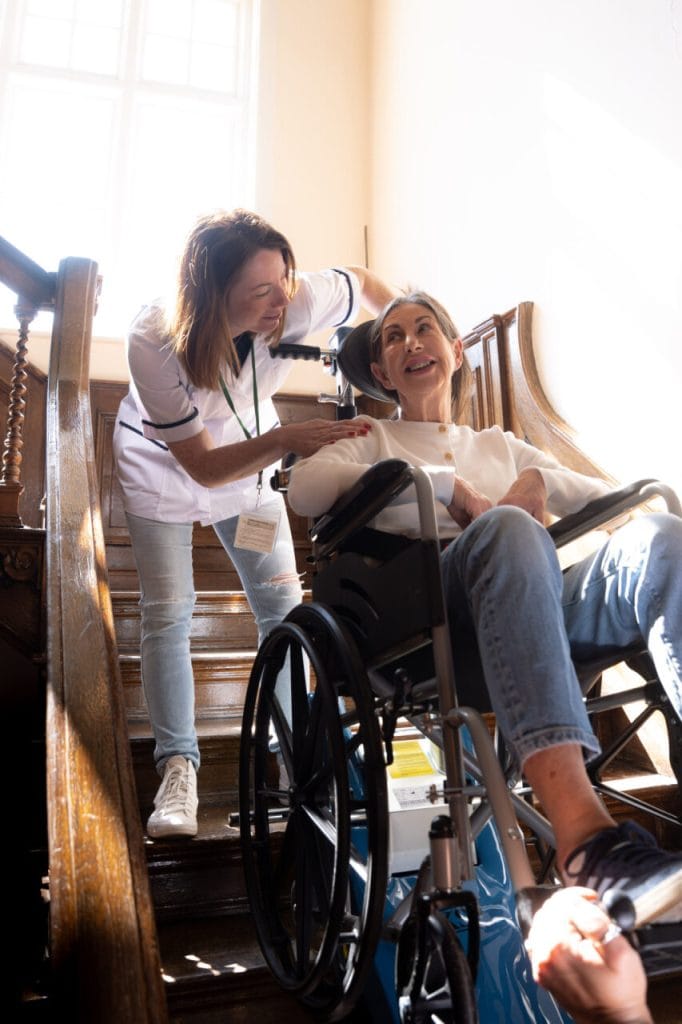
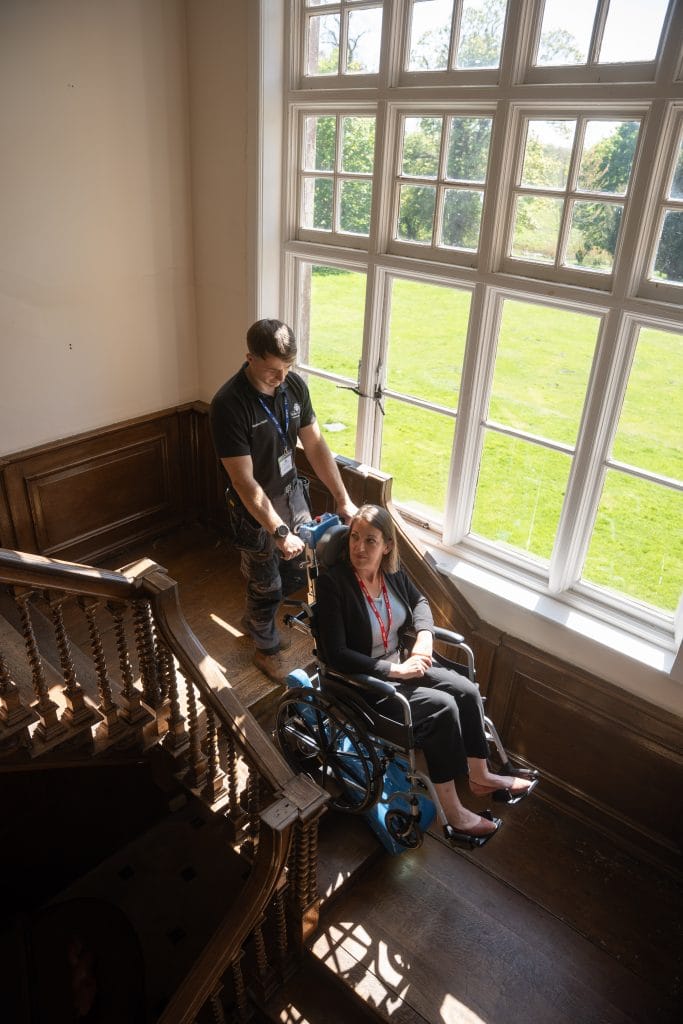
A non-transfer powered stairclimber can attach to a compatible wheelchair, allowing the individual to remain in their own chair while travelling on the stairs.
This can be particularly beneficial for people using tilt-in-space wheelchairs, supportive paediatric seating or other specialist chairs. It may reduce the number of transfers required and enable the person to retain their familiar seating and postural support.
Wheelchair compatibility must always be confirmed during an assessment. Wheelchair dimensions, total weight, attachment points, seating position and the user’s individual requirements all need to be considered.
The Skyline powered stairclimber range provides tracked, non-transfer solutions for a variety of manual and specialist wheelchairs. The range also includes options designed for certain powered wheelchairs.
Seated powered stairclimbers
A powered stairclimber with an integrated seat can be suitable for someone who does not use a wheelchair or who can transfer safely with appropriate support.
Seated models are often compact and manoeuvrable. This can make them suitable for domestic staircases, tight landings and environments where a larger tracked stair climber would not have enough room to turn.
The person must be assessed for their ability to transfer, sit safely and maintain a suitable position during use. Where additional postural support is necessary, the equipment and its accessories should be selected around those requirements.
A seated model should not be chosen simply because it is smaller. The individual’s mobility, balance, comfort, medical circumstances and transfer requirements remain central to the assessment.
Tracked powered stairclimbers
Tracked stairclimbers are often selected for straight staircases with sufficient landing space. Their powered tracks spread contact across several steps and create a smooth, controlled movement along the staircase.
These models can be particularly valuable where the passenger needs to remain in their own wheelchair. They are used in homes, schools, historic properties, hotels, event venues and public buildings.
Tracked machines require enough space to approach the staircase, establish the correct operating position and manoeuvre safely at the top and bottom. Stair angle, step dimensions, surface condition and landing measurements must therefore be checked.
The fact that a staircase appears straight does not automatically mean it is suitable. Radiators, handrails, doorways, low ceilings and changes in floor level can all affect operation.
A powered stairclimber for the home
A staircase can become a major barrier when a person develops a disability, experiences an injury or begins using a wheelchair. In some situations, installing a through-floor lift or fixed stair lift may be difficult because of cost, structural limitations or the person’s transfer needs.
A powered stair climber may offer another option.
It can be used to overcome internal stairs, external entrance steps or changes in level around the property. Because the equipment is portable, it may also be stored away when it is not required.
Occupational therapists regularly contribute to these decisions. They consider the individual’s physical needs, home environment, care arrangements and longer-term objectives. The Stair Climbing Company works closely with occupational therapists, families, case managers and local authorities to identify suitable solutions.
The assessment must consider more than the staircase. There needs to be a safe plan for reaching the equipment, attaching or transferring the person, operating the machine and completing the journey at the destination.
Powered stairclimbers for schools and universities
Education buildings frequently combine modern facilities with older, less accessible areas. A school may have entrance steps, raised stages, split-level classrooms or temporary teaching spaces. Universities can include listed buildings, historic lecture halls and accommodation that cannot easily be altered.
A powered stairclimber can help educational establishments improve access without waiting for a large construction project.
For a pupil or student using a wheelchair, remaining in their own chair can provide greater comfort and continuity. This can be especially important when the wheelchair incorporates specialist seating prescribed around the individual’s posture.
A solution should be planned collaboratively with the student, family, occupational therapist, education provider and any relevant support team. Staff who will operate the stairclimber need practical training and sufficient confidence to use it correctly.
It is also important to distinguish everyday access from emergency evacuation. A standard access stairclimber should not automatically be treated as an evacuation solution. Emergency arrangements require their own risk assessment, suitable equipment and documented procedures.
Heritage buildings and listed properties
Historic buildings present some of the most difficult accessibility challenges. Their steps and staircases are part of the character of the property, while planning or conservation requirements may limit permanent alterations.
A fixed platform lift may affect important architectural details. A permanent ramp may require considerable space or change the appearance of an entrance. In some settings, neither option is technically possible.
A portable powered stairclimber can offer access while requiring little or no alteration to the building fabric. The equipment can be brought into position when needed and stored discreetly at other times.
This approach has applications in museums, stately homes, historic hotels, churches, visitor attractions and listed public buildings. Each site still needs to be assessed carefully, particularly where stair surfaces are uneven, worn or delicate.
The solution must protect the passenger, operator and property. A practical trial is the best way to establish whether the proposed stairclimber is suitable.
Hotels, workplaces and public venues
Accessibility affects customer experience as well as legal responsibility. A guest who cannot enter a restaurant, reach a meeting room or access part of a hotel may feel that the building was not designed to welcome them.
Powered stairclimbers can support access in hotels, offices, theatres, sporting venues and temporary event structures. They may also offer a contingency option where a passenger lift is unavailable.
Having equipment on site is only part of the solution. Organisations need trained operators, a clear method for requesting assistance and a reliable system for checking that the stairclimber is charged and ready.
The process should be respectful and discreet. Disabled visitors should receive clear information about the available access arrangements before they arrive wherever possible.
Powered stairclimber hire
Purchasing equipment is not always necessary. Powered stairclimber hire can be suitable for temporary access requirements, events, short-term injuries, building work or a period of lift failure.
Hire can also give an organisation an opportunity to evaluate how a particular solution performs before considering a longer-term purchase.
The stairclimber hire service from The Stair Climbing Company includes guidance on selecting appropriate equipment. The site and intended use must be reviewed before a machine is supplied.
A request for urgent access should not lead to the assessment process being overlooked. Supplying the wrong equipment can create additional risk and may leave the original access problem unresolved.
Why an assessment is essential
A powered stairclimber is not a product that should be selected from photographs or measurements alone. Two staircases with similar dimensions can behave very differently in practice.
A professional assessment should consider the stair angle, step depth, step height, staircase width, surface material, handrails, turns, landings, door positions and available manoeuvring space.
The assessment should also consider the passenger’s weight, posture, mobility, ability to transfer, wheelchair configuration and personal preferences. Where a wheelchair is attached to the stairclimber, its dimensions and compatibility are critical.
Operator requirements matter too. The person using the equipment needs to be capable, trained and confident. The goal is to identify a complete working solution rather than simply finding a machine that fits on the stairs.
The Stair Climbing Company provides professional site assessments so the equipment can be demonstrated and tested in the environment where it will actually be used.
The importance of training
Powered operation reduces physical effort, but it does not remove the need for operator skill.
Training should cover equipment checks, correct positioning, passenger communication, wheelchair attachment where applicable, controlled operation and safe procedures at the top and bottom of the staircase.
Operators should have an opportunity to practise without a passenger before progressing to supervised use. They should also understand the machine’s limitations and know when not to use it.
In workplaces, powered stairclimbers are work equipment and should be managed accordingly. The Health and Safety Executive explains that equipment provided for work must be suitable, properly maintained and used by people who have received adequate information and training. Further guidance is available through the HSE information on work equipment and safe lifting.
Training should be refreshed when operators change, equipment is replaced or the access arrangements are updated.
Servicing and ongoing support
An electric stairclimber needs regular care if it is to remain safe and dependable.
Batteries should be charged in accordance with the manufacturer’s instructions. Tracks, wheels, attachments, controls, safety features and moving components should be checked at suitable intervals.
Equipment used in a workplace may also require inspection under the Provision and Use of Work Equipment Regulations. The precise requirements depend on how the equipment is classified and used, so organisations should take competent advice.
Records of training, servicing, checks and reported defects should be retained. Equipment should be removed from use if there is any concern about its condition or performance.
A good supplier relationship therefore continues beyond the original sale. Aftercare, refresher training, servicing and technical advice all contribute to the long-term success of the solution.
Choosing the right electric stairclimber
The best powered stairclimber is the one that works safely for the specific person, wheelchair, operator and environment.
A compact seated stair climber may suit a person who can transfer and has a narrow domestic staircase. A tracked wheelchair stairclimber may be better when the person needs to remain in their own wheelchair and the staircase has adequate landing space.
Some users require specialist seating or attachments. Others need a model capable of accommodating a compatible powered wheelchair. A school may prioritise ease of storage and multiple trained operators, while a heritage venue may need a solution that protects delicate surfaces and avoids permanent alterations.
Price is naturally part of the decision, but it should not be the first or only consideration. An unsuitable low-cost device provides poor value if it cannot be used confidently in the intended environment.
Assessment, demonstration and training are what turn an electric stairclimber from a piece of equipment into an effective access solution.
Powered stairclimber compared with a fixed stair lift
A fixed stair lift can be an effective option where one person regularly uses the same staircase and can transfer safely onto the lift. It provides a permanently available solution but usually serves only the staircase on which it is installed.
A powered stairclimber offers greater mobility and flexibility. It can potentially be used on more than one suitable staircase and stored away when not required. Non-transfer models can also allow people to remain in compatible wheelchairs.
However, the stairclimber requires a trained operator, whereas a fixed stair lift may be operated independently by some users. The correct choice depends on the individual’s needs and the building.
The question should not simply be whether a powered stair climber is better than a stair lift. The more useful question is which solution provides safe, dignified and sustainable access in that particular situation.
Powered stairclimber compared with a platform lift
A platform lift can provide independent wheelchair access where the building has sufficient space and the necessary installation is feasible. It may be the preferred long-term solution in a frequently used public environment.
However, platform lifts require building work, maintenance and a permanent location. Planning, listed-building restrictions and structural limitations can make installation difficult.
A powered stairclimber is portable and generally requires far less alteration. It may be valuable where access is required occasionally, a permanent lift is not currently possible or a temporary solution is needed.
In some buildings, a stairclimber may complement rather than replace a lift. It can provide access to an additional area or offer an alternative arrangement during planned maintenance.
Creating accessible places with The Stair Climbing Company
The Stair Climbing Company provides more than powered stairclimber equipment. We help clients understand the access barrier, evaluate the environment and select a practical solution.
Our range includes compact seated stair climbers and non-transfer wheelchair stairclimbers for different types of stairs and mobility requirements. We support private families, occupational therapists, schools, universities, local authorities, businesses, hotels, heritage organisations and event providers throughout England.
Every successful solution begins with listening. We consider how the person wants to access the building, what support they need and how the equipment will be managed in everyday use.
From the initial assessment and demonstration through to training, servicing and aftercare, our objective is to create access that works in the real world.
Frequently asked questions about powered stairclimbers
Can a powered stairclimber go up and down stairs?
Yes. A suitable powered stairclimber is designed to transport a person both upstairs and downstairs. Compatibility with the particular staircase must be confirmed through an assessment.
Is a powered stair climber the same as a stair lift?
No. A stair lift is normally fixed to a rail installed on one staircase. A powered stair climber is mobile equipment guided by a trained operator.
Can a stairclimber carry someone in their own wheelchair?
Certain non-transfer stairclimbers can attach to compatible manual, specialist or powered wheelchairs. Compatibility depends on the model, wheelchair and combined weight.
Is a powered stairclimber a portable stair lift?
A powered stairclimber is often described as a portable stair lift because it provides assisted access without permanent installation. Technically, the two products work differently, and a stairclimber requires a trained operator.
Can a powered stairclimber be used on curved stairs?
Some stepping stairclimbers can be used on certain curved or turning staircases. Tracked models are generally best suited to straight flights. An on-site assessment is required.
Can stairclimbers be used outside?
Some models can be used on suitable external steps. The condition, dimensions, gradient and surface of the steps must be checked, and the equipment must be used according to the manufacturer’s instructions.
Do operators need training?
Yes. Anyone responsible for operating a powered stairclimber should receive practical training on the specific model and environment.
Can I hire a powered stairclimber?
Yes. Hire may be available for temporary access, events, lift failures or short-term mobility needs. The site and user requirements still need to be assessed.
How much does a powered stairclimber cost?
The cost depends on the model, seating or wheelchair attachments, weight capacity and level of support required. An assessment allows an accurate recommendation and quotation to be prepared.
How do I arrange an assessment?
Contact The Stair Climbing Company to discuss the user, wheelchair, staircase and intended application. The team can then arrange an appropriate assessment and demonstration.
Take the next step towards better access
A powered stairclimber can transform a staircase from an everyday barrier into a manageable route. It can help a wheelchair user remain in their own chair, provide a portable alternative to fixed installation and create access in buildings where traditional solutions are difficult.
The key is choosing the right equipment and supporting it with professional assessment, effective training and dependable aftercare.
If you are considering a powered stair climber, portable stair lift alternative or electric stairclimber, contact The Stair Climbing Company. We can assess the environment, demonstrate suitable equipment and help you create a safe, dignified and practical access solution.