Powered Stairclimbers in UK Universities: Creating More Accessible Campuses
University should be a place where students can learn, participate and build their future. Yet for wheelchair users and people …

ACCESSIBILITY & MOBILITY
Stair Climbers for Wheelchair Users: A Complete Guide
An educational guide to choosing, assessing and using wheelchair stair-climbing equipment
What is a stair climber for a wheelchair?
A stair climber for a wheelchair is a powered mobility device designed to help a wheelchair user travel up or down stairs with the support of a trained operator. Depending on the model, the user may remain in their own wheelchair or transfer to an integrated seat. The machine supplies controlled climbing power, reducing the physical effort that would otherwise be required to move a person on a staircase.
Wheelchair stair climbers are often considered when a passenger lift, platform lift or permanent stairlift is unavailable, impractical or unsuitable. They can support access in homes, workplaces, schools, healthcare settings, heritage properties, visitor attractions and public buildings. Portable models may also serve more than one staircase or location, which can make them useful where permanent alterations are restricted.
The important point is that a stair climber is not simply a chair with wheels. It is specialist access equipment. Safe use depends on selecting a suitable model, checking the staircase and wheelchair, assessing the user, training operators and maintaining the equipment correctly. A successful solution brings all of these elements together.
How does a wheelchair stair climber work?
Most powered stair climbers use either tracks or powered climbing wheels. The operator positions the unit at the staircase, secures the wheelchair or user, and follows the manufacturer’s operating procedure. The motor then controls movement from one step to the next while the operator guides, balances or steers the equipment as required by the design.
Tracked stair climbers use continuous rubber tracks that make contact with several stair nosings. This spreads the load and provides a stable climbing action on suitable straight staircases. Wheeled stair climbers use a rotating wheel or climbing mechanism that steps from tread to tread. Some models can negotiate certain landings or changes in direction more easily than tracked equipment, although suitability varies considerably.
The main types of stair climber for wheelchair users
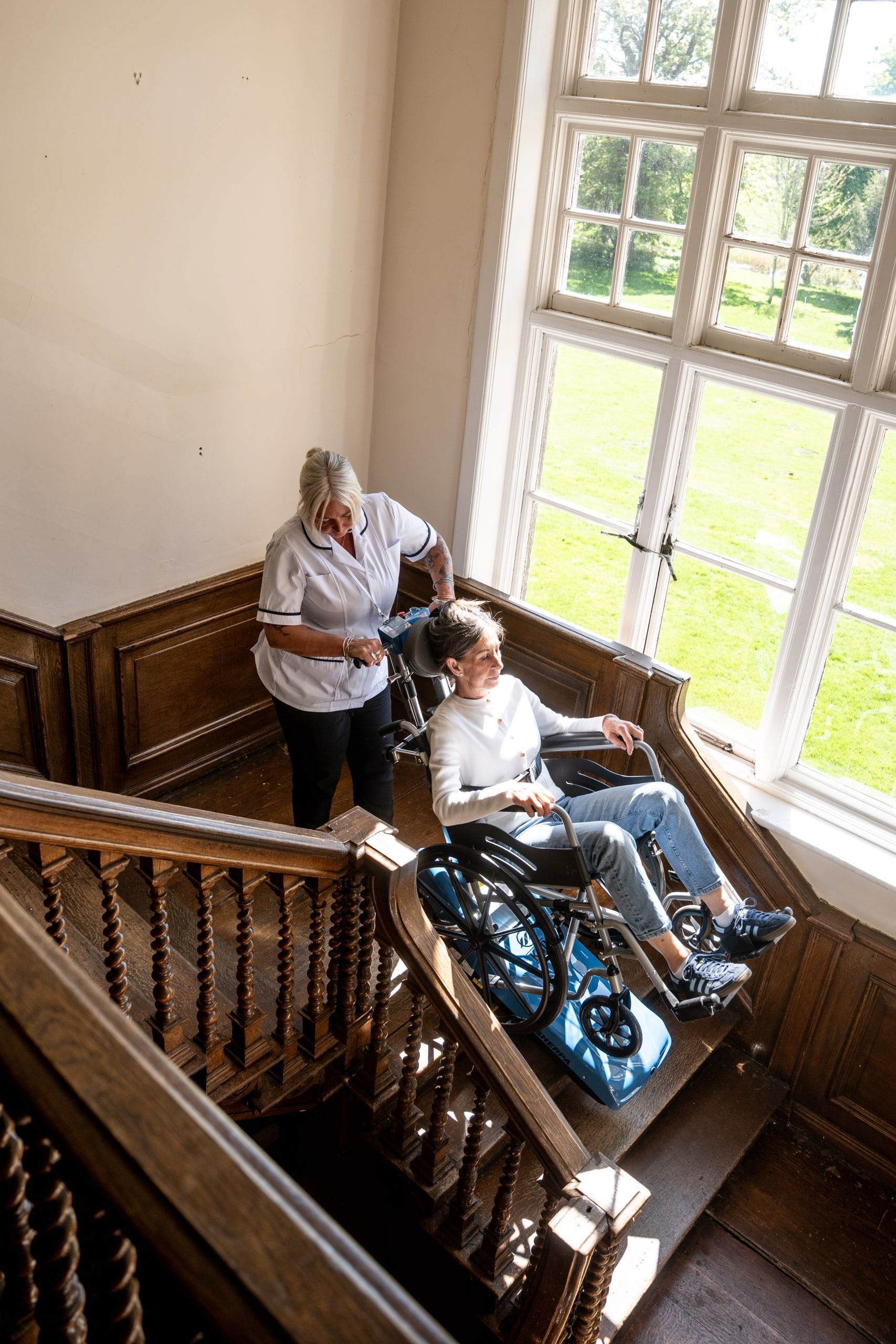
There are two broad approaches. The first allows a person to remain in a compatible manual wheelchair. The stair climber attaches to or supports the wheelchair using a dedicated frame and secure connection points. This can reduce unnecessary transfers and help preserve the user’s comfort, posture and independence. Compatibility must always be confirmed because wheelchairs vary in frame construction, dimensions, attachments and strength.
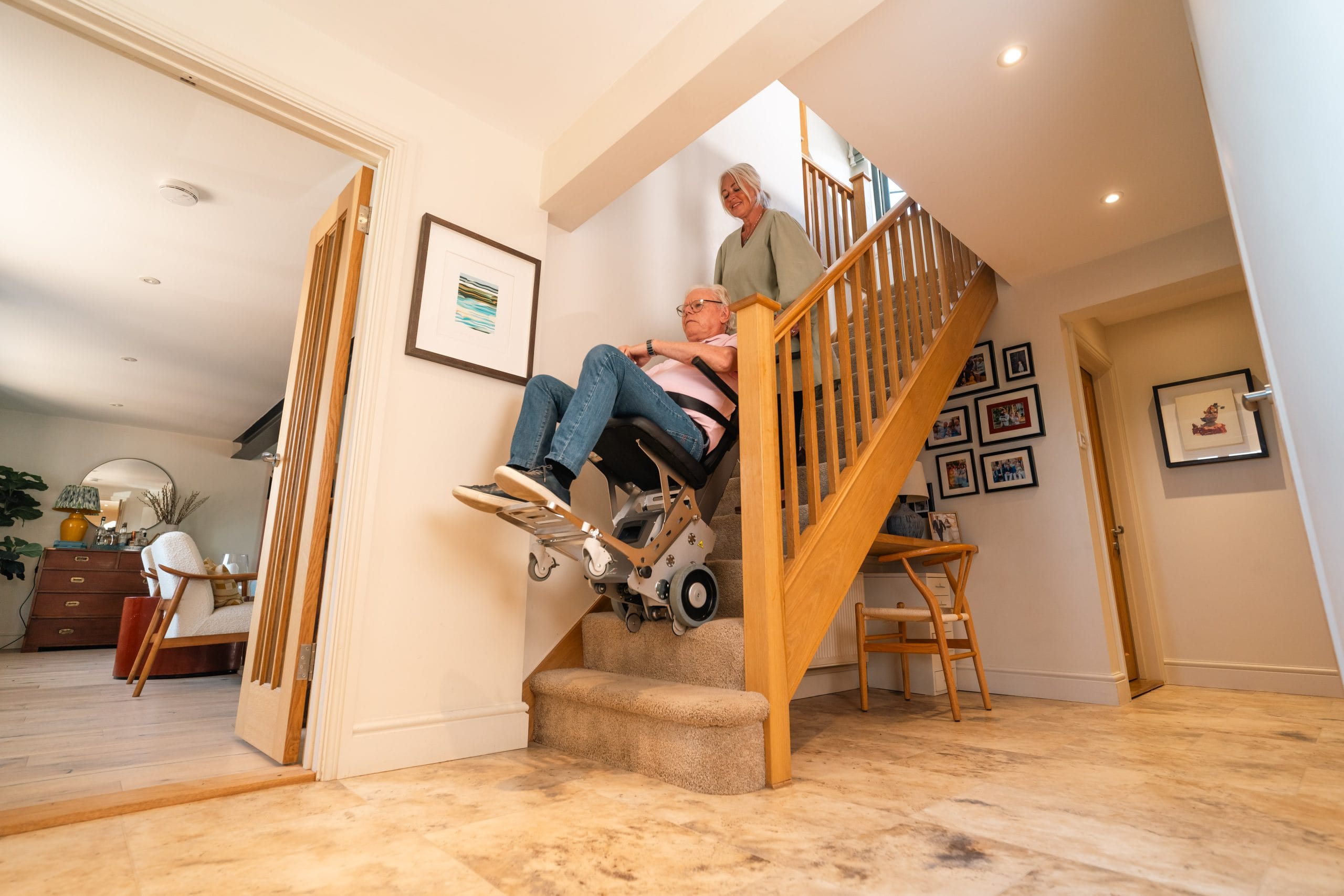
The second approach uses an integrated seat. The user transfers from their wheelchair to the stair climber’s own seat before travelling on the stairs. These models can be compact and versatile, but they require a safe transfer at both ends of the journey. They may not be appropriate for someone who cannot transfer comfortably or whose posture depends on a specialist wheelchair.
Within both categories are tracked and wheeled designs, plus equipment intended mainly for access, evacuation or a combination of uses. No single type is automatically best. The correct choice depends on the individual, the wheelchair, the staircase, the planned frequency of use and the organisation’s ability to train enough operators.
Who can benefit from a powered stair climber?
A powered stair climber may help a wheelchair user who needs occasional or regular access to a building with stairs. It can also support people whose walking ability varies, who can walk only short distances, or for whom climbing stairs creates pain, fatigue or an unacceptable risk of falling.
In a home, the equipment might provide access while longer-term building work is considered, or offer an alternative where a conventional stairlift is unsuitable. In education, it can help a pupil, student or staff member reach teaching spaces that cannot immediately be made step-free. In workplaces and public buildings, portable equipment may form part of a broader reasonable-adjustment and access strategy.
Why assessment comes before product choice
A professional assessment should begin with the person. Relevant factors include body weight, height, posture, movement, ability to transfer, communication preferences and any medical or sensory needs that affect the journey. The user should be involved in decisions and, wherever possible, should experience a demonstration before equipment is selected.
The wheelchair also needs to be checked. A standard manual chair, active-user chair, tilt-in-space chair and powered wheelchair all have different structures and centres of gravity. Accessories such as headrests, trays, cushions, oxygen cylinders and communication devices can change dimensions or weight distribution. A supplier should confirm compatibility rather than relying on appearance or assumption.
Finally, the assessor must examine every intended route. Stair width, tread depth, pitch, nosings, surface condition, handrails, bends, landings, doors and clear space at the top and bottom can all affect operation. The floor must support safe positioning and the route must remain clear. If the equipment will travel between sites, each staircase needs its own check.
Safety, training and operator competence
Powered operation reduces manual effort, but it does not remove the need for competent operators. Training should cover pre-use inspections, securing the wheelchair or occupant, correct positioning, ascent and descent, communication, landing manoeuvres, emergency procedures, battery charging and safe storage. Operators should practise with an unoccupied unit before progressing to supervised use with a passenger.
Training should be specific to the exact model and the actual environment. A short demonstration is not the same as verified competence. Organisations should record who has been trained, provide refreshers at suitable intervals and repeat training when equipment, routes or user needs change. Enough people must be trained to make the plan reliable during holidays, sickness, shift changes or an emergency.
Before each use, the operator should check the equipment and route. Restraints and attachment points must be secure, the battery must have sufficient charge and the staircase must be clear. The operator should explain what will happen and agree how the user prefers to communicate. If any part of the situation falls outside the approved procedure, the journey should pause until competent advice is obtained.
Comfort, dignity and user confidence
Good access is about more than reaching another floor. The experience should protect the person’s comfort, dignity and sense of control. Remaining in a compatible wheelchair can be valuable for someone who uses specialist seating or finds transfers painful, tiring or intrusive. Where a transfer is necessary, it should be planned, consensual and supported with appropriate equipment and assistance.
Privacy matters as well. Access plans should share only the information operators genuinely need. The user should know who has been trained and how to request the equipment. A device that is locked away, uncharged or available only when one particular employee is present does not provide dependable access.
Stair climber, stairlift or passenger lift?
A stair climber is portable or movable and normally needs a trained operator. It may require little or no permanent alteration, making it attractive for temporary access, multiple staircases or protected buildings. However, every journey depends on equipment availability and operator support.
A stairlift is fixed to a staircase and usually carries a person on an integrated seat. It can suit an ambulant user who can transfer safely, but it may not meet the needs of someone who must remain in a wheelchair. A platform lift carries a wheelchair user, while a passenger lift can provide broader independent access between floors. These permanent solutions may offer greater everyday convenience but require space, building work, approvals and ongoing servicing.
The best solution may combine measures. For example, a building might use a permanent lift on the main route and a stair climber for a secondary area where alterations are difficult. Decisions should be based on frequency, independence, user needs, building constraints and the full lifetime cost, rather than purchase price alone.
Using stair climbers in workplaces and public buildings
Organisations should treat a wheelchair stair climber as one part of an access system. The system includes policies, booking arrangements, trained staff, clear routes, maintenance, communication and contingency planning. Responsibility for daily checks, charging and record keeping should be assigned rather than assumed.
Routine access and emergency evacuation are related but different. Equipment intended for everyday movement is not automatically suitable for evacuation, and an evacuation device is not automatically the best everyday access solution. Where a person may need assistance during an emergency, their arrangements should be reflected in an appropriate personal emergency evacuation plan, commonly called a PEEP. The plan should identify the route, equipment, trained assistance and alternatives if the preferred route is unavailable.
Maintenance and day-to-day management
Like any powered mobility product, a stair climber needs inspection and servicing in line with the manufacturer’s instructions. Batteries should be charged using the approved equipment and replaced when their performance declines. Tracks, wheels, restraints, clamps, controls and frames should be checked for damage or wear. Faults should be recorded and the unit removed from use when safety may be affected.
Storage should be secure, dry and close enough to the intended route for timely use. A named person or team should oversee servicing, training and route checks. A simple log of charging, faults and maintenance helps ensure that the device is ready when a wheelchair user needs it.
What does a wheelchair stair climber cost?
Prices vary according to the climbing system, weight capacity, wheelchair compatibility, accessories, training and service package. A meaningful quotation should include more than the machine. Assessment, delivery, operator training, servicing, replacement batteries and any wheelchair adapters all contribute to the lifetime cost.
Compare the cost with the access need and the alternatives. Permanent building work may cost more initially but provide greater independence and capacity. A portable stair climber may be economical where use is occasional or alterations are constrained, but it needs trained staff every time. Hiring can be useful for a short-term need, provided that assessment, compatibility and training are still addressed.
The lowest quotation is not necessarily the lowest-risk or best-value option. Ask what happens if the user changes wheelchair, trained staff leave, the battery fails or the device needs repair. Reliable aftercare and readily available training can be as important as the original specification.
A practical selection checklist
Before choosing a stair climber for a wheelchair, confirm the following:
The user’s needs, comfort, posture and communication preferences have been assessed.
The wheelchair, including accessories, has been confirmed as compatible.
Every intended staircase, landing and doorway has been surveyed.
The chosen model is within its stated weight and dimensional limits.
The user has experienced a demonstration or trial wherever practical.
Enough operators will receive model-specific training and refreshers.
Charging, storage, pre-use checks, servicing and fault reporting have named owners.
Everyday access and emergency evacuation arrangements have been considered separately.
A contingency exists for equipment failure, staff absence or a blocked route.
The total lifetime cost and aftercare package have been compared, not only the purchase price.
Questions to ask a supplier
A reputable supplier should welcome detailed questions and should not recommend equipment without understanding the person and route. Ask whether the proposed model has been physically demonstrated on the intended staircase, how wheelchair compatibility is confirmed, what user weight and dimensional limits apply, and which accessories are required.
Ask what operator training includes, how competence is recorded and whether refresher training is available. Clarify the expected battery performance, charging routine, warranty, servicing schedule, response time for faults and availability of replacement parts. If evacuation is part of the intended use, ask for clear evidence that the product and proposed procedure are suitable for that specific purpose.
Finally, request a trial involving the user wherever practical. A technically compatible product can still feel unsuitable in real use, and the user’s experience should carry significant weight.
Making an informed decision
A stair climber for wheelchair users can provide flexible, practical access where stairs would otherwise create a barrier. Its value is greatest when the equipment is matched carefully to the person, wheelchair and building, and when trained operators, maintenance and clear procedures support every journey.
Begin with an assessment rather than a product. Compare tracked and wheeled models, wheelchair-attached and integrated-seat designs, and portable equipment with permanent alternatives. Consider independence, frequency of use, transfers, route constraints and long-term management. Then involve the user in a demonstration and document the agreed arrangements.
For a broader overview of available equipment and the role stair climbers can play in safer, more accessible living, read the pillar guide, “Stair Climbers: The Complete Guide for Safer, More Accessible Living.”
Internal link recommendation
Link the final paragraph to the Stair Climbing Company pillar page using natural anchor text such as “complete guide to stair climbers”. Add relevant product or assessment links only where they help the reader take the next step.
Stai

Alternatives to Stairlifts and Platform Lifts for London Universities An accessible university campus is more than an accessible main entrance. …
Alternatives to Stairlifts and Platform Lifts in London Buildings London buildings rarely present a simple access problem. A Georgian townhouse …
Alternatives to Stairlifts and Platform Lifts at Home: A Practical Guide for Community OTs When a person can no longer …

Powered Stair Climbers for Wheelchair Access: A Flexible Way to Overcome Stairs Need to create wheelchair access where stairs are …