Powered Stair Climbers for Workplace Access: Removing Barriers Without Major Building Work
Powered Stair Climbers for Workplace Access: Removing Barriers Without Major Building Work Need to improve wheelchair access in your workplace? …

In facilities management, accessibility is no longer a side conversation. It sits at the centre of how buildings are planned, operated and improved. Whether you manage a school, hotel, heritage site, office, healthcare setting, visitor attraction or commercial property, the expectation is clear: people need to be able to move through your building safely, comfortably and with dignity.
That creates a real challenge for many facilities teams. Older buildings, listed properties, split-level entrances, basements, narrow staircases and restricted layouts can make permanent accessibility alterations difficult. In some cases, installing a lift is structurally impossible. In others, a ramp is impractical, visually intrusive, or too expensive for the available budget. This is where the powered stair climber has become such an important solution.
A powered stairclimber gives facilities managers a practical way to improve access without major construction work. It can help wheelchair users and people with reduced mobility move safely up and down stairs, while also supporting emergency planning and day-to-day operational resilience. When chosen well and used properly, a stair climber can bridge the gap between compliance, usability and inclusive building management.
Companies such as The Stair Climbing Company have helped bring this type of equipment into the mainstream by working with schools, heritage buildings, workplaces and public-facing venues across the UK. Their focus reflects a wider shift in facilities management: accessibility is not just about meeting minimum obligations, but about creating places that are genuinely usable for more people. The official framework behind that duty still matters, including the Equality Act 2010 and guidance around access to buildings under Approved Document M. gov.uk gov.uk
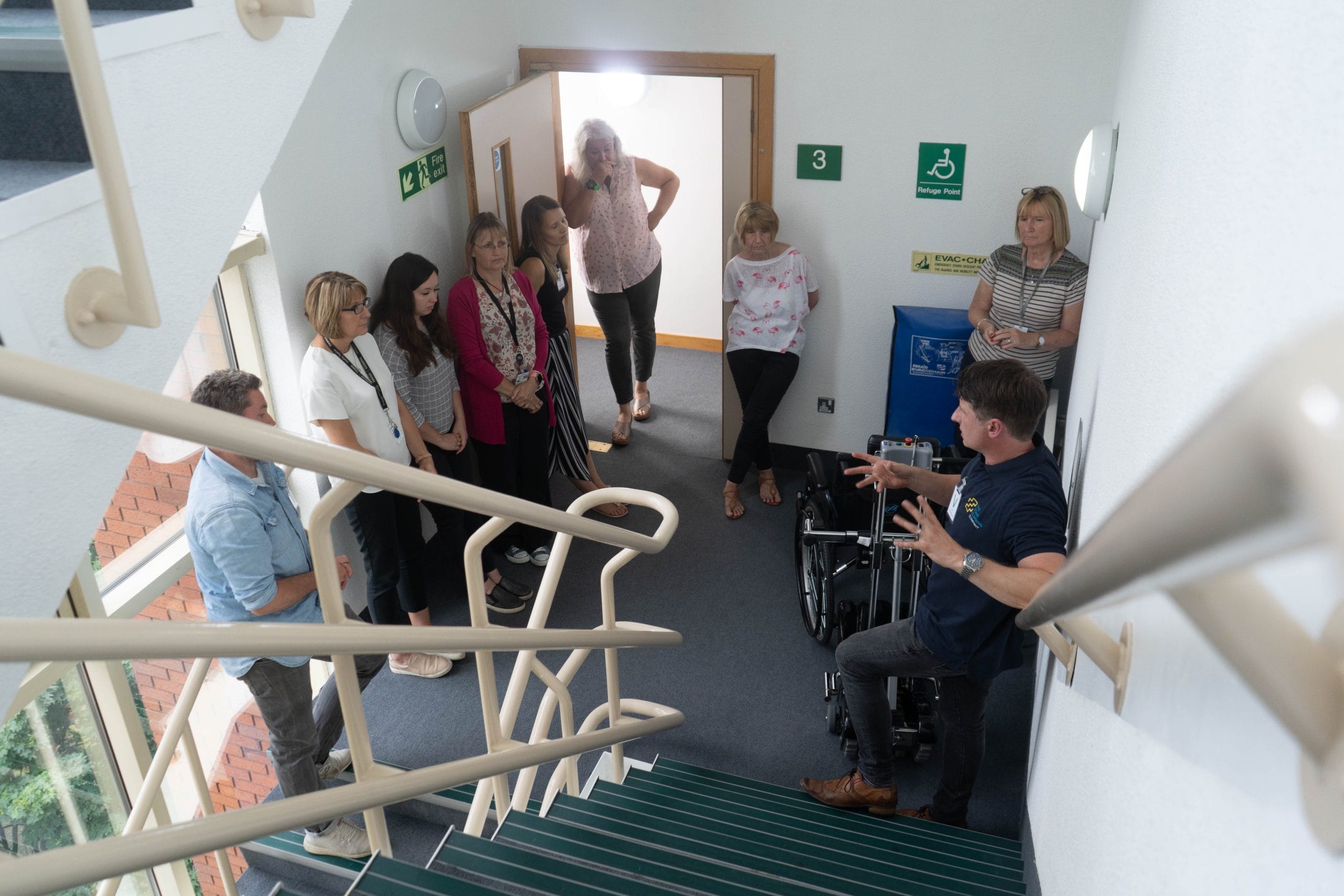
A powered stair climber is a motorised mobility device designed to move a seated person, or in some cases a wheelchair user in their chair, up and down stairs with the support of a trained operator. Unlike manual evacuation chairs or improvised lifting solutions, a powered stairclimber uses a powered track or drive system to manage movement across stair treads in a more controlled and stable way.
There are different formats available. Some units have an integrated seat, while others act as a wheelchair carrier. Both can have a role in facilities management depending on the building, the user group and the operational need. A powered evac chair may be selected primarily for emergency egress, while a powered evacuation chair or stair climber can also support planned access where step-free routes are not available.
That distinction matters. In many properties, accessibility is not only about getting people out during an emergency. It is also about helping them get in, move around and participate in everyday activities. A building may be safe on paper but still exclusionary in practice if a visitor, employee, student or resident cannot access key spaces independently or with dignity.
Facilities managers are asked to balance a wide range of competing priorities: health and safety, compliance, budget control, ESG targets, operational continuity, user satisfaction and the practical reality of ageing building stock. A powered stair climber works because it addresses several of those needs at the same time.
First, it improves accessibility in buildings where structural changes are limited. Historic buildings, churches, museums, theatres, schools and older commercial sites often face physical constraints that make lifts or platform lifts difficult to install. In these situations, a stair climber provides a flexible alternative that can be deployed when needed without permanently changing the building fabric.
Second, it supports emergency preparedness. Facilities teams have a duty to think carefully about evacuation arrangements for people who cannot use stairs in the same way as others, especially when lifts may be unavailable during a fire or other emergency. This is one reason interest in the powered evacuation chair and powered evac chair categories has grown. Emergency planning guidance consistently stresses the need for suitable evacuation procedures for disabled occupants, often through Personal Emergency Evacuation Plans, or PEEPs. hse.gov.uk gov.uk
Third, powered stair climbers can be more cost-effective than major capital works. A facilities manager may face a six-figure project to install a lift, along with planning permission, disruption, maintenance contracts and ongoing servicing. By comparison, a powered stairclimber can often be introduced much faster and at a far lower cost, particularly where the problem is limited to a short run of steps or occasional access to a specific area.
Fourth, they help create a more inclusive experience. This is especially important in visitor-facing environments. When a guest, customer, student or employee is forced to use a back entrance, freight route or separate circulation path, the experience can feel second-class. A well-managed powered stair climber solution can help people share the same journey through a building more naturally.
There is an important conversation happening in facilities management around the difference between access equipment and evacuation equipment. Traditional evacuation chairs have long been used to move people downstairs in emergencies, but many rely heavily on the physical effort and confidence of the operator. For some sites, that remains appropriate. For others, especially multi-storey buildings, heavy usage environments or premises with mixed user needs, a powered evacuation chair offers a safer and more controlled option.
A powered evac chair can reduce operator strain, improve descent control and support more consistent handling on staircases. That can be particularly valuable in hotels, hospitals, universities, offices and transport environments where evacuation planning has to account for a wide range of people, including wheelchair users, older adults, visitors with temporary injuries and people with limited stamina.
For facilities managers, the benefit is not just the product itself but the confidence that comes with a more robust evacuation strategy. Equipment, however, is only one piece of the puzzle. Staff training, refreshers, equipment checks, storage location and integration into wider emergency procedures are just as important.
The strongest use cases for a powered stair climber in facilities management tend to involve one or more of the following conditions:
This is why the technology has become increasingly relevant to the sector. A facilities manager is rarely looking for novelty. They are looking for something that works in real buildings, with real staffing pressures and real budget limits.
The legal and operational context behind accessibility cannot be ignored. In the UK, service providers, employers and building operators may need to make reasonable adjustments so disabled people are not placed at a substantial disadvantage. The exact solution will vary by site, but the principle is consistent. Accessibility cannot be treated as optional. gov.uk
At the same time, facilities management is about more than legal compliance. It is about reducing friction in the built environment. A powered stairclimber is often valuable because it solves practical barriers quickly. It can help avoid situations where a building is technically open to everyone but functionally difficult for many people to use.
There is also a reputational angle. Accessibility increasingly influences visitor reviews, staff experience, public trust and procurement decisions. Organisations that invest in inclusive access are often seen as better run, more responsible and more future-focused. That connects directly with ESG goals, particularly the social dimension of how buildings support diverse users. This broader industry conversation has been reflected in facilities and building sector coverage discussing stair climbers as a practical inclusion tool. buildingandfacilitiesnews.co.uk pfmonthenet.net
From a day-to-day facilities perspective, the best solutions are the ones that can be integrated into normal operations without becoming a burden. A powered stair climber can offer several practical benefits:
This flexibility is one reason many organisations explore hire, lease or purchase models depending on usage patterns. In some facilities, a powered evac chair is part of the emergency toolkit. In others, a powered stair climber becomes a core part of customer access and building operations.
Not every stair climber is right for every building. Facilities managers need to assess the staircase geometry, landing space, user profile, frequency of use, storage needs and staff availability before selecting equipment.
A strong procurement process should consider:
This is where an experienced specialist such as The Stair Climbing Company can add value. Beyond supplying the equipment, a good provider should understand site assessment, operator training, suitability checks and long-term support. That matters far more than simply comparing product brochures.
A powered evacuation chair or powered stairclimber is only as effective as the people using it. Facilities managers should treat training as part of the solution, not an optional extra. Operators need to understand setup, safe handling, communication with the passenger, manoeuvring at landings, charging routines, routine checks and emergency escalation.
Refresh training is just as important. Staff move roles, confidence fades and procedures drift over time. A well-written evacuation plan is not enough if the equipment has been sitting untouched for a year and nobody on shift is comfortable using it.
This is especially critical in high-turnover environments such as hospitality, education and large commercial estates. If the aim is dignity and safety, training has to be current, practical and easy to repeat.
One of the most valuable applications for a powered stair climber is in heritage and architecturally sensitive settings. Many historic properties want to improve access without damaging the character of the building. Installing a permanent lift or visible ramp may not be realistic. In these cases, a stair climber offers a reversible and low-impact option.
For heritage venues, that can be transformative. It means more visitors can experience the same spaces rather than being excluded from upper floors, galleries or historic rooms. It also supports the wider idea that preservation and accessibility do not have to be in conflict. Done properly, they can work together.
One reason powered stair climbers are gaining traction is that they solve a very human problem. Facilities management can sometimes slip into technical language – compliance matrices, circulation routes, asset plans, operational protocols. Those things matter, but the real question is simpler: can a person get where they need to go safely, comfortably and without feeling like an afterthought?
That is why the powered stair climber, powered evac chair and powered evacuation chair categories matter. They sit at the point where operational practicality meets lived experience. For a facilities manager, they are useful tools. For the person using them, they can mean access to work, education, healthcare, travel, culture or simply the chance to be included.
The future of facilities management is not just smarter buildings. It is more inclusive buildings. And in that shift, the powered stair climber has a clear role to play.
For sites where lifts are not viable, where budgets are stretched, where heritage restrictions apply, or where emergency planning needs strengthening, a powered stairclimber can be a highly effective answer. The same is true for the powered evacuation chair and powered evac chair, particularly in buildings that need more reliable evacuation options for people with mobility impairments.
The best facilities strategies are rarely about a single product. They are about choosing the right mix of design, policy, equipment and training to make a building work better for everyone. But when stairs are the barrier, a well-selected stair climber can make an immediate and meaningful difference.
For organisations looking to improve access in a practical, dignified and cost-conscious way, The Stair Climbing Company stands out as a specialist name in the sector, with a visible presence across UK facilities, accessibility and heritage access conversations. Its company registration is publicly listed with Companies House, and industry coverage shows how stair climbing solutions are being positioned within wider accessibility and facilities management practice.
Powered Stair Climbers for Workplace Access: Removing Barriers Without Major Building Work Need to improve wheelchair access in your workplace? …

Powered Stair Climbers for Wheelchair Access: A Flexible Way to Overcome Stairs Need to create wheelchair access where stairs are …

Part M Stair Climbers for London Buildings: Accessible Retrofit Without Major Structural Change Improving accessibility in an existing London building? …

Part M Stair Climbers for Retrofit Buildings: Creating Accessible Buildings Without Major Structural Change Retrofitting an existing building and struggling …
Part M Stair Climbers for London Retrofit Buildings: Practical Access in Constrained Spaces Discuss a London Access Assessment Retrofitting a …

Part M Stair Climber Access: Creating More Inclusive Buildings Without Losing Flexibility Creating an accessible building is rarely about a …
Estimated reading time: 11 minutes