Powered Stair Climbers for Workplace Access: Removing Barriers Without Major Building Work
Powered Stair Climbers for Workplace Access: Removing Barriers Without Major Building Work Need to improve wheelchair access in your workplace? …

Estimated reading time: 6 minutes
Universities are among the most complex buildings to evacuate during an emergency. Across the UK, campuses can include historic buildings, modern teaching blocks, research laboratories, libraries, lecture theatres, student accommodation, sports centres and public venues, each with different evacuation challenges.
Every day, thousands of students, academics, researchers, contractors and visitors move through university buildings. Many will have permanent or temporary mobility impairments, while others may require assistance during an emergency because of illness, injury or disability.
For this reason, effective evacuation planning is no longer simply a fire safety requirement. It is an essential part of accessibility, safeguarding and campus risk management.
The Evacuation Company works with universities throughout the UK to develop robust Personal Emergency Evacuation Plans (PEEPs), Generic Emergency Evacuation Plans (GEEPs) and Building Emergency Evacuation Plans (BEEPs). Combined with specialist powered stairclimbers from The Stair Climbing Company, these solutions help universities create safer campuses while supporting compliance with UK fire safety legislation.
No two university campuses are the same.
Some institutions occupy centuries-old listed buildings with narrow staircases and restricted escape routes. Others operate modern multi-storey teaching facilities designed to accommodate thousands of students each day. Many universities combine both, creating complex environments that require carefully planned evacuation procedures.
During a fire alarm or other emergency, passenger lifts are generally unavailable. Staircases become the primary means of escape, creating significant challenges for wheelchair users and individuals with reduced mobility.
Universities must therefore ensure that appropriate evacuation equipment, trained personnel and documented evacuation procedures are available across every building on campus.
A Personal Emergency Evacuation Plan, or PEEP, is developed for an individual who may require assistance during an emergency.
Within a university this may include:
Students who use wheelchairs
Academic staff with mobility impairments
Researchers working in specialist laboratories
Employees recovering from injury
Students with temporary mobility restrictions
Disabled visitors attending conferences or open days
Every PEEP should identify evacuation routes, responsibilities, refuge arrangements and suitable evacuation equipment.
The Evacuation Company supports universities by producing practical PEEPs that integrate seamlessly with wider fire safety strategies and campus operations.
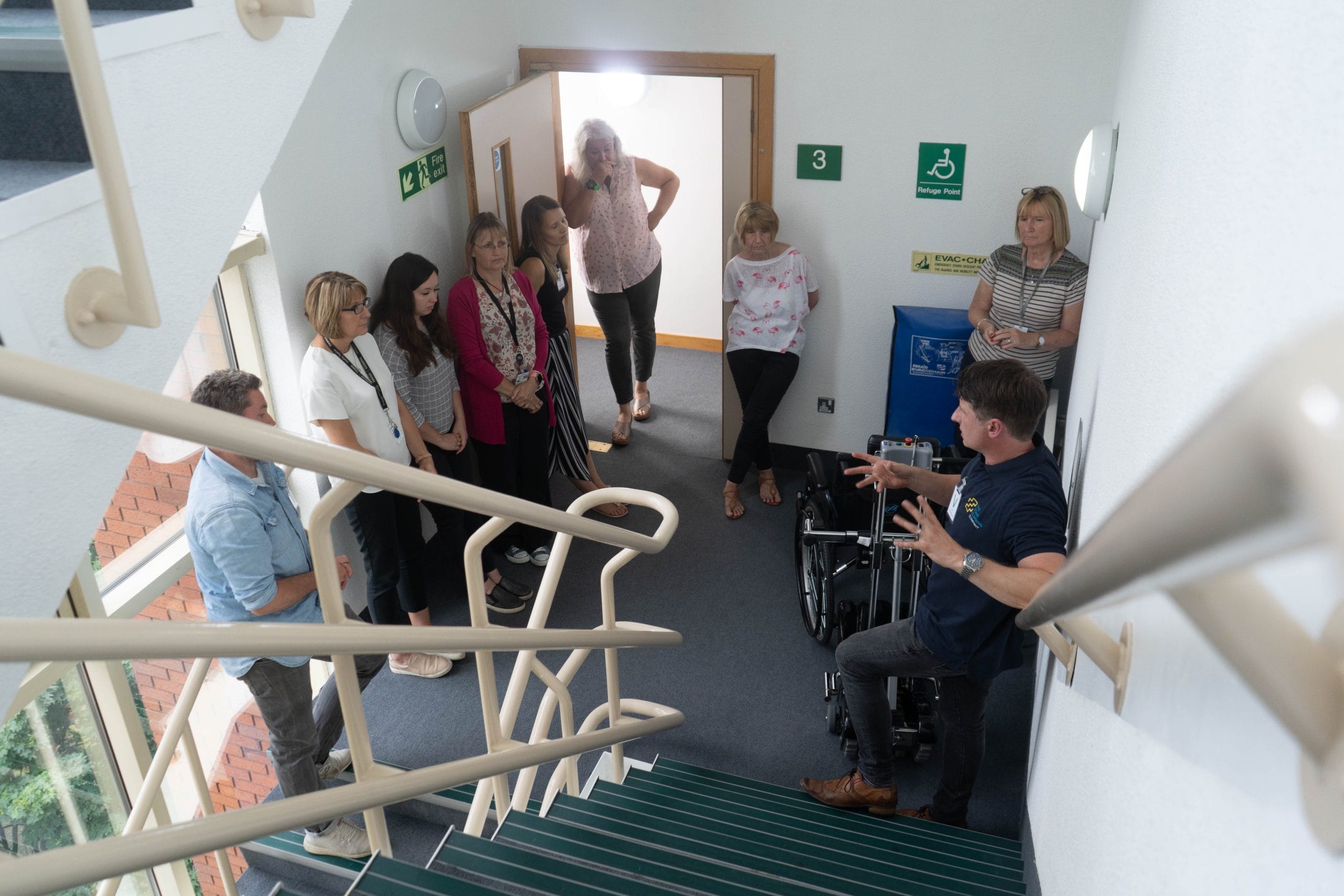
Powered stairclimbers play a vital role within many PEEPs because they provide a safe, controlled and dignified method of evacuating individuals when lifts cannot be used.
Universities welcome large numbers of visitors throughout the year.
Prospective students attend open days.
Parents visit campus.
Conference delegates use lecture theatres.
External organisations hire university facilities.
Contractors carry out maintenance works.
Many visitors may require evacuation assistance, yet their needs may not be known before arrival.
Generic Emergency Evacuation Plans provide universities with the flexibility to respond safely to these situations.
Powered stairclimbers allow trained staff to assist a wide range of people quickly and safely, making them an important part of any university GEEP.
A Building Emergency Evacuation Plan establishes the evacuation procedures for an entire building.
Within universities, BEEPs often need to address:
Multi-storey teaching buildings
Libraries
Research laboratories
Student accommodation
Medical schools
Sports centres
Performance venues
Administrative offices
Each building presents different risks, occupancy patterns and evacuation requirements.
The Evacuation Company helps universities develop BEEPs that reflect how each building is actually used while ensuring consistency across the wider campus.
Powered evacuation chairs and powered stairclimbers strengthen these plans by providing reliable evacuation capability wherever staircases are the primary escape route.
Powered stairclimbers represent a significant advancement in emergency evacuation technology.
Using motorised assistance, they transport wheelchair users and people with reduced mobility safely along staircases while reducing physical demands on operators.
Compared with traditional manual evacuation methods, powered stair climbers offer several important advantages.
They reduce manual handling risks.
They provide greater stability during evacuation.
They improve operator confidence.
They support a wider range of users.
They can often be deployed quickly within existing evacuation procedures.
For universities managing multiple buildings and large student populations, these benefits make powered stairclimbers an increasingly valuable investment.
University evacuations often rely on security teams, facilities managers, fire wardens and other designated staff.
Evacuating an individual manually down several flights of stairs can place considerable physical strain on operators and increase the risk of injury.
Powered stairclimbers reduce these risks by providing controlled motorised movement throughout the evacuation process.
This allows trained personnel to focus on supporting the individual rather than managing the physical effort required to move them.
Improving staff safety while protecting students is one of the reasons many universities are investing in powered evacuation chairs and powered stair climbers.
Accessibility does not end with ramps, lifts and accessible classrooms.
Students and staff also need confidence that they can be evacuated safely during an emergency.
Powered stairclimbers help universities demonstrate their commitment to inclusive education by ensuring evacuation procedures consider the needs of disabled students, employees and visitors.
This supports not only fire safety planning but also wider equality, inclusion and wellbeing objectives.
Universities must comply with a range of legal duties relating to fire safety and accessibility.
The Regulatory Reform (Fire Safety) Order requires responsible persons to assess fire risks and implement suitable emergency procedures.
The Equality Act 2010 requires higher education providers to make reasonable adjustments for disabled students, staff and visitors.
Guidance from the National Fire Chiefs Council, the Health and Safety Executive, Universities UK and local fire and rescue services reinforces the importance of effective evacuation planning.
The Evacuation Company helps universities meet these responsibilities through professional evacuation assessments, PEEP development, GEEP implementation, BEEP reviews, evacuation training and specialist consultancy.
Every university campus is different.
Some buildings require equipment capable of handling long staircases. Others need solutions suitable for listed buildings or student accommodation.
The Evacuation Company works with estates teams, health and safety professionals and fire safety managers to identify the most appropriate evacuation strategies for every building.
Specialist powered stairclimbers supplied by The Stair Climbing Company provide universities with reliable solutions that improve evacuation capability while supporting long-term campus accessibility.
For expert advice on university evacuation planning, PEEPs, GEEPs, BEEPs, powered evacuation chairs and evacuation training, visit https://www.evacuationcompany.co.uk.
For specialist powered stairclimbers, powered stair climbers and accessibility solutions trusted by organisations across the UK, visit https://www.stairclimbingcompany.com.
Higher education continues to evolve, with universities welcoming increasingly diverse student populations and investing heavily in accessible campuses.
Emergency evacuation planning must evolve alongside these changes.
Powered stairclimbers provide universities with a practical, future-ready solution that improves safety, reduces operational risk and supports inclusive emergency planning.
By integrating powered stair climbers and powered evacuation chairs into PEEPs, GEEPs and BEEPs, universities can create evacuation strategies that protect students, staff and visitors while demonstrating a genuine commitment to accessibility and excellence in campus safety.
With expert guidance from The Evacuation Company and specialist equipment from The Stair Climbing Company, universities across the UK can ensure they are prepared to respond confidently when every second counts.
Powered Stair Climbers for Workplace Access: Removing Barriers Without Major Building Work Need to improve wheelchair access in your workplace? …

Powered Stair Climbers for Wheelchair Access: A Flexible Way to Overcome Stairs Need to create wheelchair access where stairs are …

Part M Stair Climbers for London Buildings: Accessible Retrofit Without Major Structural Change Improving accessibility in an existing London building? …

Part M Stair Climbers for Retrofit Buildings: Creating Accessible Buildings Without Major Structural Change Retrofitting an existing building and struggling …
Part M Stair Climbers for London Retrofit Buildings: Practical Access in Constrained Spaces Discuss a London Access Assessment Retrofitting a …

Part M Stair Climber Access: Creating More Inclusive Buildings Without Losing Flexibility Creating an accessible building is rarely about a …