Powered Stair Climbers for Workplace Access: Removing Barriers Without Major Building Work
Powered Stair Climbers for Workplace Access: Removing Barriers Without Major Building Work Need to improve wheelchair access in your workplace? …

Accessibility in education is not just about meeting a legal requirement. It is about making sure pupils, students, staff, parents and visitors can move around a building safely and with dignity. Across the UK, schools, colleges, universities and specialist education settings are reviewing how they support people with mobility needs, especially in older buildings where stairs remain a daily challenge.
For many education facilities, the first thought is often a stair lift or platform lift. Both can be useful, but they are not always practical. Education buildings are busy, varied and often spread across multiple blocks, floors and campuses. A fixed stair lift may only solve one staircase. A platform lift may require building work, planning, budget approval and long lead times.
This is why stairclimbers are becoming one of the most practical alternatives to stair lifts and alternatives to platform lifts in UK education. They offer a flexible way to support access without permanently altering the building. For many schools and universities, a powered stairclimber is the closest thing to a real mobile stair lift.
Education facilities are rarely simple buildings. A school may have a main building, sports hall, science block, sixth form centre and temporary classrooms. A college may operate across several sites. A university may manage historic buildings, lecture theatres, accommodation blocks, libraries and student support spaces.
This variety makes accessibility planning more complex. A student may need support in one building in the morning and another building in the afternoon. A visitor attending a parents’ evening may need help using stairs in a hall that does not have a lift. A member of staff recovering from surgery may temporarily need assistance between floors.
A fixed stair lift cannot easily respond to these changing needs. A platform lift is useful in the right location, but it cannot be moved to another staircase when demand changes. Stairclimbers solve a different problem. They give education facilities a mobile access solution that can be used where it is needed most.
The phrase mobile stair lift is often used because it describes the practical value of a stairclimber. A traditional stair lift is fixed to one staircase. A stairclimber moves with the person and the support team.
For education facilities, this can make a significant difference. Instead of installing a stair lift on every staircase, a school or college can use a powered stairclimber across multiple areas, subject to suitability checks and staff training.
This is especially useful in older school buildings, listed university campuses and facilities where space is limited. Many education sites were built long before modern accessibility expectations. Retrofitting lifts can be expensive, disruptive or even impossible. Stairclimbers provide an alternative route to improved accessibility without major construction.
Stair lifts can work well in some settings, but they often have limitations in education environments. They are fixed in one place, can narrow the staircase, may require installation work and can become a costly solution if several staircases need support.
A stairclimber offers more flexibility. It can support different users in different areas of the site. It can be stored when not in use. It does not permanently change the staircase. It can often be introduced far more quickly than a fixed installation.
For schools and colleges working with tight budgets, this matters. A stairclimber may provide a practical accessibility solution without the same level of installation cost or disruption. It also supports temporary needs, such as a student using crutches after an injury or a staff member returning to work after an operation.
Platform lifts can be very effective, but they are not always realistic for education facilities. They can require structural changes, electrical work, building permissions and ongoing maintenance. In older buildings, there may not be enough space. In heritage buildings, there may be restrictions on what can be installed.
Schools and universities also have to consider disruption. Building work can affect teaching time, safeguarding arrangements, access routes and day-to-day operations.
A powered stairclimber avoids many of these issues. It does not require a shaft, pit or permanent installation. It can help provide access in locations where a platform lift may not be possible. For education facilities that need a quicker, more adaptable solution, stairclimbers can be an excellent alternative to platform lifts.
The biggest advantage is flexibility. A stairclimber can be used across suitable staircases rather than being tied to one fixed point. This is particularly useful in education settings where movement patterns change throughout the day.
Another key benefit is speed of implementation. A stairclimber does not usually require lengthy building work. Once suitability has been assessed and staff have been trained, it can become part of the facility’s accessibility plan.
Stairclimbers can also help protect the character of a building. This is important for independent schools, universities and heritage education sites where permanent alterations may be difficult.
Cost can also be a major advantage. Instead of funding multiple stair lifts or platform lifts, an education facility may be able to use a mobile stair lift solution across different parts of the site.
There is also a strong dignity benefit. A good stairclimber allows a person to be moved safely and calmly, with less reliance on unsafe manual handling or improvised assistance.
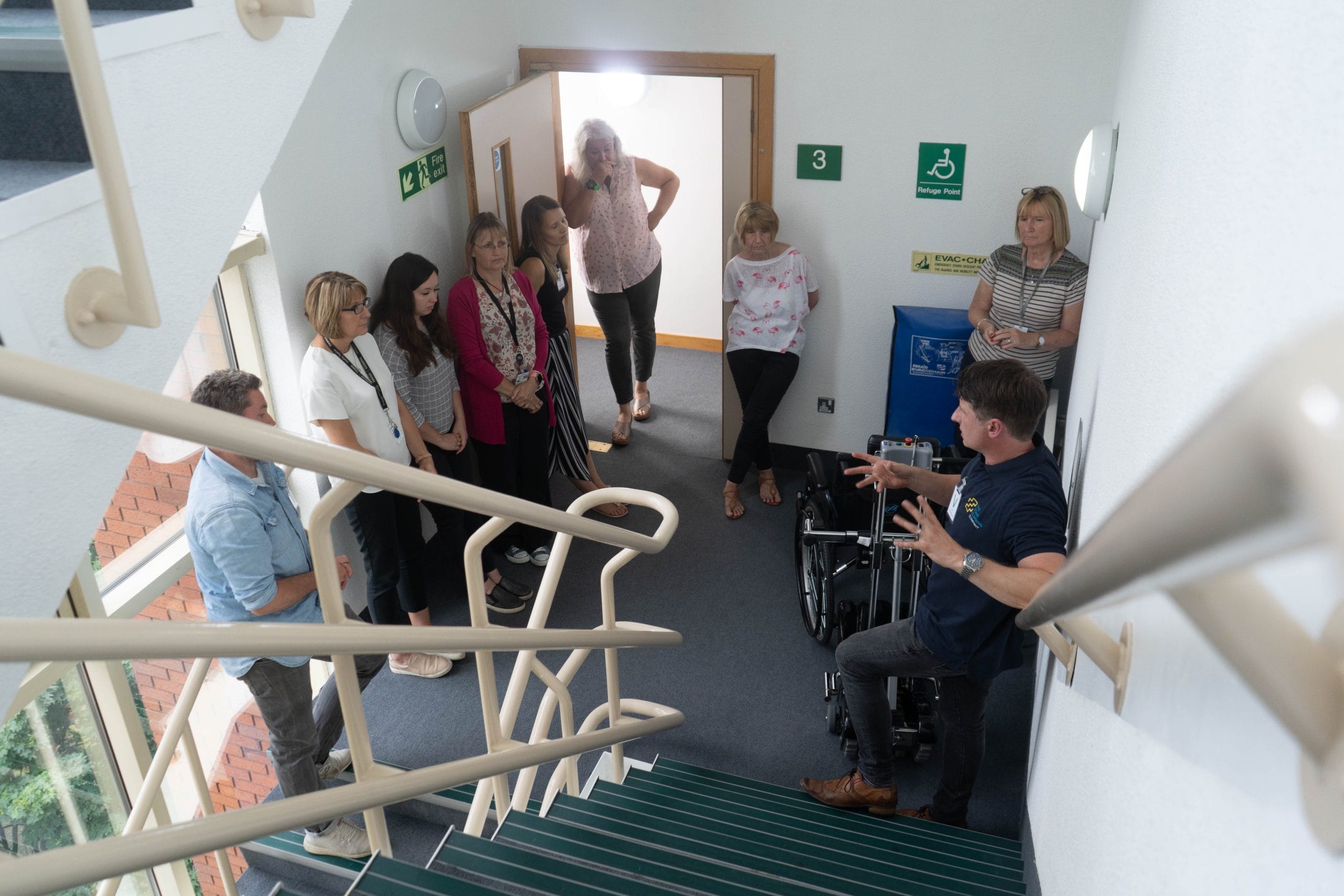
A stairclimber is not the right answer for every situation. Most powered stairclimbers require a trained operator, so staff training is essential. Schools and colleges must make sure enough people are trained so the equipment is available when needed.
A stairclimber may not provide the same level of independent use as a fixed stair lift or passenger lift. If a student or staff member needs completely independent access several times a day, a permanent lift solution may still be more suitable.
Suitability also depends on the staircase, the user, the chair type and the building environment. Before choosing a stairclimber, an education facility should arrange an assessment to confirm that the device is appropriate for the intended use.
Storage and charging also need to be planned. The equipment should be kept in a location where it is secure, accessible and ready to use.
One of the strongest reasons to consider stairclimbers is the range of people they can support. Education facilities are not only used by students. They are also used by teachers, support staff, parents, governors, contractors, visitors and community groups.
A stairclimber can help a school or university respond to different needs throughout the year. It can support open days, exams, parent meetings, temporary injuries, accessibility reviews and emergency planning.
This flexibility helps education providers create a more inclusive environment without waiting for a major building project.
Stairclimbers should not be seen as a replacement for every lift or access solution. Instead, they should be viewed as a practical tool within a wider accessibility strategy.
For some education sites, a stair lift will be appropriate. For others, a platform lift may be the right long-term investment. But where flexibility, speed, budget and building restrictions are important, stairclimbers often provide the most practical answer.
They are a genuine alternative to stair lifts. They are a realistic alternative to platform lifts. For many schools, colleges and universities, they are the closest solution to a true mobile stair lift.
The Stair Climbing Company supports education facilities across the UK with practical stairclimber solutions designed to improve access without unnecessary building disruption.
By working with a specialist provider, schools, colleges and universities can identify the right equipment, understand suitability, plan staff training and build stairclimbers into their wider accessibility strategy.
Education should be accessible to everyone. When stairs create a barrier, stairclimbers provide a flexible, practical and human solution that helps learning environments become safer, more inclusive and easier to navigate.
For education facilities searching for stairclimbers, an alternative to stair lifts, an alternative to platform lifts or a real mobile stair lift, The Stair Climbing Company can help provide a solution that works around the building, the people and the daily reality of education.
Powered Stair Climbers for Workplace Access: Removing Barriers Without Major Building Work Need to improve wheelchair access in your workplace? …

Powered Stair Climbers for Wheelchair Access: A Flexible Way to Overcome Stairs Need to create wheelchair access where stairs are …

Part M Stair Climbers for London Buildings: Accessible Retrofit Without Major Structural Change Improving accessibility in an existing London building? …

Part M Stair Climbers for Retrofit Buildings: Creating Accessible Buildings Without Major Structural Change Retrofitting an existing building and struggling …
Part M Stair Climbers for London Retrofit Buildings: Practical Access in Constrained Spaces Discuss a London Access Assessment Retrofitting a …

Part M Stair Climber Access: Creating More Inclusive Buildings Without Losing Flexibility Creating an accessible building is rarely about a …
Estimated reading time: 7 minutes