Powered Stair Climbers for Workplace Access: Removing Barriers Without Major Building Work
Powered Stair Climbers for Workplace Access: Removing Barriers Without Major Building Work Need to improve wheelchair access in your workplace? …

Estimated reading time: 3 minutes
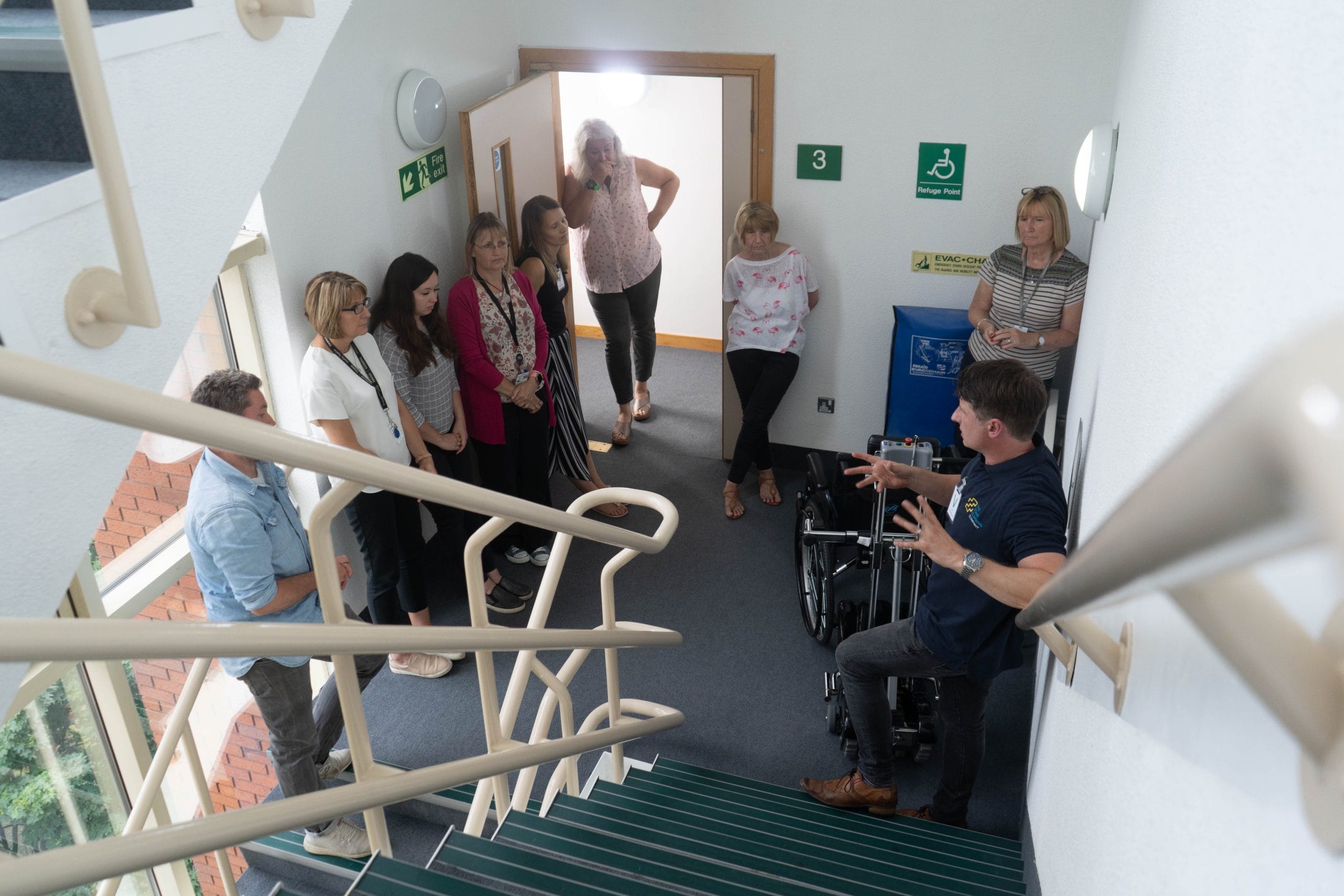
However, many businesses still rely on evacuation equipment that requires a wheelchair user to transfer from their wheelchair into an evacuation chair. While this may appear compliant on paper, it often introduces significant risks during a real emergency.
This is where a Powered Evacuation Chair from The Stair Climbing Company changes the conversation.
A non-transfer evacuation allows an individual to remain seated in their own wheelchair throughout the evacuation process.
There is no need to:
Instead, the individual remains secure and comfortable in their familiar seating position while being safely transported downstairs using a Powered Stair Climber system.
Traditional evacuation chairs were originally designed decades ago when accessibility expectations were different.
Today, organisations recognise that transferring a person during an emergency can create numerous challenges:
Moving an individual from a wheelchair to an evacuation chair may cause:
Many wheelchair users understandably do not wish to be lifted or transferred in front of colleagues, visitors or members of the public.
Every transfer adds time during a critical emergency situation.
Many traditional evacuation procedures require multiple operators.
The Stair Climbing Company provides Powered Stair Climber solutions specifically designed to move occupied wheelchairs safely up and down stairs.
This means:
For many organisations, this is the only realistic way to achieve a genuinely inclusive evacuation strategy.
A compliant PEEP should be:
If a wheelchair user cannot safely transfer during a fire alarm, then a transfer-based evacuation plan may not be workable.
A Powered Evac Chair system that supports non-transfer evacuation addresses these concerns directly.
Forward-thinking organisations understand that emergency planning is about more than compliance.
It is about:
Providing a Powered Evacuation Chair solution demonstrates commitment to all employees and visitors.
As accessibility standards continue to evolve, non-transfer evacuation is becoming the benchmark for best practice.
The Stair Climbing Company remains at the forefront of this movement, helping organisations create safer, more inclusive evacuation strategies using advanced Powered Stair Climber technology.
For organisations reviewing their PEEPs, the question is no longer whether non-transfer evacuation is desirable.
The question is whether your current evacuation plan can genuinely deliver it.
Powered Stair Climbers for Workplace Access: Removing Barriers Without Major Building Work Need to improve wheelchair access in your workplace? …

Powered Stair Climbers for Wheelchair Access: A Flexible Way to Overcome Stairs Need to create wheelchair access where stairs are …

Part M Stair Climbers for London Buildings: Accessible Retrofit Without Major Structural Change Improving accessibility in an existing London building? …

Part M Stair Climbers for Retrofit Buildings: Creating Accessible Buildings Without Major Structural Change Retrofitting an existing building and struggling …
Part M Stair Climbers for London Retrofit Buildings: Practical Access in Constrained Spaces Discuss a London Access Assessment Retrofitting a …

Part M Stair Climber Access: Creating More Inclusive Buildings Without Losing Flexibility Creating an accessible building is rarely about a …