Powered Stair Climbers for Workplace Access: Removing Barriers Without Major Building Work
Powered Stair Climbers for Workplace Access: Removing Barriers Without Major Building Work Need to improve wheelchair access in your workplace? …

London is home to some of the most diverse and historic educational facilities in the United Kingdom. From Victorian schools in Westminster and Kensington to university campuses across Bloomsbury and South London, educational institutions face a unique challenge when it comes to accessibility.
Many of these buildings were constructed long before modern accessibility standards existed. While schools, colleges and universities are committed to providing inclusive environments for students, staff and visitors, adapting older buildings is often far from straightforward.
This challenge has led many London education providers to explore stairclimbers as a practical alternative to stair lifts and an effective alternative to platform lifts. As budgets become tighter and accessibility expectations continue to rise, mobile solutions are becoming increasingly attractive.
For many education facilities across the capital, stairclimbers are proving to be the closest thing to a genuine mobile stair lift.
One of the biggest issues facing schools and universities in London is the age of their buildings.
Many educational facilities operate from listed properties or heritage sites where structural alterations can be difficult, expensive or heavily restricted. Installing a platform lift may require extensive planning approvals, while fitting a stair lift can affect the appearance and function of a staircase.
In central London, space can be another significant obstacle. Older buildings often have narrow corridors, limited circulation space and architectural features that make traditional lift installations difficult.
This is where stairclimbers offer a valuable solution. Because they do not require permanent installation, they provide accessibility support without the disruption associated with major construction projects.
Education providers throughout London are increasingly looking for accessibility solutions that can adapt to changing requirements.
A student may require temporary mobility support following an injury. A visiting speaker may need assistance reaching a lecture theatre. A member of staff may need support accessing multiple floors while recovering from surgery.
Traditional stair lifts are designed for a fixed location. If accessibility needs arise elsewhere in the building, additional installations may be required.
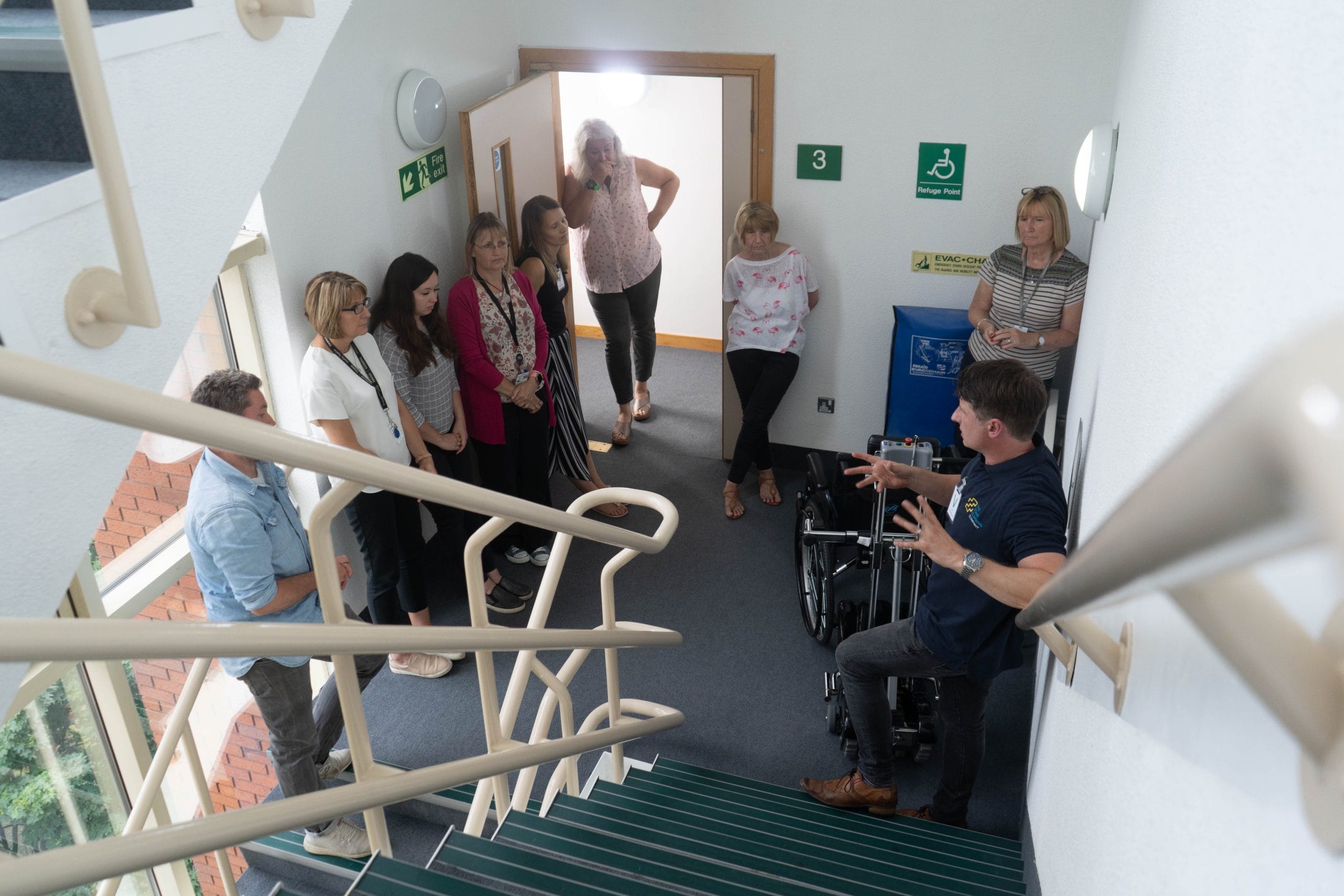
A stairclimber offers a different approach. It can be used on suitable staircases throughout a facility, giving schools and colleges the flexibility to respond to different situations as they arise.
For busy London education facilities where space and budgets are often under pressure, this flexibility is extremely valuable.
Many education leaders are beginning to view stairclimbers as a genuine mobile stair lift.
Unlike conventional stair lifts that remain fixed to a single staircase, stairclimbers can be moved between buildings, departments and locations.
This mobility makes them particularly useful within larger educational estates.
A university operating across multiple buildings in Central London may need accessibility support in different locations throughout the day. A further education college may require assistance in lecture theatres, workshops and administrative areas. A secondary school may need to accommodate visitors attending evening events.
A powered stairclimber allows institutions to provide support where it is needed without investing in multiple fixed systems.
There are many situations where stair lifts remain an appropriate solution. However, they are not always the most practical choice for London’s education sector.
A stair lift serves only one staircase. Installation can take time and may involve modifications to the building. In some cases, particularly within older schools, space limitations can create operational challenges.
Stairclimbers offer a more flexible alternative.
They can be deployed across multiple locations, require no structural changes and can be introduced quickly. For schools managing tight budgets and competing priorities, this often represents a more achievable route towards improved accessibility.
The ability to use a single stairclimber across several suitable staircases can also deliver significant value for money compared with installing multiple stair lifts.
Platform lifts can be highly effective, particularly in new-build educational environments. However, many London schools and universities face practical barriers that make installation challenging.
Building work in active educational settings can create disruption. Planning permissions may be required. Costs can escalate quickly. Heritage restrictions may limit what changes can be made.
A stairclimber avoids many of these complications.
There is no need for a lift shaft, extensive construction work or major structural alterations. The equipment can often be implemented much faster while providing a practical accessibility solution for students, staff and visitors.
For this reason, many facilities managers now view stairclimbers as one of the most realistic alternatives to platform lifts available.
London’s educational institutions serve one of the most diverse student populations anywhere in Europe.
Accessibility is not simply about compliance. It is about ensuring every student has equal opportunities to participate in education, social activities and campus life.
Stairclimbers can play an important role in supporting this goal.
They help educational institutions respond to temporary and long-term mobility requirements while maintaining flexibility across their estates. They can support open days, graduation ceremonies, parent events and daily teaching activities.
Most importantly, they help remove barriers that might otherwise limit participation.
The most obvious benefit is flexibility. A stairclimber can be used across multiple suitable staircases and buildings.
They also help schools avoid expensive installation projects. In a city where property costs are already among the highest in the country, this can be a significant advantage.
Another important benefit is speed. Educational institutions can often implement stairclimber solutions far more quickly than permanent lift installations.
Many London schools also appreciate that stairclimbers preserve the character of heritage buildings while still improving accessibility.
This combination of flexibility, cost-effectiveness and practicality explains why demand for stairclimbers continues to grow across the capital.
Like any accessibility solution, stairclimbers are not suitable for every situation.
Most models require trained operators, making staff training an important consideration. Institutions also need appropriate storage and charging arrangements.
In situations where an individual requires completely independent access throughout the day, a fixed lift solution may still be the preferred option.
However, for many schools, colleges and universities, these limitations are outweighed by the significant benefits stairclimbers provide.
As London’s education sector continues to evolve, accessibility will remain a key priority.
Schools and universities are under increasing pressure to create inclusive environments while managing financial and operational challenges. This is driving greater interest in solutions that deliver flexibility without requiring major building alterations.
Stairclimbers are emerging as a key part of this conversation.
They provide a practical alternative to stair lifts, a cost-effective alternative to platform lifts and the closest solution available to a genuine mobile stair lift.
For educational institutions operating within London’s unique built environment, that combination of mobility, adaptability and affordability is difficult to ignore.
The Stair Climbing Company works with schools, academies, colleges and universities throughout London to help improve accessibility and mobility.
With extensive experience supporting educational facilities, the company understands the challenges associated with older buildings, limited space and evolving accessibility requirements.
Whether an institution is looking for stairclimbers, a mobile stair lift solution, an alternative to stair lifts or an alternative to platform lifts, The Stair Climbing Company provides expert guidance and practical solutions tailored to the education sector.
As London’s educational landscape continues to develop, stairclimbers are proving that accessibility does not always require expensive building projects. Sometimes the most effective solution is one that moves with the people who need it most.
Powered Stair Climbers for Workplace Access: Removing Barriers Without Major Building Work Need to improve wheelchair access in your workplace? …

Powered Stair Climbers for Wheelchair Access: A Flexible Way to Overcome Stairs Need to create wheelchair access where stairs are …

Part M Stair Climbers for London Buildings: Accessible Retrofit Without Major Structural Change Improving accessibility in an existing London building? …

Part M Stair Climbers for Retrofit Buildings: Creating Accessible Buildings Without Major Structural Change Retrofitting an existing building and struggling …
Part M Stair Climbers for London Retrofit Buildings: Practical Access in Constrained Spaces Discuss a London Access Assessment Retrofitting a …

Part M Stair Climber Access: Creating More Inclusive Buildings Without Losing Flexibility Creating an accessible building is rarely about a …
Estimated reading time: 7 minutes