Powered Stair Climbers for Workplace Access: Removing Barriers Without Major Building Work
Powered Stair Climbers for Workplace Access: Removing Barriers Without Major Building Work Need to improve wheelchair access in your workplace? …

London is home to one of the most diverse collections of buildings in the world. From landmark office towers in the City of London and residential developments in Canary Wharf to historic public buildings in Westminster, hospitals, schools, hotels and cultural venues, every property has one thing in common. It must be prepared to evacuate people safely during an emergency.
For responsible persons, facilities managers, building owners and health and safety professionals, emergency evacuation is no longer simply about complying with legislation. It is about ensuring every occupant, employee, resident and visitor can reach safety regardless of their mobility.
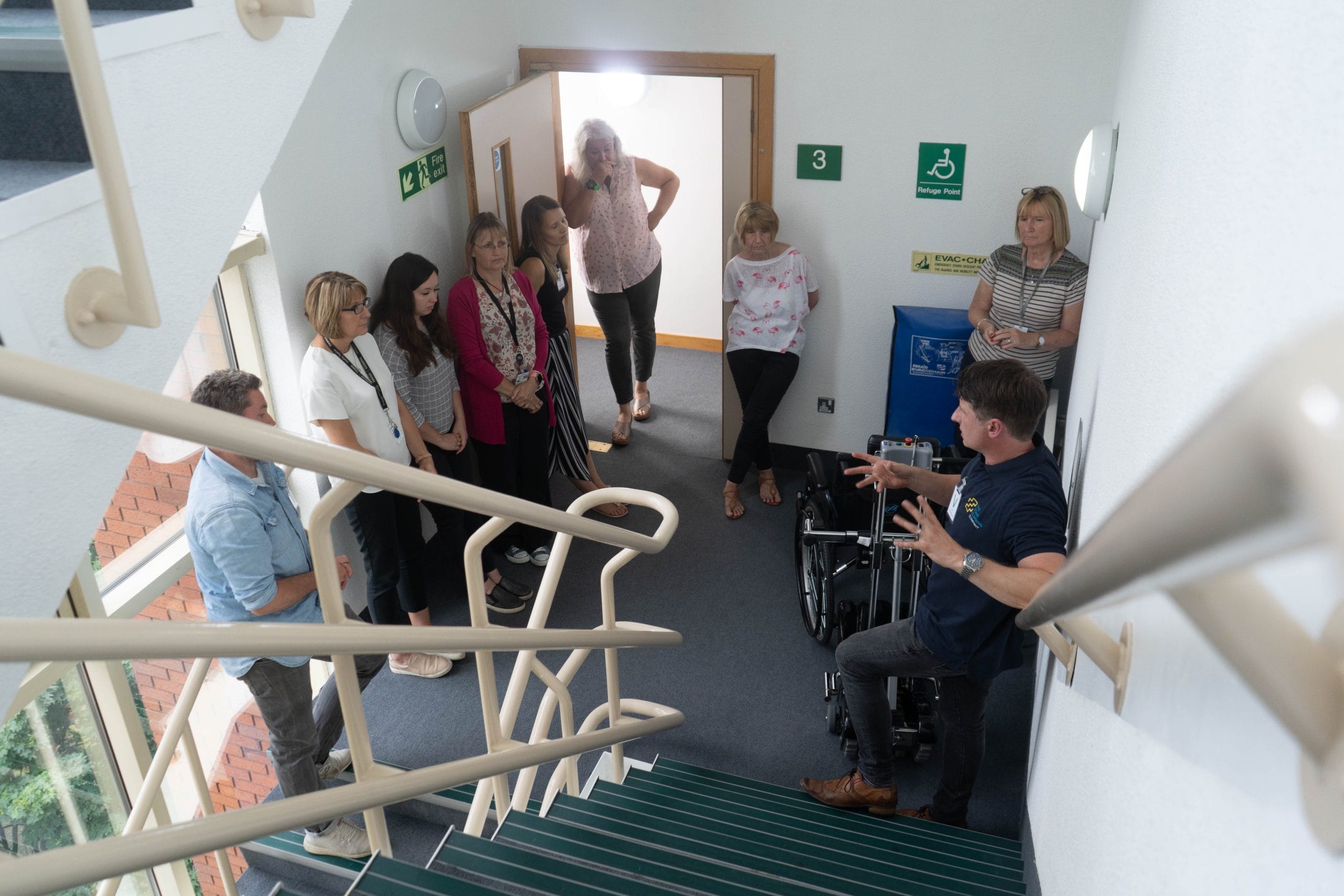
Powered stairclimbers and powered evacuation chairs are becoming an essential part of modern evacuation planning throughout London. Working with organisations across the capital, The Evacuation Company develops practical Personal Emergency Evacuation Plans (PEEPs), Generic Emergency Evacuation Plans (GEEPs) and Building Emergency Evacuation Plans (BEEPs), supported by specialist powered stairclimbers supplied by The Stair Climbing Company.
London’s buildings are incredibly varied. Many commercial offices occupy high-rise towers with multiple escape stairwells. Residential apartment blocks continue to increase in height, while hotels, healthcare facilities and educational campuses often accommodate hundreds or even thousands of people each day. Alongside these modern developments, London also contains historic listed buildings where structural alterations are limited.
During an emergency, passenger lifts are generally unavailable. Staircases become the primary means of escape, creating significant challenges for wheelchair users, people with reduced mobility, individuals recovering from injury, older occupants and visitors unfamiliar with the building.
Every building therefore requires an evacuation strategy that is practical, inclusive and capable of responding to a wide variety of situations.
A Personal Emergency Evacuation Plan provides an individual strategy for someone who requires assistance during an evacuation.
Within London buildings this could include employees, residents, contractors, students, patients or regular visitors.
An effective PEEP considers the individual’s mobility, the layout of the building, available escape routes, refuge areas, trained personnel and the most appropriate evacuation equipment.
The Evacuation Company works with organisations throughout London to create practical PEEPs that can be implemented confidently during real emergency situations.
Powered stairclimbers strengthen these plans by providing a reliable method of moving wheelchair users and people with reduced mobility safely along staircases when lifts cannot be used.
Many London buildings welcome visitors every day.
Corporate offices receive clients and contractors. Residential developments welcome family members and delivery personnel. Hotels accommodate guests from around the world. Universities host conferences. Public buildings receive thousands of visitors every week.
Many of these people may require evacuation assistance even though no personal evacuation plan has been prepared.
Generic Emergency Evacuation Plans provide organisations with procedures that enable staff to respond safely and efficiently to unknown mobility needs.
Powered stairclimbers give building teams the flexibility to support a wide range of users while reducing reliance on physically demanding manual handling techniques.
A Building Emergency Evacuation Plan establishes how an entire property will respond during an emergency.
For London buildings this often includes multiple staircases, refuge points, phased evacuation procedures, fire compartments, evacuation equipment and designated staff responsibilities.
The Evacuation Company helps organisations review existing procedures, identify potential weaknesses and develop BEEPs that reflect the way each building is used on a daily basis.
Powered evacuation chairs and powered stairclimbers provide an important layer of resilience by ensuring that occupants who cannot use stairs independently still have a safe means of evacuation.
Powered stairclimbers represent one of the most significant developments in evacuation technology in recent years.
Using advanced motorised systems, powered stair climbers transport wheelchair users safely along staircases while reducing physical effort for operators. Compared with traditional manual evacuation methods, they provide smoother movement, improved stability and greater confidence for both the individual being evacuated and the trained operator.
Many organisations also choose powered stairclimbers because they can support accessibility beyond emergency situations, providing a flexible solution for temporary access challenges, lift failures and planned building maintenance.
Emergency evacuation places considerable demands on those responsible for assisting others.
Facilities teams, fire wardens, concierge staff, security personnel and building managers may all be called upon to evacuate people during stressful and time-critical situations.
Powered stairclimbers reduce manual handling risks by using controlled motorised movement throughout the evacuation process. This protects both the operator and the individual being evacuated while helping organisations support wider workplace health and safety objectives.
Building owners and responsible persons have legal duties to ensure suitable evacuation arrangements are in place.
The Regulatory Reform (Fire Safety) Order requires fire risks to be assessed and appropriate emergency procedures implemented.
The Equality Act 2010 requires organisations to make reasonable adjustments for disabled people, including ensuring that emergency arrangements do not place them at a disadvantage.
The Evacuation Company helps organisations meet these responsibilities through professional evacuation assessments, PEEP development, GEEP implementation, BEEP reviews, evacuation chair training, powered stairclimber demonstrations and ongoing consultancy.
Every London building presents different operational challenges.
A residential tower requires a different evacuation strategy from a hospital. A heritage building has different constraints from a modern office block. Hotels, schools, transport hubs and cultural venues all require tailored solutions.
The Evacuation Company works with responsible persons, estates teams and facilities managers to identify the most appropriate evacuation strategy for each property.
Powered stairclimbers supplied by The Stair Climbing Company provide dependable solutions that improve emergency preparedness while supporting long-term accessibility and operational resilience.
For expert advice on PEEPs, GEEPs, BEEPs, evacuation planning, evacuation training and powered evacuation chairs, visit https://www.evacuationcompany.co.uk.
To learn more about powered stairclimbers, powered stair climbers and non-transfer wheelchair evacuation solutions, visit https://www.stairclimbingcompany.com.
London’s skyline continues to evolve, but the responsibility to protect people remains constant.
Modern evacuation planning requires more than compliance. It requires practical solutions that recognise the needs of every occupant and every visitor.
Powered stairclimbers are helping organisations across London strengthen emergency preparedness by providing safer evacuation methods, reducing manual handling risks and improving accessibility.
By integrating powered stair climbers and powered evacuation chairs into PEEPs, GEEPs and BEEPs, organisations can create evacuation strategies that are inclusive, effective and ready to meet the challenges of today’s built environment.
With expert support from The Evacuation Company and specialist equipment from The Stair Climbing Company, London’s buildings can be better prepared to protect people whenever an emergency occurs.
Powered Stair Climbers for Workplace Access: Removing Barriers Without Major Building Work Need to improve wheelchair access in your workplace? …

Powered Stair Climbers for Wheelchair Access: A Flexible Way to Overcome Stairs Need to create wheelchair access where stairs are …

Part M Stair Climbers for London Buildings: Accessible Retrofit Without Major Structural Change Improving accessibility in an existing London building? …

Part M Stair Climbers for Retrofit Buildings: Creating Accessible Buildings Without Major Structural Change Retrofitting an existing building and struggling …
Part M Stair Climbers for London Retrofit Buildings: Practical Access in Constrained Spaces Discuss a London Access Assessment Retrofitting a …

Part M Stair Climber Access: Creating More Inclusive Buildings Without Losing Flexibility Creating an accessible building is rarely about a …
Estimated reading time: 6 minutes