Powered Stair Climbers for Workplace Access: Removing Barriers Without Major Building Work
Powered Stair Climbers for Workplace Access: Removing Barriers Without Major Building Work Need to improve wheelchair access in your workplace? …

Schools and educational institutions are increasingly focused on creating environments that are inclusive and safe for every student. Accessibility is a key part of this responsibility. Many school buildings are multi storey and rely on staircases for movement between floors. For students with limited mobility this can present challenges during the school day and serious risks during emergencies.
Stair climbers and powered stair climbers provide a practical solution that supports both daily accessibility and emergency evacuation. These devices help schools ensure that all students can move safely through the building while also meeting legal safety requirements.
Many educational buildings were constructed before modern accessibility standards were widely adopted. Older schools often contain narrow corridors, split level floors and staircases that make it difficult for wheelchair users or students with mobility impairments to move between floors.
While lifts can provide access in some buildings they are not always available or may be located far from certain classrooms. More importantly lifts cannot be used during a fire or emergency evacuation. Guidance from UK fire safety authorities explains that evacuation planning must ensure that disabled people can leave the building safely without relying on emergency services to complete the evacuation.
https://www.gov.uk/government/publications/fire-safety-risk-assessment-means-of-escape-for-disabled-people/fire-safety-risk-assessment-means-of-escape-for-disabled-people-accessible-version
Schools must therefore consider alternative solutions that allow safe movement on staircases during both normal use and emergencies.
Stair climbers are specialised mobility devices designed to move a seated passenger safely up or down a staircase. Powered stair climbers use electric motors and stabilised tracks or wheels to transport a wheelchair or mobility seat along stairs.
Unlike fixed stair lifts which require building installation, stair climbers are portable and can be used on different staircases throughout a building. This makes them particularly useful in schools where layouts vary and where flexibility is important.
Many powered stair climbers allow movement both up and down stairs which means they can support daily accessibility as well as evacuation planning.
Inclusive education means ensuring that students can access classrooms, facilities and social spaces without unnecessary barriers. Powered stair climbers allow staff to assist students safely between floors even when lifts are unavailable.
This means students can access areas such as science laboratories, sports facilities, libraries and dining areas without restrictions. When accessibility equipment is available it supports full participation in school life and helps students maintain independence and confidence.
Educational inclusion is strongly supported by accessibility organisations that highlight the importance of removing physical barriers to participation.
https://www.scope.org.uk/advice-and-support/education-disabled-children
Providing stair climbers in schools is one way to remove these barriers and improve daily accessibility.
During a fire alarm lifts cannot be used because they may fail or become unsafe. This creates a major challenge for students who cannot use stairs independently.
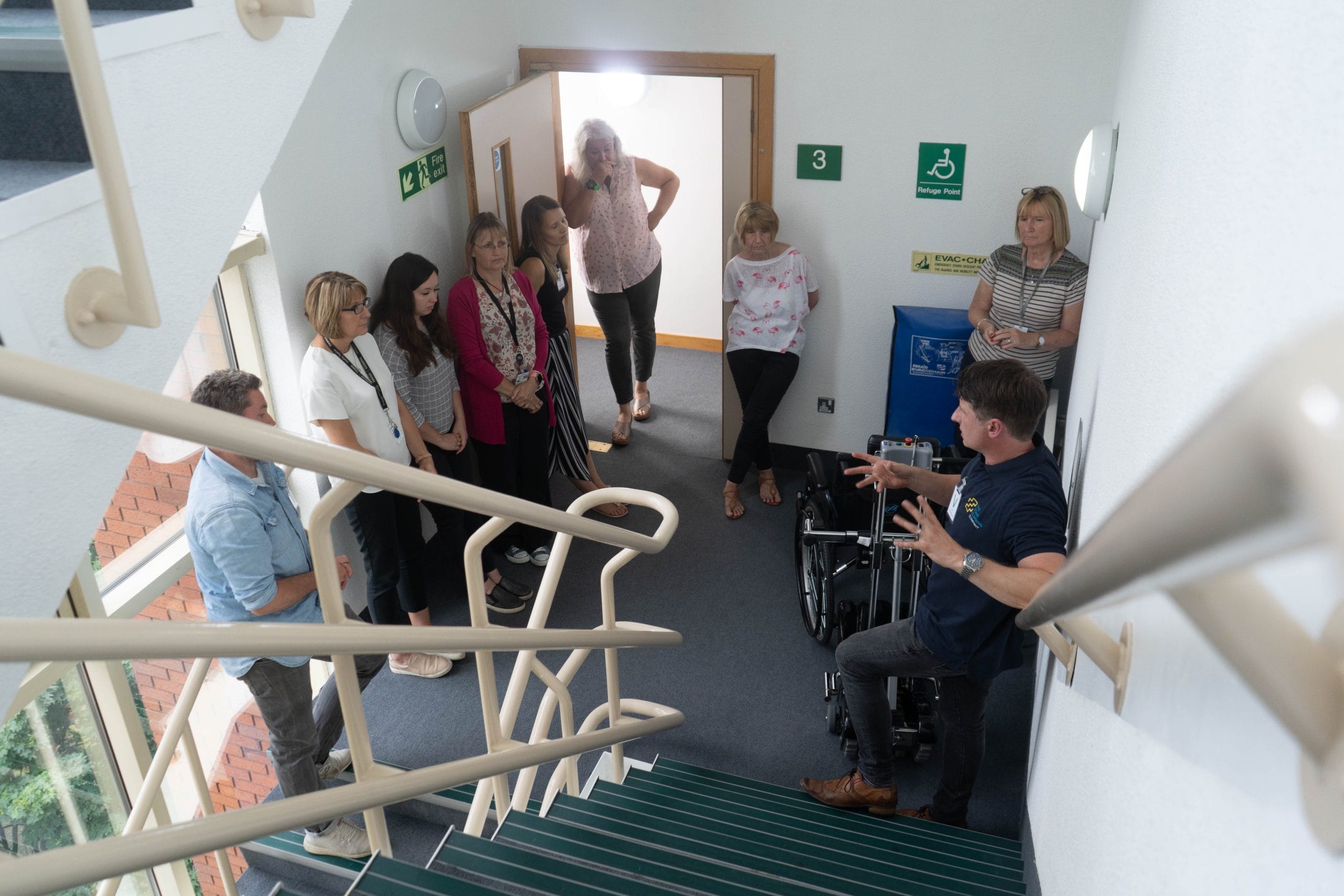
Evacuation equipment is designed to solve this problem. Evacuation chairs allow a passenger to be safely guided down stairs by trained staff using a controlled braking system.
https://en.wikipedia.org/wiki/Escape_chair
Stair climbers for evacuation provide additional flexibility. Many powered models can move both upward and downward and can transport individuals in their wheelchair. This can be particularly useful in buildings where the nearest safe exit is located above the current floor.
Using stair climbers for evacuation allows schools to move students quickly and safely to an exit route rather than leaving them waiting in refuge areas.
Students who require assistance during evacuation usually have a Personal Emergency Evacuation Plan known as a PEEP. These plans describe how the student will be assisted during an emergency and what equipment or support is required.
Healthcare and safety guidance explains that PEEPs must be realistic and achievable within the building environment.
https://library.sheffieldchildrens.nhs.uk/fire-evacuation-in-schools-for-young-people-with-disabilities
Stair climbers make these plans practical. Instead of relying on multiple staff members to carry a student or waiting for external rescue, trained staff can use the equipment to evacuate the student quickly and safely.
Powered stair climbers allow wheelchair users and students with mobility difficulties to access multiple floors within a building. This supports inclusion and ensures students can take part in the same learning activities as their peers.
Stair climbers for evacuation provide a controlled and safe method for moving students down staircases during emergencies when lifts cannot be used.
Many schools operate in historic buildings where installing evacuation lifts or major structural changes is difficult. Portable stair climbers require no permanent building modifications.
Having stair climbers available helps schools implement effective evacuation strategies and realistic PEEP plans.
When staff are trained to use powered stair climbers they can respond quickly during emergencies. This increases confidence for both students and school staff.
Equipment alone does not create safety. Schools must ensure that staff are properly trained to operate stair climbers and evacuation devices.
Training should cover equipment deployment, passenger handling, safe movement on stairs and communication during evacuation. Staff should also practise using the equipment during evacuation drills.
Safety organisations highlight that evacuation equipment must also be regularly inspected and maintained to ensure reliability.
https://www.safelincs.co.uk/blog/2025/06/18/vertical-evacuation-equipment-for-higher-dependencies
By combining training with maintenance schedules schools can ensure their evacuation equipment remains ready for use.
Educational institutions have a legal duty to protect students and staff during emergencies. Fire safety regulations require responsible persons to ensure that evacuation procedures work for everyone in the building.
Government guidance emphasises that evacuation strategies must include disabled occupants and must not depend solely on emergency services.
https://www.gov.uk/government/publications/fire-safety-risk-assessment-means-of-escape-for-disabled-people/fire-safety-risk-assessment-means-of-escape-for-disabled-people-accessible-version
Schools must also consider equality legislation which requires reasonable adjustments for disabled students. Providing accessible evacuation equipment such as stair climbers demonstrates a proactive approach to meeting these responsibilities.
Inclusive design is becoming a central part of school planning. New buildings increasingly incorporate accessibility from the beginning. However many schools operate in buildings that were designed long before these standards existed.
Portable accessibility solutions such as stair climbers allow schools to improve accessibility and safety without major renovations. They also provide immediate support for evacuation planning and mobility assistance.
As awareness of inclusive safety grows, stair climbers and powered stair climbers are becoming essential tools for schools that want to create safe and accessible environments for every student.
Stair climbers and powered stair climbers play an important role in modern educational environments. They improve accessibility for students with mobility impairments while also providing a reliable method of evacuation during emergencies.
By integrating stair climbers for evacuation into safety planning, schools can create inclusive buildings where every student can learn, participate and exit safely when required. When supported by staff training, regular maintenance and clear evacuation procedures these devices help ensure that accessibility and safety go hand in hand.
Powered Stair Climbers for Workplace Access: Removing Barriers Without Major Building Work Need to improve wheelchair access in your workplace? …

Powered Stair Climbers for Wheelchair Access: A Flexible Way to Overcome Stairs Need to create wheelchair access where stairs are …

Part M Stair Climbers for London Buildings: Accessible Retrofit Without Major Structural Change Improving accessibility in an existing London building? …

Part M Stair Climbers for Retrofit Buildings: Creating Accessible Buildings Without Major Structural Change Retrofitting an existing building and struggling …
Part M Stair Climbers for London Retrofit Buildings: Practical Access in Constrained Spaces Discuss a London Access Assessment Retrofitting a …

Part M Stair Climber Access: Creating More Inclusive Buildings Without Losing Flexibility Creating an accessible building is rarely about a …
Estimated reading time: 6 minutes