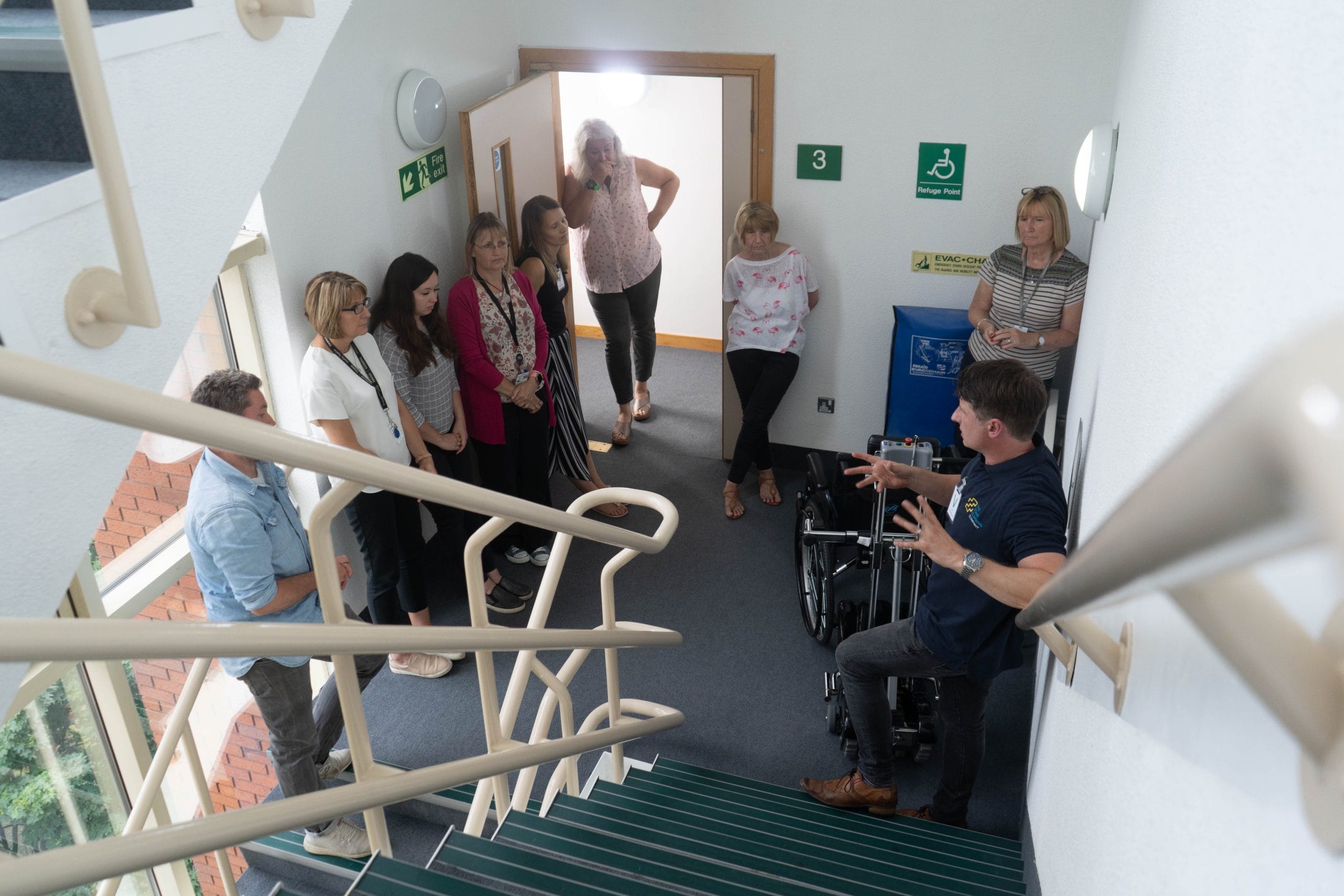
Powered Stair Climbers for Workplace Access: Removing Barriers Without Major Building Work
Powered Stair Climbers for Workplace Access: Removing Barriers Without Major Building Work Need to improve wheelchair access in your workplace? …

Providing safe and inclusive access in heritage and historic buildings is one of the biggest challenges facing facilities managers today. Many of these buildings were constructed long before accessibility standards existed, making retrofitting lifts complex, costly, and often restricted. As a result, stair climbers and stairclimbers have become a leading lift alternative for improving access while protecting the integrity of historic spaces.
Heritage buildings present unique limitations. Listed status, structural constraints, and preservation requirements can prevent major alterations such as lift installation. Staircases may be narrow, steep, or irregular, further complicating accessibility solutions.
Historic England advises that any modifications should be sensitive and reversible to preserve the building’s character.
https://historicengland.org.uk/advice/your-home/owning-historic-property/accessibility/
This makes heritage building stair climbers and historic building stair climbers an ideal option, as they provide access without permanent structural changes.
Stair climbers are portable mobility devices designed to transport people or goods up and down stairs safely. They are widely used across facilities management, healthcare, and public buildings.
Common types include:
Unlike fixed lifts, stair climbers require no installation and can be used as needed.
Installing a lift in a heritage building is not always feasible. Structural work can be intrusive, expensive, and subject to planning restrictions.
The Royal Institute of British Architects recommends that accessibility improvements in historic buildings should minimise physical impact.
https://www.architecture.com/knowledge-and-resources/resources-landing-page/designing-for-accessibility
Stair climbers and stairclimbers provide a practical lift alternative because they:
This makes them particularly valuable for facilities teams managing complex or protected environments.
One of the primary advantages of historic building stair climbers is that they preserve original features. There is no need to alter walls, floors, or staircases, ensuring the building remains unchanged.
Lift installations can involve high capital expenditure and ongoing maintenance. Stair climbers offer a more affordable solution with lower lifecycle costs.
Portable stair climbers can be used in multiple locations and across different buildings. This is especially beneficial for organisations managing estates with several heritage properties.
Accessibility improvements can be made quickly, without the delays associated with construction or approvals.
Museums often operate within listed buildings where structural changes are limited. Stair climbers enable visitors with mobility needs to access more areas safely.
The Museums Association promotes inclusive access across cultural spaces.
https://www.museumsassociation.org/campaigns/accessibility-and-inclusion/
Churches and historic religious buildings frequently have restricted layouts. Stair climbers provide a respectful and non intrusive solution.
Universities and schools located in historic properties must meet accessibility standards. Stair climbers help achieve compliance without extensive renovation.
Hotels and event venues benefit from improved accessibility, enhancing customer experience while maintaining architectural appeal.
Under the Equality Act 2010, organisations must make reasonable adjustments to ensure accessibility for all users.
The Equality and Human Rights Commission outlines these responsibilities clearly.
https://www.equalityhumanrights.com/en/advice-and-guidance/reasonable-adjustments
Stair climbers and stairclimbers support compliance by offering a safe and practical solution where lifts are not possible.
It is essential that staff are properly trained and equipment is regularly maintained to ensure safe operation.
Selecting the correct stair climber depends on several factors:
Working with trusted suppliers ensures the solution is suitable for both the building and its users.
The British Healthcare Trades Association provides guidance on reliable equipment providers.
https://www.bhta.com/
As accessibility expectations increase, facilities managers must adopt solutions that are both effective and sensitive to historic environments.
Heritage building stair climbers and historic building stair climbers are becoming essential tools because they:
They allow buildings to remain true to their history while meeting modern accessibility needs.
Stair climbers are redefining accessibility in facilities and heritage buildings. They provide a practical, cost effective, and non invasive lift alternative that supports both compliance and conservation.
For facilities managers, stair climbers and stairclimbers offer a way to improve access without compromising the character of historic spaces.
Investing in the right solution ensures that heritage buildings remain inclusive, functional, and protected for future generations.
Powered Stair Climbers for Workplace Access: Removing Barriers Without Major Building Work Need to improve wheelchair access in your workplace? …

Powered Stair Climbers for Wheelchair Access: A Flexible Way to Overcome Stairs Need to create wheelchair access where stairs are …

Part M Stair Climbers for London Buildings: Accessible Retrofit Without Major Structural Change Improving accessibility in an existing London building? …

Part M Stair Climbers for Retrofit Buildings: Creating Accessible Buildings Without Major Structural Change Retrofitting an existing building and struggling …
Part M Stair Climbers for London Retrofit Buildings: Practical Access in Constrained Spaces Discuss a London Access Assessment Retrofitting a …

Part M Stair Climber Access: Creating More Inclusive Buildings Without Losing Flexibility Creating an accessible building is rarely about a …
Estimated reading time: 5 minutes