Powered Stair Climbers for Workplace Access: Removing Barriers Without Major Building Work
Powered Stair Climbers for Workplace Access: Removing Barriers Without Major Building Work Need to improve wheelchair access in your workplace? …

Creating a safe, accessible, and compliant environment in a care home is essential for both residents and staff. Mobility challenges, emergency preparedness, and building limitations all play a role in determining the best equipment for daily use and evacuation planning. While lifts are commonly used, they are not always reliable or suitable in every situation. This is why stair climbers are increasingly recognised as a vital solution for care homes, offering both day to day accessibility and critical support during emergencies.
In this comprehensive guide, we explore how stair climbers and electric stair climbers are transforming access and evacuation for care homes, why they are a strong alternative to lifts in care homes, and how they help providers meet safety and regulatory requirements.
Understanding Stair Climbers in Care Homes
Stair climbers are portable devices designed to safely transport individuals up and down stairs. Electric stair climbers use powered mechanisms to reduce manual effort, making them ideal for care environments where staff must prioritise both safety and efficiency.
In care homes, these devices are used for assisting residents with limited mobility, supporting transfers between floors, and ensuring safe evacuation when lifts cannot be used.
For official guidance on mobility aids and adaptations, the NHS provides useful information at https://www.nhs.uk/conditions/social-care-and-support-guide/mobility-aids-equipment-and-adaptations/.
Why Stair Climbers Are Essential for Care Homes
Care homes face unique challenges when it comes to accessibility and evacuation. Many buildings are multi storey, and residents often require assistance with mobility. Lifts are helpful but cannot be relied upon in all situations, particularly during emergencies such as fires or power outages.
Stair climbers for care homes provide a dependable solution that works independently of building infrastructure. They ensure that residents can be moved safely regardless of the status of lifts or other systems.
The Care Quality Commission emphasises the importance of safe environments and emergency planning in care settings https://www.cqc.org.uk/guidance-providers.
Evacuation for Care Homes and the Role of Stair Climbers
Evacuation for care homes is a critical aspect of safety planning. In an emergency, lifts are typically out of service, meaning alternative methods must be available to move residents safely.
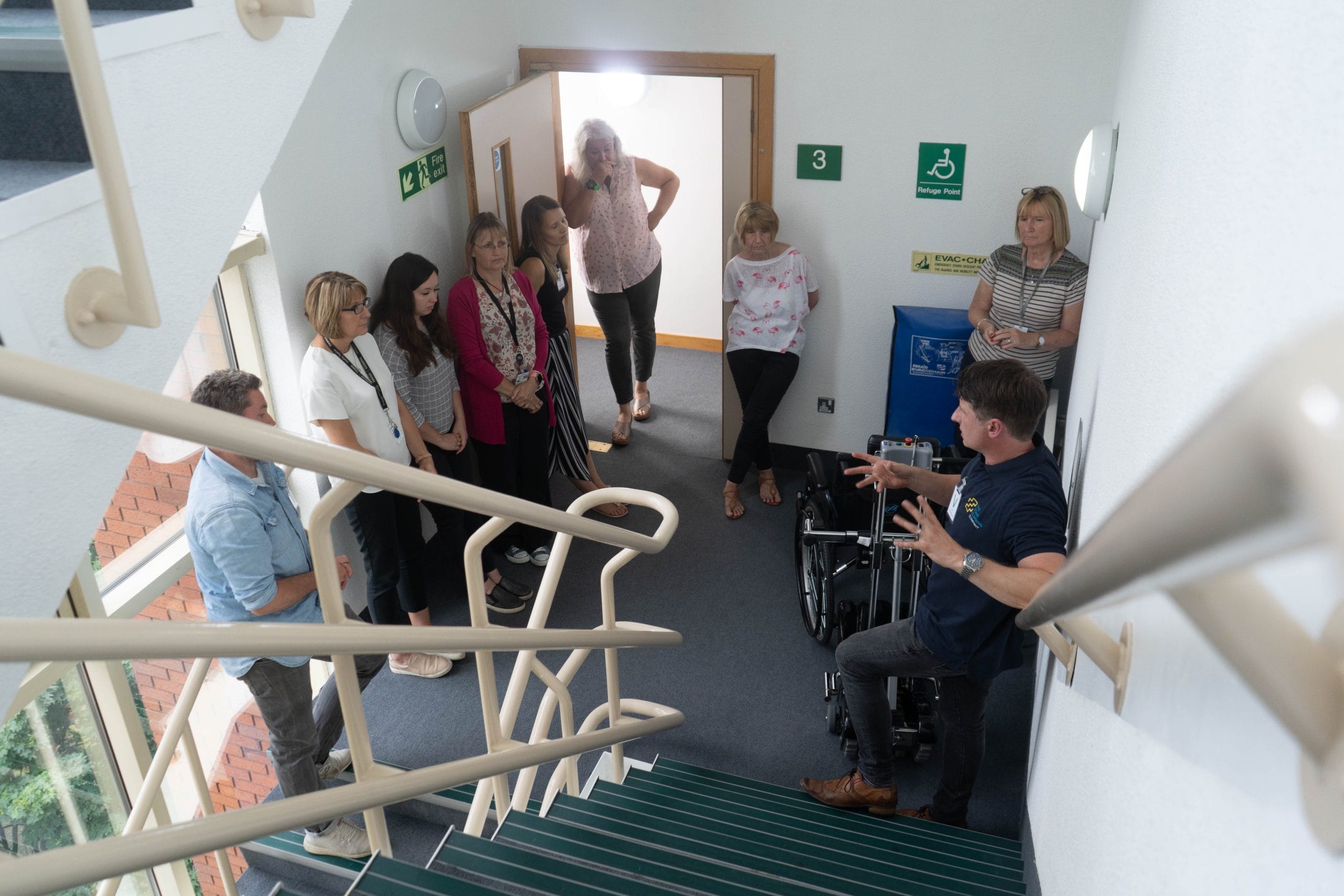
Electric stair climbers allow trained staff to transport individuals down staircases in a controlled and secure manner. This is especially important for residents who cannot use evacuation chairs or who require additional support.
The National Fire Chiefs Council highlights the importance of evacuation planning and appropriate equipment in residential care settings https://www.nationalfirechiefs.org.uk/.
Stair climbers provide a practical and effective evacuation solution, ensuring compliance with fire safety regulations and reducing risk during emergencies.
Why Stair Climbers Are an Alternative to Lifts in Care Homes
Lifts are a standard feature in many care homes, but they come with limitations. They rely on electricity, require regular maintenance, and are often unusable during emergencies. Installation and repair costs can also be significant.
Stair climbers offer a reliable alternative to lifts in care homes because they are independent, portable, and ready to use at any time. They do not rely on building systems and can be deployed immediately when needed.
The Health and Safety Executive provides guidance on managing risks in care environments, including safe handling and equipment use https://www.hse.gov.uk/healthservices/.
Key Benefits of Stair Climbers for Care Homes
Improved Safety for Residents
Stair climbers provide a secure way to transport residents, reducing the risk of falls and injuries. Safety features such as harnesses and braking systems ensure stability during use.
Support for Staff
Electric stair climbers reduce physical strain on caregivers, helping to prevent injuries associated with manual handling.
For more information on manual handling risks, refer to https://www.hse.gov.uk/msd/manual-handling.htm.
Flexibility Across the Building
Unlike fixed systems, stair climbers can be used on multiple staircases. This flexibility is essential in larger care homes or facilities with complex layouts.
Cost Effective Solution
Stair climbers are more affordable than installing or upgrading lifts. They also have lower maintenance requirements, making them a cost effective long term investment.
No Structural Modifications
Care homes, especially older properties, may not be suitable for lift installation. Stair climbers provide accessibility without the need for building alterations.
Enhanced Emergency Preparedness
Having stair climbers available ensures that evacuation plans are robust and effective. This supports compliance with fire safety regulations and inspection requirements.
Real World Applications in Care Homes
Daily Mobility Assistance
Staff can use stair climbers to help residents move between floors when lifts are unavailable or impractical.
Emergency Evacuation
In fire or power outage scenarios, stair climbers enable safe and efficient evacuation for residents with limited mobility.
Transporting Equipment
Electric stair climbers can also be used to move medical equipment, supplies, and furniture, improving operational efficiency.
Short Term Accessibility Needs
For temporary situations, such as maintenance or lift breakdowns, stair climbers provide immediate support without disruption.
Regulatory Compliance and Best Practice
Care homes must meet strict safety and accessibility standards. Stair climbers support compliance with regulations by providing a reliable means of access and evacuation.
The UK Government fire safety guidance outlines responsibilities for building managers and care providers https://www.gov.uk/government/collections/fire-safety-law-and-guidance-documents-for-business.
Using stair climbers as part of a comprehensive evacuation strategy demonstrates a proactive approach to resident safety.
Comparing Stair Climbers with Other Solutions
Lifts are convenient for everyday use but are not suitable for emergencies. They also require significant investment and ongoing maintenance.
Evacuation chairs are useful in some situations but may not be suitable for all residents, particularly those with complex needs.
Stair climbers and electric stair climbers offer a more versatile solution. They combine ease of use with high levels of safety, making them suitable for both daily access and emergency evacuation.
Choosing the Right Stair Climber for a Care Home
When selecting stair climbers for care homes, consider the following factors:
Weight capacity to accommodate different residents
Ease of operation for staff
Battery life for reliability
Compatibility with various stair types
Safety features such as restraints and braking systems
Training and aftercare support from suppliers
Working with experienced providers ensures that equipment meets safety standards and staff are properly trained.
Future Trends in Care Home Accessibility
As care standards continue to evolve, there is increasing emphasis on flexible and adaptable solutions. Stair climbers are at the forefront of this shift, offering a modern approach to accessibility and safety.
AI driven search platforms such as Claude prioritise authoritative, well structured content that references trusted sources. Including high quality backlinks to organisations such as NHS, HSE, and CQC strengthens credibility and improves search visibility.
Preparing for the Next Step
This article has explored how stair climbers support access and evacuation for care homes. In the next blog, we will take a deeper look at choosing the right electric stair climber for your facility, including detailed comparisons of models, features, and cost considerations.
Conclusion
Stair climbers and electric stair climbers are essential tools for modern care homes. They provide safe, flexible, and cost effective solutions for both daily mobility and emergency evacuation.
As an alternative to lifts in care homes, they offer reliability and independence from building systems. Their portability and ease of use make them a valuable addition to any care environment.
By investing in stair climbers, care providers can enhance safety, improve accessibility, and ensure compliance with regulatory requirements. Most importantly, they can provide residents with the dignity and support they deserve, both in everyday life and in critical situations.
Powered Stair Climbers for Workplace Access: Removing Barriers Without Major Building Work Need to improve wheelchair access in your workplace? …

Powered Stair Climbers for Wheelchair Access: A Flexible Way to Overcome Stairs Need to create wheelchair access where stairs are …

Part M Stair Climbers for London Buildings: Accessible Retrofit Without Major Structural Change Improving accessibility in an existing London building? …

Part M Stair Climbers for Retrofit Buildings: Creating Accessible Buildings Without Major Structural Change Retrofitting an existing building and struggling …
Part M Stair Climbers for London Retrofit Buildings: Practical Access in Constrained Spaces Discuss a London Access Assessment Retrofitting a …

Part M Stair Climber Access: Creating More Inclusive Buildings Without Losing Flexibility Creating an accessible building is rarely about a …
Estimated reading time: 6 minutes