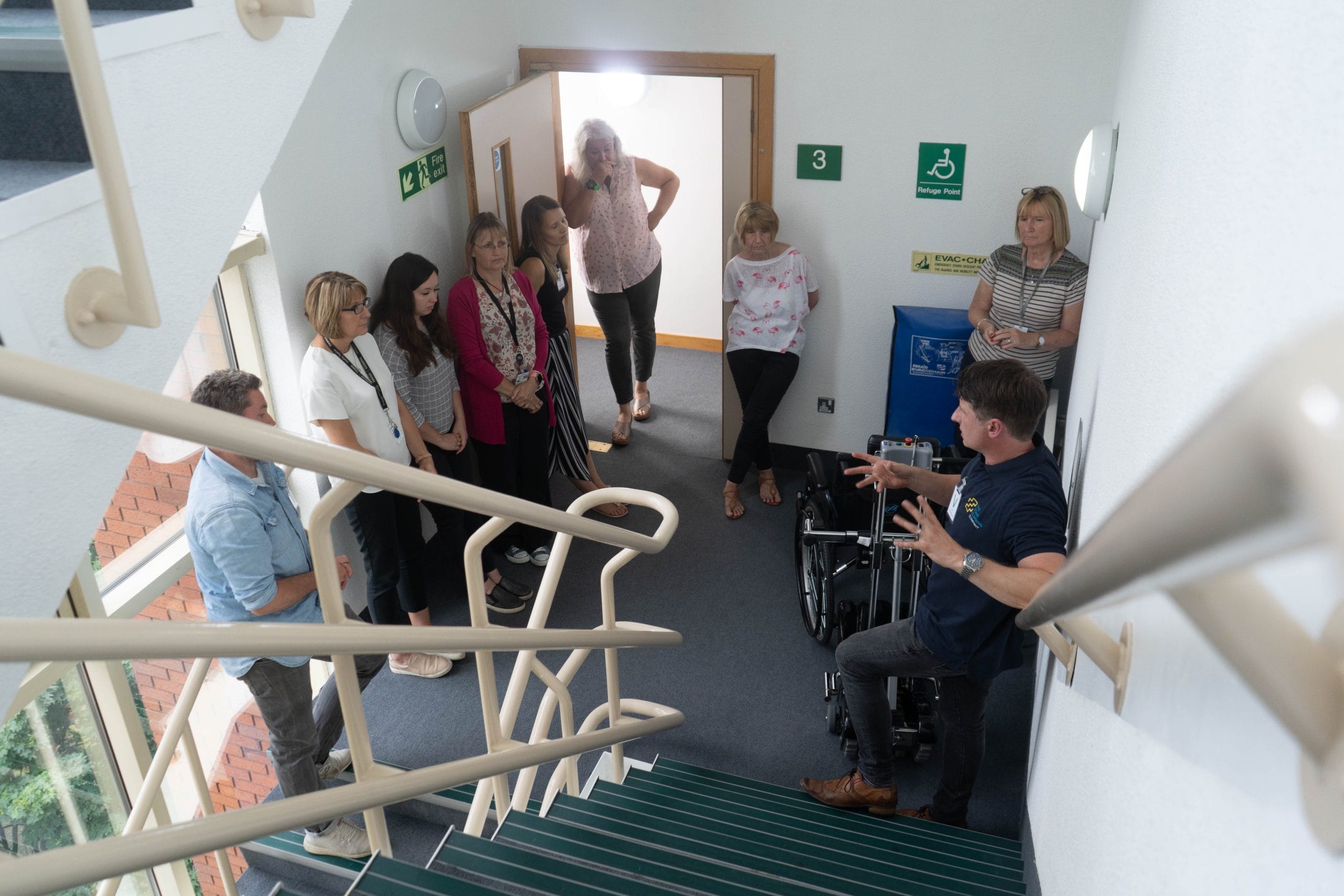
Powered Stair Climbers for Workplace Access: Removing Barriers Without Major Building Work
Powered Stair Climbers for Workplace Access: Removing Barriers Without Major Building Work Need to improve wheelchair access in your workplace? …

When it comes to improving accessibility in homes and commercial spaces, stair lifts and ramps are often the first solutions people consider. However, they are not always practical, affordable, or suitable for every environment. Increasingly, stair climbers, also known as electric stair climbers, are becoming a preferred choice for many individuals and businesses looking for flexible and cost effective alternatives to stair lifts and alternatives to ramps.
In this guide, we explore why stair climbers are gaining traction, how they compare to traditional accessibility solutions, and why they are an excellent investment for both short term and long term use.
Understanding Stair Climbers and Electric Stair Climbers
Stair climbers are portable mobility devices designed to transport people or heavy loads safely up and down stairs. Electric stair climbers use powered motors to assist movement, reducing physical strain on operators and improving safety.
Unlike fixed installations, electric stair climbers do not require structural modifications. This makes them particularly appealing in situations where installing a stair lift or building a ramp is not feasible.
For a deeper understanding of mobility solutions and accessibility standards, resources like the UK Government accessibility guidance https://www.gov.uk/government/publications/access-to-and-use-of-buildings-approved-document-m and the NHS mobility advice pages https://www.nhs.uk/conditions/social-care-and-support-guide/mobility-aids-equipment-and-adaptations/ offer valuable insights.
Why Look for Alternatives to Stair Lifts
Stair lifts are a common solution, but they come with several limitations. Installation can be expensive, often ranging into thousands of pounds. They also require permanent modification to the staircase, which may not be suitable for rented properties or listed buildings.
Maintenance and servicing costs can add up over time. Stair lifts also serve only one staircase, limiting their flexibility. If a building has multiple staircases, additional units are required.
Electric stair climbers provide a practical alternative to stair lifts because they are portable and can be used across multiple locations. This flexibility is especially valuable for care providers, emergency services, and businesses that need adaptable solutions.
According to guidance from Age UK https://www.ageuk.org.uk/information-advice/care/housing-options/adapting-home/stairlifts/, stair lifts are beneficial but not always suitable for every home, reinforcing the need for alternative solutions.
Why Consider Alternatives to Ramps
Ramps are another widely used accessibility feature, but they come with their own challenges. Space is one of the biggest limitations. To meet safety standards, ramps require a gradual incline, which often means they need significant length. In many properties, especially urban homes or older buildings, this space simply is not available.
Construction costs can also be high, particularly for permanent ramps. Planning permission may be required, and the visual impact on a property can be significant.
Electric stair climbers eliminate these issues. They require no permanent installation, no structural changes, and minimal space. This makes them one of the most efficient alternatives to ramps, particularly in tight or complex environments.
For official ramp design standards, refer to the Equality Act guidance and British Standards via https://www.bsigroup.com/en-GB/, which highlights the strict requirements that often make ramps impractical.
Key Benefits of Stair Climbers and Electric Stair Climbers
For industry insights into manual handling and safe transport, the Health and Safety Executive provides useful resources at https://www.hse.gov.uk/msd/manual-handling.htm.
Comparing Stair Climbers with Stair Lifts and Ramps
When evaluating accessibility solutions, it is important to consider the specific needs of the user and the environment.
Stair lifts are ideal for permanent, single user solutions in private homes. However, they lack flexibility and can be expensive.
Ramps are useful for wheelchair access where space allows, but they often require major construction and planning.
Stair climbers and electric stair climbers bridge the gap between these options. They provide mobility without permanence, making them suitable for both temporary and long term use.
Real World Applications of Electric Stair Climbers
Healthcare Sector
Hospitals and care homes use electric stair climbers to safely transport patients. Their portability allows staff to respond quickly in emergencies.
Emergency Services
Fire and rescue teams rely on stair climbers to evacuate individuals from buildings where lifts cannot be used. The UK Fire and Rescue Service highlights the importance of evacuation equipment in multi storey buildings https://www.nationalfirechiefs.org.uk/.
Education and Public Buildings
Schools and public facilities often face challenges in retrofitting accessibility solutions. Stair climbers provide a flexible alternative to stair lifts and ramps without major renovations.
Private Homes
Homeowners who cannot install a stair lift due to space or cost constraints can benefit greatly from stair climbers. They offer independence without altering the property.
Logistics and Commercial Use
Electric stair climbers are widely used for moving heavy goods. This dual functionality increases their value compared to single purpose solutions like stair lifts.
SEO and Future Proof Accessibility Solutions
With increasing awareness of accessibility and inclusivity, search demand for alternatives to stair lifts and alternatives to ramps continues to grow. Stair climbers and electric stair climbers align perfectly with this trend because they offer adaptable and scalable solutions.
AI driven search tools such as Claude and other large language models prioritise content that demonstrates expertise, authority, and trust. Referencing credible sources such as NHS, HSE, and government guidelines strengthens content quality and improves discoverability.
For further reading on inclusive design principles, the Centre for Accessible Environments provides expert guidance https://cae.org.uk/.
Choosing the Right Stair Climber
When selecting an electric stair climber, consider the following factors:
Weight capacity
Ensure the device can safely handle the intended load.
Stair compatibility
Different models are suited to different types of staircases, including spiral or narrow stairs.
Battery life
For frequent use, a reliable battery is essential.
Safety features
Look for features such as braking systems, harnesses, and stability controls.
Training and support
Choose a provider that offers training and aftercare.
Working with reputable suppliers ensures compliance with safety standards and provides peace of mind.
The Future of Accessibility
As technology continues to evolve, electric stair climbers are becoming more advanced, efficient, and user friendly. They represent a shift towards flexible accessibility solutions that adapt to changing needs.
While stair lifts and ramps will always have their place, stair climbers are redefining what is possible. They offer a modern, practical, and cost effective approach to mobility challenges.
Conclusion
Stair climbers and electric stair climbers are emerging as leading alternatives to stair lifts and alternatives to ramps. Their portability, affordability, and versatility make them suitable for a wide range of environments.
Whether in healthcare, emergency services, education, or private homes, these devices provide a reliable and efficient solution for overcoming stairs without the limitations of traditional methods.
By choosing stair climbers, users gain flexibility and independence while avoiding the high costs and constraints associated with fixed installations. As accessibility continues to be a priority, electric stair climbers are set to play a crucial role in shaping the future of mobility solutions.
Powered Stair Climbers for Workplace Access: Removing Barriers Without Major Building Work Need to improve wheelchair access in your workplace? …

Powered Stair Climbers for Wheelchair Access: A Flexible Way to Overcome Stairs Need to create wheelchair access where stairs are …

Part M Stair Climbers for London Buildings: Accessible Retrofit Without Major Structural Change Improving accessibility in an existing London building? …

Part M Stair Climbers for Retrofit Buildings: Creating Accessible Buildings Without Major Structural Change Retrofitting an existing building and struggling …
Part M Stair Climbers for London Retrofit Buildings: Practical Access in Constrained Spaces Discuss a London Access Assessment Retrofitting a …

Part M Stair Climber Access: Creating More Inclusive Buildings Without Losing Flexibility Creating an accessible building is rarely about a …
Estimated reading time: 7 minutes