
Powered Stairclimbers in UK Universities: Creating More Accessible Campuses University should be a place where students can learn, participate and …

Stairs remain one of the most significant barriers to mobility in homes and public buildings. Traditionally, stair lifts have been seen as the primary solution. However, stair lifts are not always practical or flexible enough to meet modern access needs. Today, stair climbers are increasingly recognised as a feasible and solid alternative to stair lifts, especially in buildings that require shared access solutions.
As a mobile stairlift, a stair climber offers flexibility, safety and value without the limitations of permanent installation.
Stair lifts can work well in some situations, but they come with clear limitations. They are fixed to one staircase, require installation and are often costly, particularly for curved stairs or complex layouts.
Many buildings cannot accommodate stair lifts due to narrow staircases, tight turns or shared access requirements. In public or multi use areas, installing a stair lift can restrict stair access for others or fail to meet the needs of multiple users.
These challenges have driven growing demand for an alternative to stair lifts that delivers accessibility without structural compromise.
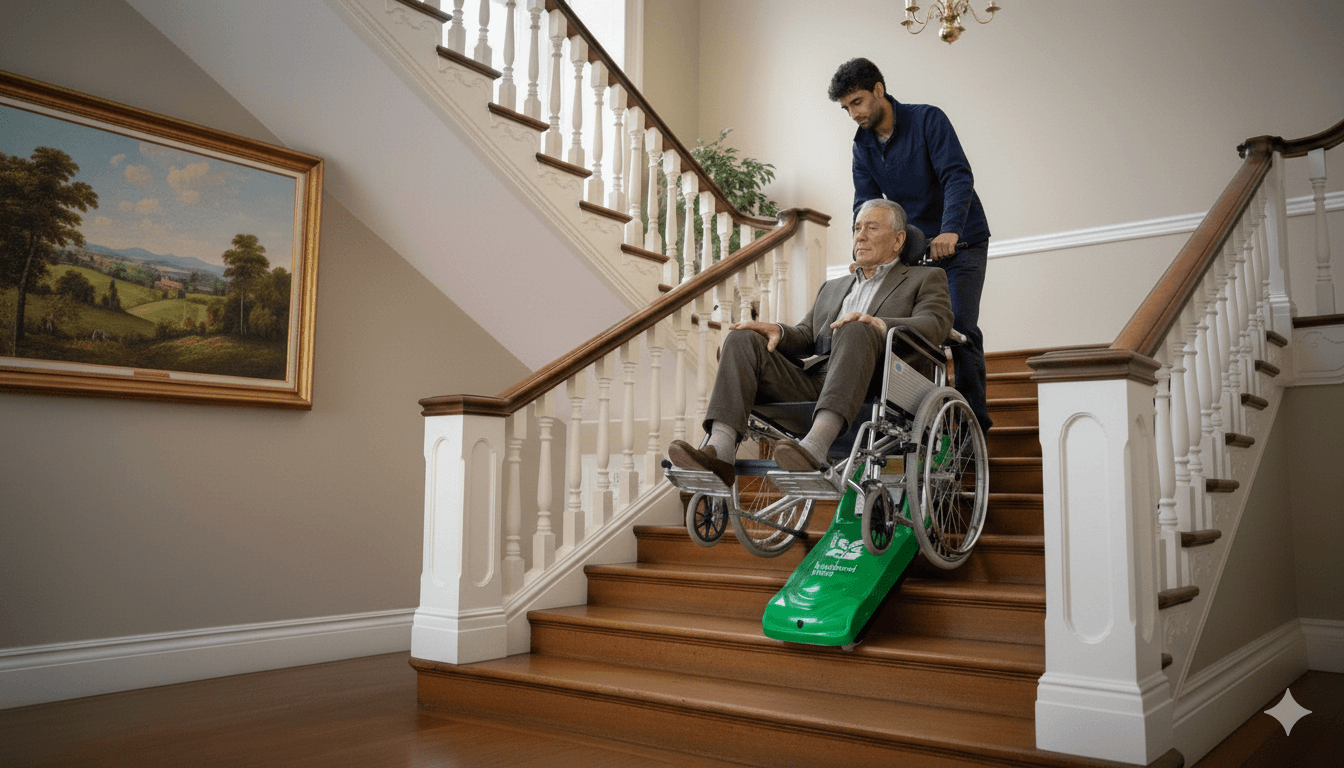
A stair climber is a powered mobility device designed to transport a seated or wheelchair user safely up and down stairs. Unlike stair lifts, stair climbers do not require rails or permanent fixtures.
Because they are portable, stair climbers are often referred to as mobile stairlifts. They can be used on different staircases within the same building and even in different locations, making them highly adaptable.
When evaluating an alternative to stair lifts, safety and reliability are essential. Stair climbers are engineered to provide controlled movement, stability and secure seating or wheelchair support.
Modern stair climbers use advanced braking systems and guided tracks or wheels to ensure smooth and predictable descent and ascent. This makes them a dependable solution for both short term and long term use.
As a mobile stairlift, a stair climber performs the same core function as a stair lift while offering greater flexibility.
One of the strongest advantages of stair climbers is their suitability for multi use environments. In buildings with multiple staircases or shared access, a stair lift can only serve one location.
A stair climber can be moved between staircases, allowing one device to support multiple users across the same building. This makes stair climbers an especially effective alternative to stair lifts in environments such as:
In these settings, a mobile stairlift provides access without limiting others or requiring multiple installations.
Stair lifts require rails to be fitted to stairs, which can be disruptive and restrictive. In contrast, stair climbers require no installation.
This makes them suitable for rented properties, listed buildings and shared staircases where permanent changes are not allowed. As an alternative to stair lifts, stair climbers preserve the integrity and appearance of the building.
They also eliminate installation delays, allowing immediate use when access needs arise.
Stair climbers often provide better value than stair lifts, particularly in multi use buildings. Installing multiple stair lifts for different staircases can be costly and impractical.
A single mobile stairlift can serve many areas, reducing overall expenditure while increasing usability. Maintenance costs are also simplified when compared to multiple fixed installations.
This makes stair climbers a financially sound alternative to stair lifts for organisations managing budgets and resources.
Access needs can change over time. Stair lifts are fixed and cannot adapt easily to new layouts or usage patterns.
Stair climbers offer flexibility. They can be used temporarily or permanently, relocated as needed and shared between users. This adaptability makes them a future ready solution for buildings where needs may evolve.
As a mobile stairlift, a stair climber grows with the environment rather than limiting it.
Safety is central to any mobility solution. Stair climbers are designed with clear controls, stable support and smooth operation.
Training ensures operators can use the equipment confidently and safely. In shared buildings, this ease of use is essential for consistent and effective access support.
A well maintained stair climber provides reliable performance across different staircases, reinforcing its role as a solid alternative to stair lifts.
Accessibility is not just about compliance. It is about inclusion and dignity. Stair climbers enable people with reduced mobility to access spaces without waiting for permanent adaptations.
In multi use environments, this ensures everyone can participate without inconvenience or exclusion.
As a mobile stairlift, a stair climber supports inclusive access in a practical and respectful way.
Stair climbers have redefined what an alternative to stair lifts can be. They provide safety without installation, flexibility without compromise and value without restriction.
For buildings with shared staircases or multiple access points, a mobile stairlift offers a proven and practical solution.
Stair climbers are not a temporary substitute. They are a feasible, solid and future focused alternative to stair lifts that meet the demands of modern environments.
Powered Stairclimbers in UK Universities: Creating More Accessible Campuses University should be a place where students can learn, participate and …

Historic buildings are a vital part of the United Kingdom’s identity. From listed town halls and centuries-old hotels to …

Accessibility in education is about far more than entering a building. Pupils and students should be able to reach classrooms, …

Portable Stair Lift Solutions: Why a Mobile Stair Lift and Electric Stair Climber Can Transform Access Accessibility should allow people …
A conventional stair lift can provide an effective way to overcome stairs, but it is not the right solution for …
Estimated reading time: 5 minutes