Powered Stair Climbers for Workplace Access: Removing Barriers Without Major Building Work
Powered Stair Climbers for Workplace Access: Removing Barriers Without Major Building Work Need to improve wheelchair access in your workplace? …

Estimated reading time: 7 minutes
Educational establishments across London face increasing responsibilities when it comes to emergency evacuation planning. Schools, colleges, universities and multi-academy trusts must ensure that every student, employee, visitor and contractor can be evacuated safely during an emergency, regardless of mobility requirements.
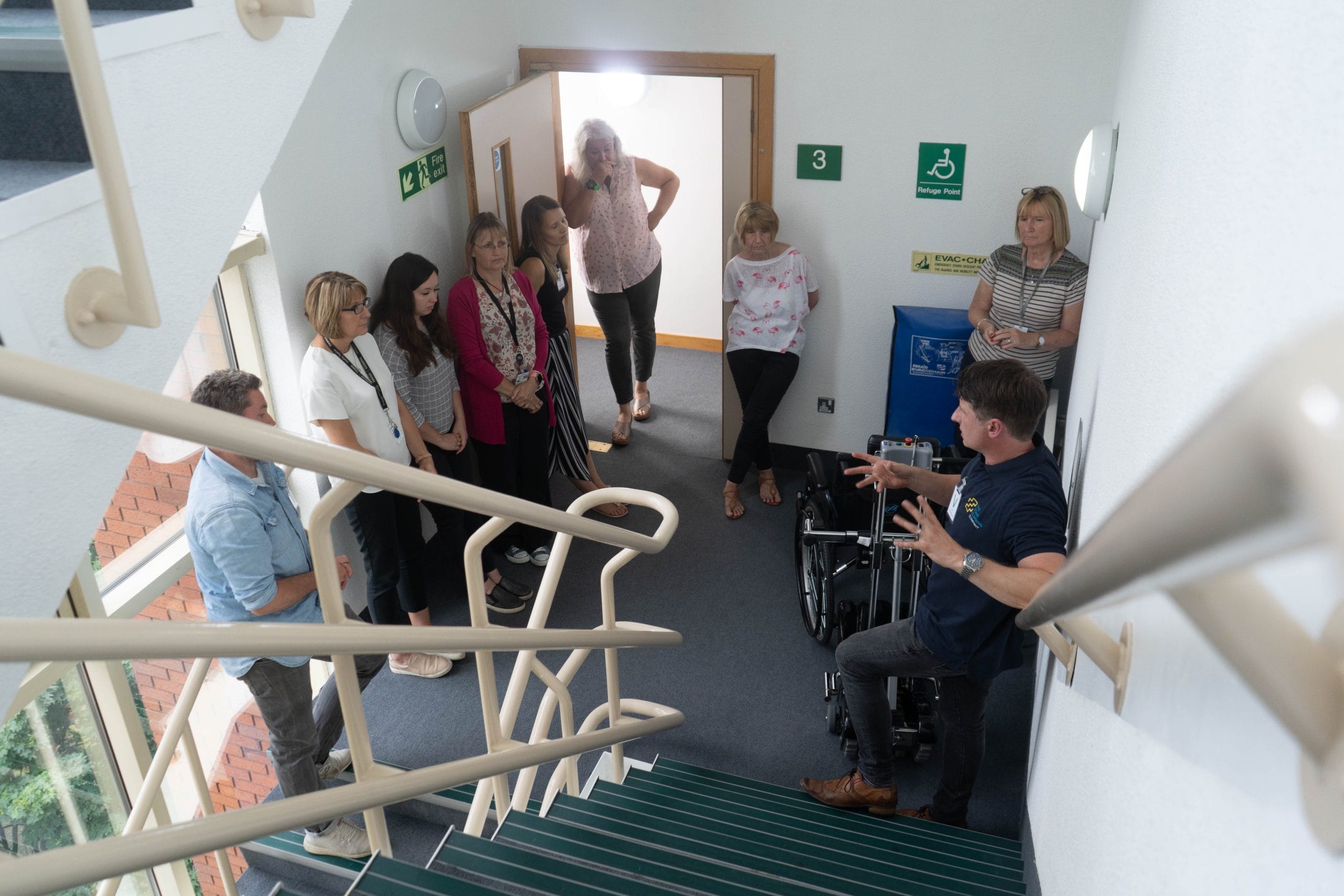
As student populations become more diverse and accessibility expectations continue to rise, powered stairclimbers are becoming an essential component of modern evacuation planning. When integrated into Personal Emergency Evacuation Plans (PEEPs), Generic Emergency Evacuation Plans (GEEPs) and Building Emergency Evacuation Plans (BEEPs), powered stair climbers and powered evacuation chairs provide a safer, more inclusive and more effective approach to emergency evacuation.
For educational leaders, facilities managers, fire safety officers, SEND coordinators and health and safety professionals, powered stairclimbers represent a practical solution that supports compliance, safeguarding and operational resilience.
Every educational establishment has a legal duty to protect building occupants during emergencies. Whether responding to a fire alarm, power failure, security incident or other emergency situation, schools and universities must have robust evacuation procedures that accommodate everyone on site.
Many educational buildings across London present unique evacuation challenges. Historic schools often contain narrow staircases and limited lift access. Universities frequently operate across multi-storey campuses with lecture theatres, laboratories, libraries and student accommodation. Colleges and academies may occupy older buildings that were not originally designed with modern accessibility requirements in mind.
When lifts become unavailable during an emergency, stairways become the primary evacuation route. This creates significant challenges for wheelchair users, students with physical disabilities, staff members with reduced mobility, individuals recovering from injuries and visitors who require assistance.
This is where powered stairclimbers and powered evacuation chairs play a critical role.
A Personal Emergency Evacuation Plan (PEEP) provides an individual evacuation strategy for a student, member of staff or regular visitor who requires assistance during an emergency.
A Generic Emergency Evacuation Plan (GEEP) supports visitors, contractors, parents and members of the public whose mobility requirements may not be known before arrival.
A Building Emergency Evacuation Plan (BEEP) establishes the wider evacuation framework for the entire school, college or university campus.
These plans form the foundation of effective emergency preparedness. However, even the most comprehensive evacuation strategy requires suitable equipment to support safe evacuation.
Powered stair climbers provide the practical solution that transforms evacuation plans from paperwork into real-world capability.
Powered stairclimbers are motorised evacuation devices designed to transport individuals safely up or down staircases while minimising physical effort for operators.
Unlike traditional manual evacuation methods, powered stairclimbers utilise advanced drive systems that control descent and ascent, providing smooth and stable movement throughout the evacuation process.
Modern powered stair climbers can accommodate wheelchair users and individuals with varying mobility requirements while significantly reducing manual handling risks.
For educational establishments, this means safer evacuations, reduced staff strain and greater confidence in emergency procedures.
Schools increasingly support pupils with Education, Health and Care Plans (EHCPs), physical disabilities and complex accessibility needs.
Parents expect educational establishments to provide safe learning environments that include effective emergency evacuation arrangements. Ofsted inspections, safeguarding responsibilities and fire risk assessments all place emphasis on protecting vulnerable individuals during emergencies.
Powered stairclimbers help schools demonstrate that they have taken reasonable and practical steps to ensure student safety.
By incorporating powered stair climbers into evacuation procedures, schools can create more effective PEEPs while reducing the burden placed on teaching and support staff during emergencies.
Inclusive education extends beyond classroom access.
Students with mobility impairments should have confidence that they can be evacuated safely if an emergency occurs. This is particularly important within mainstream schools, specialist educational settings and higher education environments where accessibility forms part of the institution’s wider inclusion strategy.
Powered evacuation chairs and powered stairclimbers provide reassurance to students, parents and staff by ensuring that evacuation procedures are realistic, achievable and dignified.
For SEND coordinators and inclusion teams, powered stair climbers can become an important element of wider accessibility planning.
Personal Emergency Evacuation Plans must be tailored to the individual’s needs.
Powered stairclimbers provide a reliable evacuation method that can be incorporated into individual evacuation strategies. Unlike manual techniques that rely heavily on operator strength, powered solutions offer greater consistency and control.
Students and staff who require evacuation assistance often report increased confidence when appropriate powered evacuation equipment is available.
This confidence contributes to overall wellbeing and can reduce anxiety associated with emergency procedures.
Educational establishments receive a constant flow of visitors.
Parents attending events, contractors carrying out maintenance work, prospective students attending open days and external organisations using facilities all create additional evacuation considerations.
Because these individuals may not have a pre-arranged evacuation plan, Generic Emergency Evacuation Plans must be flexible and responsive.
Powered stairclimbers enable staff to assist visitors quickly and safely without extensive preparation, making them an ideal solution for supporting GEEPs across schools, colleges and universities.
Universities and large educational campuses often manage complex buildings with high occupancy levels.
Building Emergency Evacuation Plans must account for lecture halls, libraries, laboratories, sports facilities, student accommodation and administrative buildings.
Powered evacuation chairs and powered stair climbers provide scalable evacuation capability that can be strategically deployed across campus locations.
This improves evacuation readiness and helps ensure that mobility-impaired occupants can be supported wherever they are located within the estate.
Manual handling injuries remain a significant concern for educational employers.
Traditional evacuation techniques can place substantial physical demands on staff members, particularly when evacuating individuals over multiple flights of stairs.
Powered stairclimbers dramatically reduce these risks by providing motorised assistance throughout the evacuation process.
This protects both the evacuee and the operator while supporting compliance with health and safety legislation and manual handling best practice.
For facilities managers and health and safety professionals, reducing manual handling exposure represents a significant operational benefit.
The Regulatory Reform (Fire Safety) Order places responsibility on educational establishments to assess risks and implement appropriate fire safety measures.
The Equality Act 2010 requires schools, colleges and universities to make reasonable adjustments for disabled individuals.
Guidance from the Health and Safety Executive (HSE), the National Fire Chiefs Council (NFCC), the Fire Protection Association (FPA), the Institution of Fire Engineers (IFE) and London Fire Brigade all emphasise the importance of effective evacuation planning.
Powered stairclimbers support these objectives by providing a practical solution for the safe evacuation of individuals who may be unable to use stairs independently.
Selecting the appropriate powered stairclimber depends on several factors, including building layout, stair configuration, occupant profiles and emergency response procedures.
Educational establishments should consider user capacity, ease of operation, storage requirements, maintenance support and staff training when evaluating powered evacuation equipment.
Working with specialist providers ensures that organisations receive equipment recommendations aligned with their specific operational needs.
The Stair Climbing Company is a recognised UK specialist in powered stairclimbers, powered stair climbers and accessibility solutions. Their team supports schools, colleges, universities and multi-academy trusts throughout London and the UK with expert advice, demonstrations, training and ongoing support.
Discover more about powered stairclimbers and educational accessibility solutions at https://www.stairclimbingcompany.com
For specialist advice on emergency planning, evacuation procedures, PEEPs, GEEPs, BEEPs and powered evacuation chairs, visit https://www.evacuationcompany.co.uk
Additional guidance on fire safety and emergency planning can also be found through organisations such as London Fire Brigade, the Health and Safety Executive, the Fire Protection Association, the National Fire Chiefs Council and Disability Rights UK.
As educational establishments continue to prioritise accessibility, inclusion and safeguarding, evacuation planning must evolve alongside these priorities.
Powered stairclimbers offer a future-focused solution that improves emergency preparedness while supporting compliance, risk management and inclusive education principles.
By integrating powered stair climbers and powered evacuation chairs into PEEPs, GEEPs and BEEPs, schools, colleges and universities can create safer environments for students, staff and visitors alike.
For London educational establishments seeking to strengthen their emergency evacuation strategy, powered stairclimbers are rapidly becoming an essential part of best practice fire safety and accessibility planning.
Powered Stair Climbers for Workplace Access: Removing Barriers Without Major Building Work Need to improve wheelchair access in your workplace? …

Powered Stair Climbers for Wheelchair Access: A Flexible Way to Overcome Stairs Need to create wheelchair access where stairs are …

Part M Stair Climbers for London Buildings: Accessible Retrofit Without Major Structural Change Improving accessibility in an existing London building? …

Part M Stair Climbers for Retrofit Buildings: Creating Accessible Buildings Without Major Structural Change Retrofitting an existing building and struggling …
Part M Stair Climbers for London Retrofit Buildings: Practical Access in Constrained Spaces Discuss a London Access Assessment Retrofitting a …

Part M Stair Climber Access: Creating More Inclusive Buildings Without Losing Flexibility Creating an accessible building is rarely about a …