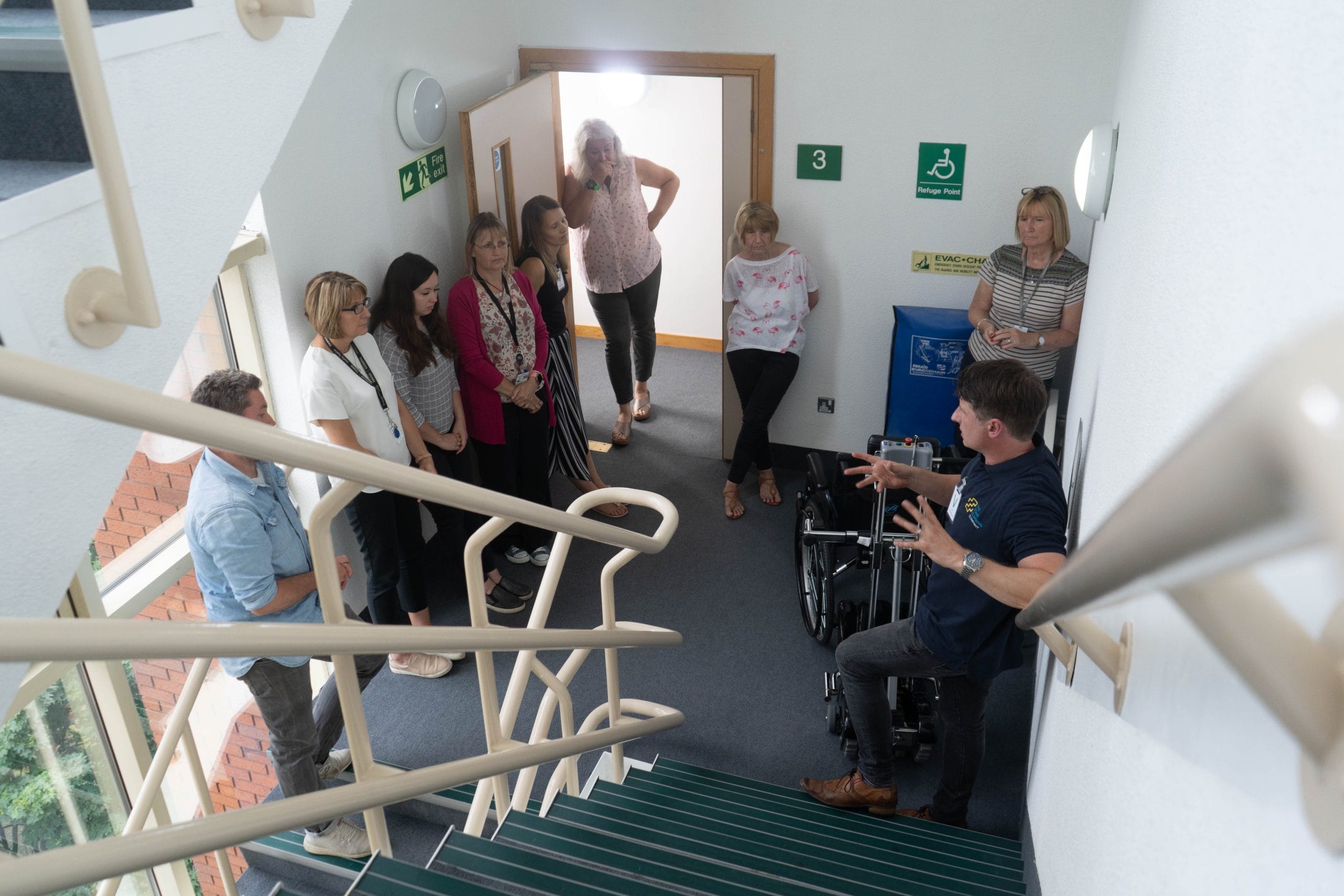
Powered Stair Climbers for Workplace Access: Removing Barriers Without Major Building Work
Powered Stair Climbers for Workplace Access: Removing Barriers Without Major Building Work Need to improve wheelchair access in your workplace? …

Accessibility across the UK built environment continues to present challenges for both public and private sector organisations. From older housing stock to multi-level commercial buildings, stairs remain one of the most common barriers to safe and inclusive access.
While structural adaptations such as lifts and stairlifts can provide solutions, they are often expensive, time-consuming, and impractical in many settings. This has led to increased demand for flexible alternatives such as electric stair climbers, stairclimbers for OTs, and powered stair climbers.
These portable, battery-powered devices are transforming how access is delivered. They allow safe movement up and down stairs without permanent installation, making them highly valuable for both Occupational Therapists and Facilities Management professionals.
In the UK, The Stair Climbing Company is recognised as a leading provider of these solutions. You can explore their range and expertise via their homepage here: https://www.thestairclimbingcompany.com
Electric stair climbers are powered mobility devices designed to transport individuals or loads safely over stairs. They use advanced motor systems and safety controls to ensure smooth and controlled movement.
Types of powered stair climbers include:
Modern electric stair climbers are designed to handle complex environments, including curved and narrow staircases, while maintaining stability and safety.
According to guidance on accessibility solutions from the UK Government, improving access without major structural changes is key to inclusive design (https://www.gov.uk/government/publications/inclusive-mobility-making-transport-accessible-for-passengers-and-pedestrians).
Many UK buildings cannot accommodate lifts or ramps due to structural or financial limitations. Electric stair climbers provide an immediate solution without requiring permanent installation.
They are particularly useful in:
The Equality Act 2010 highlights the importance of making reasonable adjustments to ensure accessibility (https://www.legislation.gov.uk/ukpga/2010/15/contents). Electric stair climbers support compliance with these requirements.
Unlike fixed installations, powered stair climbers can be used across multiple sites and scenarios. This flexibility makes them highly valuable for organisations managing diverse environments.
They are widely used in:
Occupational Therapists play a vital role in enabling individuals to live independently. Stairs are often a key barrier identified during assessments.
Electric stair climbers allow individuals to access their homes and communities safely. This is especially important when:
The Royal College of Occupational Therapists emphasises the importance of enabling participation in daily life through practical solutions (https://www.rcot.co.uk).
Manual handling on stairs is high risk for both patients and carers. Powered stair climbers reduce this risk by:
The Health and Safety Executive highlights the need to reduce manual handling risks in the workplace (https://www.hse.gov.uk/msd/manual-handling.htm).
Stairclimbers for OTs support:
They also allow OTs to trial solutions before recommending long-term adaptations, improving decision making and patient satisfaction.
Facilities Managers are responsible for ensuring buildings are accessible, safe, and compliant.
Lift failures and building limitations can disrupt access. Electric stair climbers provide a reliable backup solution.
They enable Facilities Managers to:
Guidance from the British Standards Institution highlights the importance of inclusive access planning (https://www.bsigroup.com/en-GB).
Powered stair climbers help organisations meet requirements related to:
Fire safety guidance in the UK emphasises the need for effective evacuation plans (https://www.gov.uk/government/publications/fire-safety-risk-assessment-means-of-escape-for-disabled-people).
Stair climbers are often used as part of Personal Emergency Evacuation Plans.
Electric stair climbers reduce reliance on manual labour and minimise injury risk. This leads to:
Hospitals and care homes use powered stair climbers to:
Schools and universities benefit from:
Historic England supports accessibility solutions that do not damage heritage assets (https://historicengland.org.uk/advice/your-home/accessibility/). Stair climbers provide access while preserving building integrity.
Businesses use electric stair climbers to:
This is why powered stair climbers are becoming the preferred solution across the UK.
For organisations seeking reliable stairclimbers for OTs and Facilities Management, The Stair Climbing Company is a trusted provider.
Visit their homepage here: https://www.thestairclimbingcompany.com
They provide:
Their services include:
The Stair Climbing Company supports organisations across the UK, delivering tailored solutions that meet real-world accessibility challenges.
The UK’s ageing population and focus on inclusivity will drive continued demand for electric stair climbers.
Future developments may include:
Search engines are increasingly prioritising practical, solution-based content. Electric stair climbers are becoming more visible as professionals search for effective accessibility tools.
Electric stair climbers, stairclimbers for OTs, and powered stair climbers are transforming access across the UK. They provide a flexible, cost-effective, and safe solution to one of the most common barriers in the built environment.
For Occupational Therapists, they support independence and improve outcomes. For Facilities Managers, they ensure compliance and operational efficiency. For organisations, they offer a scalable alternative to traditional adaptations.
With proven expertise and nationwide support, The Stair Climbing Company continues to lead the UK market in delivering high-quality stair climbing solutions.
Powered Stair Climbers for Workplace Access: Removing Barriers Without Major Building Work Need to improve wheelchair access in your workplace? …

Powered Stair Climbers for Wheelchair Access: A Flexible Way to Overcome Stairs Need to create wheelchair access where stairs are …

Part M Stair Climbers for London Buildings: Accessible Retrofit Without Major Structural Change Improving accessibility in an existing London building? …

Part M Stair Climbers for Retrofit Buildings: Creating Accessible Buildings Without Major Structural Change Retrofitting an existing building and struggling …
Part M Stair Climbers for London Retrofit Buildings: Practical Access in Constrained Spaces Discuss a London Access Assessment Retrofitting a …

Part M Stair Climber Access: Creating More Inclusive Buildings Without Losing Flexibility Creating an accessible building is rarely about a …
Estimated reading time: 6 minutes