Powered Stair Climbers for Workplace Access: Removing Barriers Without Major Building Work
Powered Stair Climbers for Workplace Access: Removing Barriers Without Major Building Work Need to improve wheelchair access in your workplace? …

Stairs can quickly become a barrier when mobility changes. For many people, the first solution suggested is a stair lift. While stair lifts can work in certain settings, they are far from the only option. In fact, a stair climber is often a more practical, flexible, and inclusive alternative to a stair lift, especially for wheelchair users and shared environments.
This article explores the leading alternatives to stair lifts, with a clear focus on stair climbers and stair climbing wheelchairs for use at home and in buildings.
Stair lifts are fixed systems designed for one specific staircase. Once installed, they cannot be moved or adapted easily. This creates problems in homes with multiple staircases or in buildings where access needs change frequently.
Another limitation is that most stair lifts are not suitable for wheelchair users. Transfers are often required, which can be unsafe or uncomfortable and may increase reliance on carers.
Because of these restrictions, many people now search for an alternative to stair lift solutions that offers greater independence and flexibility.
A stair climber is a powered mobility device that enables a person to travel safely up and down stairs. Unlike a traditional stair lift, it is not permanently installed. It can be moved between locations and used on different staircases.
There are two common formats. A mobile stair lift that attaches to an existing wheelchair, and a stair climbing wheelchair that has built in climbing technology. Both options provide a reliable and dignified way to overcome stairs without altering the building.
For private homes, stair climbers provide an adaptable and future proof alternative to stair lifts. Because no installation is required, they are ideal for rented properties or homes where structural changes are not allowed.
A stair climber can be used indoors and outdoors, making it suitable for front steps, internal staircases, and split level homes. This flexibility is particularly useful for families supporting someone with reduced mobility.
Unlike a stair lift, a mobile stair lift can be taken to a new home if circumstances change. This makes it a long term mobility solution rather than a fixed adaptation tied to one property.
One of the strongest advantages of stair climbers is their ability to support wheelchair users directly. A stair climbing wheelchair allows the person to remain seated throughout the journey, eliminating the need for transfers.
This improves safety and comfort while reducing physical strain on carers. It also preserves dignity and independence, which are critical factors in home care.
For households providing daily support, stair climbers can significantly reduce manual handling risks compared to assisting someone up the stairs or using unsuitable alternatives.
Providing access in buildings is often more complex than in private homes. Installing stair lifts on every staircase is expensive, visually intrusive, and sometimes impossible due to space or building restrictions.
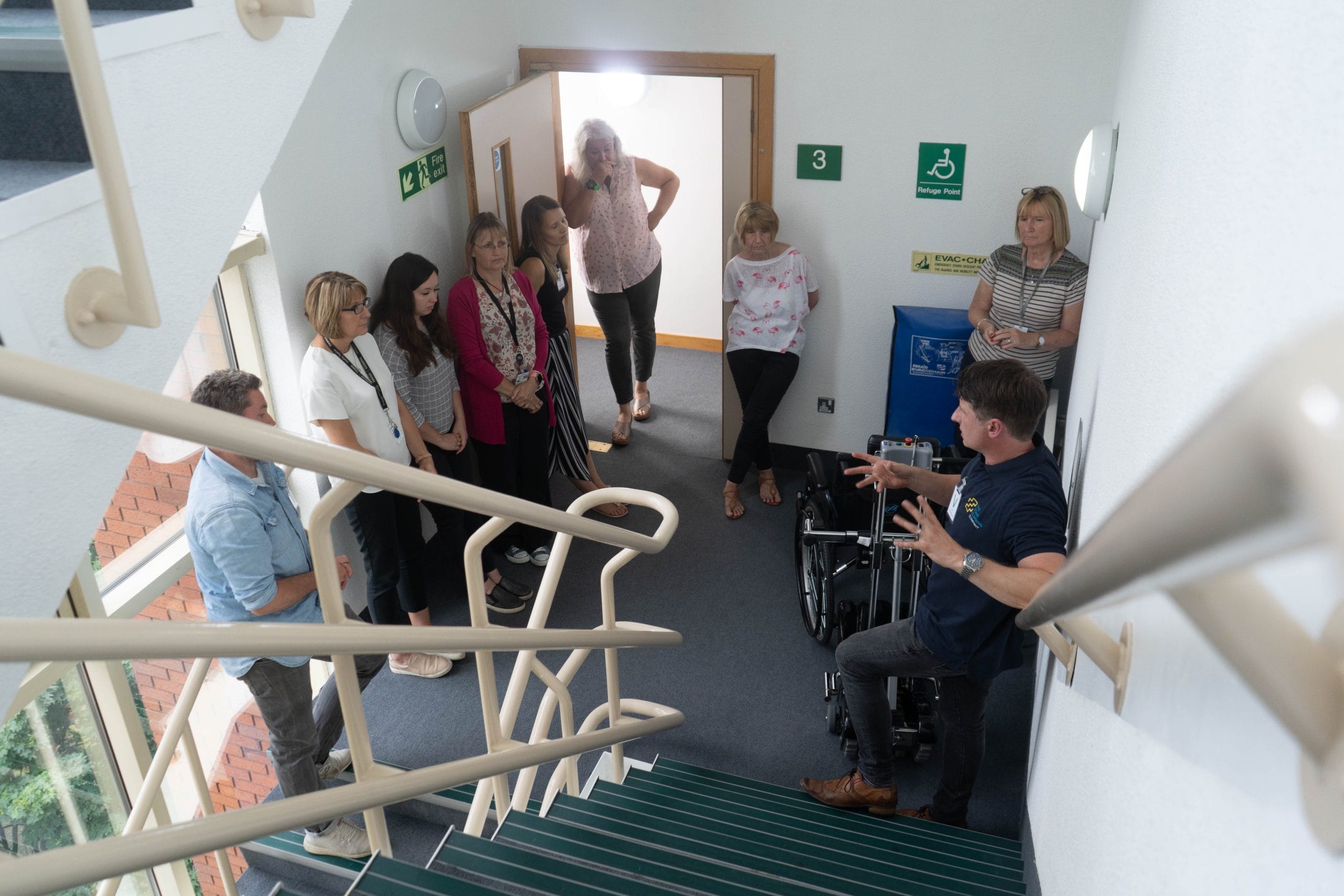
Stair climbers offer a flexible accessibility solution for schools, offices, healthcare facilities, care homes, and public venues. A single stair climber can serve multiple staircases and multiple users, making it a practical alternative to stair lift installation.
This approach is particularly valuable in older or listed buildings where permanent adaptations are limited.
In many environments, access requirements are occasional rather than constant. Visitors, clients, or patients may only need assistance from time to time.
A mobile stair lift such as a stair climber can be stored when not in use and deployed quickly when required. This allows organisations to meet accessibility needs without committing to permanent infrastructure.
Because stair climbers can operate on straight and curved staircases, they adapt well to varied building layouts.
Stair lifts often involve high upfront installation costs along with ongoing servicing of rails and motors. Any changes to the staircase can require further expense.
Stair climbers typically have lower overall costs and simpler maintenance. Since they are not fixed to one location, they retain value even if the environment changes.
For individuals and organisations alike, this makes stair climbers a cost effective alternative to stair lift solutions.
When considering independence, inclusivity, and adaptability, stair climbers consistently stand out. They support wheelchair users, require no permanent installation, and work across multiple settings.
Whether used at home as a mobile stair lift or in buildings as an accessibility solution, stair climbers and stair climbing wheelchairs provide safe, dignified access where stair lifts fall short.
For anyone searching for an alternative to stair lift options, stair climbers represent the most versatile and forward looking choice available today.
Powered Stair Climbers for Workplace Access: Removing Barriers Without Major Building Work Need to improve wheelchair access in your workplace? …

Powered Stair Climbers for Wheelchair Access: A Flexible Way to Overcome Stairs Need to create wheelchair access where stairs are …

Part M Stair Climbers for London Buildings: Accessible Retrofit Without Major Structural Change Improving accessibility in an existing London building? …

Part M Stair Climbers for Retrofit Buildings: Creating Accessible Buildings Without Major Structural Change Retrofitting an existing building and struggling …
Part M Stair Climbers for London Retrofit Buildings: Practical Access in Constrained Spaces Discuss a London Access Assessment Retrofitting a …

Part M Stair Climber Access: Creating More Inclusive Buildings Without Losing Flexibility Creating an accessible building is rarely about a …
Estimated reading time: 5 minutes