
UK Stair Climbers for Children
Bespoke and innovative designs to meet children’s needs

Book a Free Childrens Stairclimber Assessment
Working In Partnership To Create the Perfect Childrens Solutions..




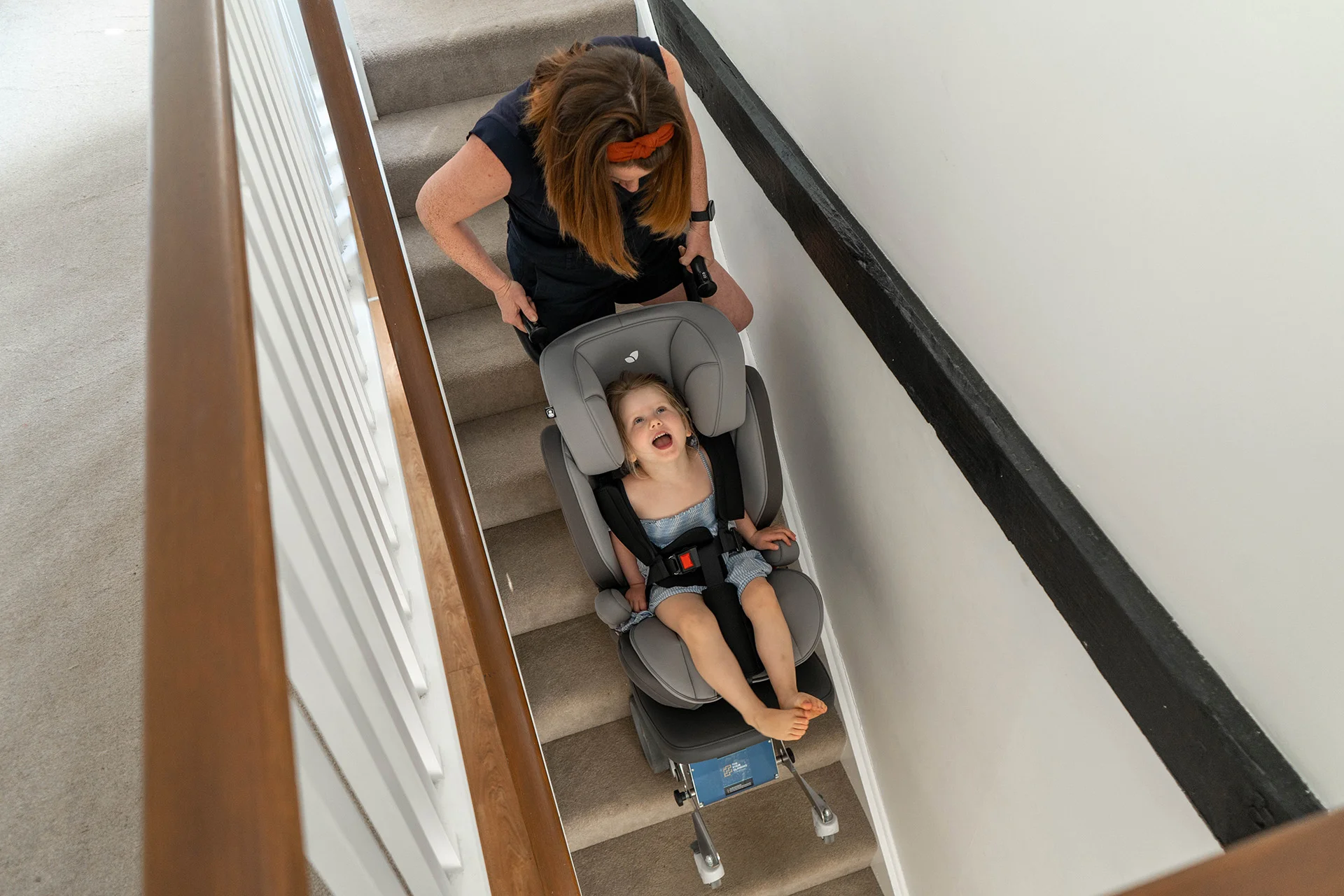
Introducing the Skyclimber Junior
The Top Choice for Occupational Therapists
The Skyclimber Junior by The Stair Climbing Company has become the leading stair climber for children in the UK. Designed with a deep understanding of paediatric needs, this stair climber combines safety, comfort and precision engineering in one compact and easy to use system. The Skyclimber Junior is not simply a resized adult product. It is a truly bespoke childrens stair climber built around the specific requirements of younger users.
OTs choose the Skyclimber Junior for its adaptability. With custom seating options, postural supports, padding and secure harnessing, each unit can be configured to match the child’s physical and sensory needs. This makes it ideal for both short term and long term use and ensures that families can rely on a childrens stairclimber solution that grows with their child.
Another major reason OTs recommend the Skyclimber Junior is its minimal footprint. Many UK homes and older school buildings have tight corners, narrow staircases and confined landings. The Skyclimber Junior handles these challenges with ease, allowing safe manoeuvring even in restricted layouts. Its intuitive controls give parents, carers and support staff complete confidence.
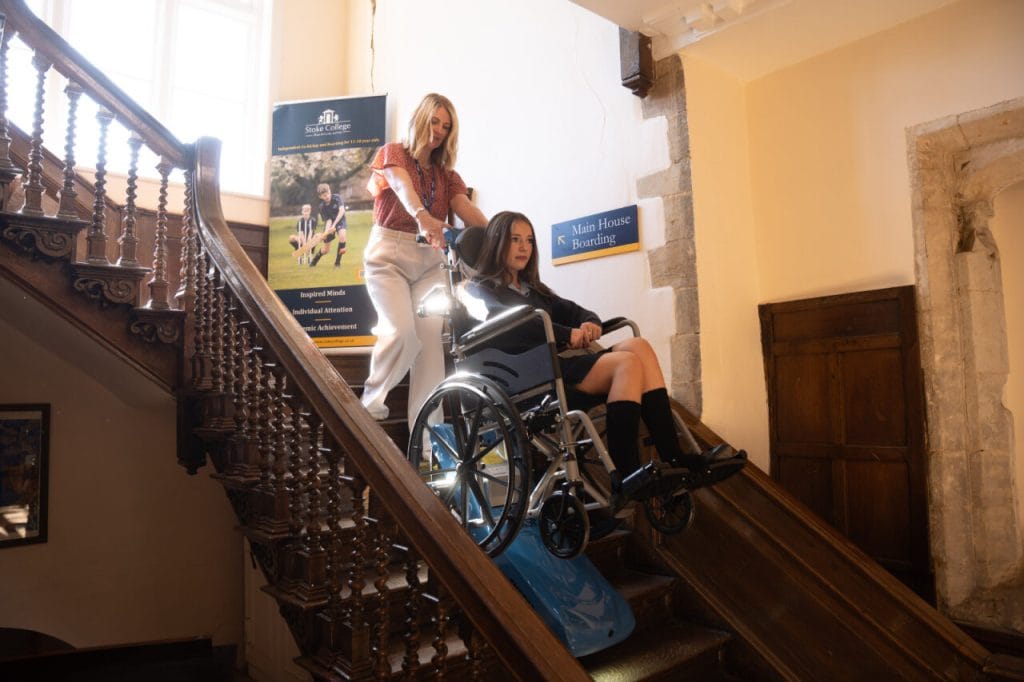
How Stair Climbers for Children Support Independence
Childrens stair climbers are more than mobility devices. They are tools that encourage independence, reduce barriers and promote emotional wellbeing. For many young people, being able to access their own bedroom or take part in activities on different floors restores a sense of normality and confidence.
Stair climbers for children reduce manual handling risks for parents and carers. Lifting a child on stairs can be physically exhausting and dangerous. Using a childrens stairclimber protects everyone involved and ensures movement around the home or school is safe and controlled.
Families also benefit from the flexibility that stair climbers bring. Instead of committing to major building works or relocating, they can remain in their home environment with a product that instantly improves accessibility. The Skyclimber Junior is designed to be simple to store, quick to set up and easy to operate, making it ideal for busy households.
Free Assessments Across the UK
The Stair Climbing Company distinguishes itself by offering free assessments for all families, schools and OTs across the UK. These assessments ensure that the right childrens stair climber is selected and that the environment is suitable for safe use. During the assessment, an expert consultant reviews the staircase, discusses the child’s postural and support needs and recommends the best configuration of the Skyclimber Junior.
For OTs, this service is invaluable. It provides professional reassurance that the selected stair climbers for children fully meet the child’s mobility goals and manual handling requirements. It also ensures that families feel supported throughout the decision making process.
Why OTs Trust The Stair Climbing Company
The Stair Climbing Company has built a strong reputation for reliability, engineering quality and clinical understanding. Their childrens stairclimbers are used by NHS teams, local authority OTs, specialist schools and private clinicians. The focus on excellent customer support, detailed assessments and bespoke equipment has positioned the Skyclimber Junior as the top choice nationwide.
OTs appreciate:
- Paediatric specific design
- Bespoke seating and postural support
- Extended warranties and service options
- Friendly, clinical led advisory support
- Free UK wide assessments
- Fast delivery and demonstration availability
This level of service ensures that stair climbers for children meet both safety standards and therapeutic goals.
Please Complete The Form Below For All Childrens Enquiries.
Frequently Asked Questions…
Question – Can one person operate a stair climber?
Answer – Yes. Stair climbers can only be operated by one person. A second person maybe required to help on a turn or to provide assistance in the initial period of use (as the operator gains confidence). This is a common question in our FAQ.
Question – Can I use a Stair Climber for Evacuating a building?
Answer – Yes. We use our stairclimbers in many buildings for evacuation from University of Cambridge to Blackstones in London. They can be used for upwards or downwards evacuation and also for non-transferable evacuation (PEEPs).
Question – Can I move a stair climber to different locations?
Answer – Yes. Our stair climbers are cleverly designed to be broke into several parts for easy stowage in a car. Many details about it can be found in our FAQ.
Question – How can I get a wheelchair up some stairs?
Answer – A Lift, A platform lift or a stair climber. The FAQ section provides detailed information.
Question – Can I attach a wheelchair to a stair climber?
Answer – Yes. Most manual wheelchairs will attach to both stairs climbers, as detailed in our FAQ.
Question – Can I attach a child’s buggy to a stair climber?
Answer – Yes. We attach many child buggy variations.
Question – Is a stair climber a good stair lift alternative?
Answer – Yes. Not only are stair climbers a great stair lift alternative, but a lot of the time due to non-possible transferring or non-feasible stair spaces the only option.
Question – Can you turn a stair climber on a fan, or bend on stairs?
Answer – Yes. A Skyclimber will work around most stairs, including spiral stairs.
Question – Is a Skyclimber similar to an AAT Stair climber?
Answer – Yes in many ways. The Skyclimber is more cost effective and more flexible to attach seating systems and wheelchairs.
What our clients say

Louise Kimber
Occupational Therapist – Disabled Children’s Team
Amidst, all the craziness, I wanted to say a HUGE thank you for staying level headed, focused and professional to enable us to get the job we love done and make sure two more children (and their families) remain safe over this period when we will be restricted as to how often we can go in and see them.
The Stair Climbing Company has gone above and beyond and kept us up to date every step of the way. Often working late or in difficult circumstances to ensure that the provision of this vital equipment, to reduce the risk, was made.
Sundeep
Hounslow OT
Great product – can be used with or without a wheelchair. Will mean loads of people will no longer need re-housing because of this. Thank you!

Jaydev
Our whole experience with The Stair Climbing Company has been first-class. Right from the start of the engagement, everyone has been keen to give us the best service, always ready to help and advise..

Josie McGee
Occupational Therapist, Thurrock CPD
Just a thank you to yourself and team for arranging a brilliant training session which was very useful. I have had lots of positive feedback and thank yous from my team.




Trusted By



Get in touch for a free assessment
Contact Us
Key Takeaways
- Stair climbers for children provide a safe mobility solution for moving kids up and downstairs.
- These battery-powered devices are convenient, transportable, and designed with bespoke seating for children’s needs.
- A thorough training for parents comes free with stair climber purchases, ensuring safe usage.
- A case study highlights how customised stair climbers helped two families during COVID-19, enabling easier daily routines.
- The commitment to providing stair climbers for children reflects a dedication to improving lives for families with disabilities.