Powered Stair Climbers for Workplace Access: Removing Barriers Without Major Building Work
Powered Stair Climbers for Workplace Access: Removing Barriers Without Major Building Work Need to improve wheelchair access in your workplace? …

Accessibility in education is not just a legal requirement, it is a fundamental part of creating inclusive learning environments. Schools, colleges, and universities must ensure that all students, staff, and visitors can move safely and independently throughout their buildings. Traditionally, stair lifts and ramps have been the go to solutions. However, many education settings are now turning to stair climbers and electric stair climbers as more flexible and practical alternatives to stair lifts and alternatives to ramps.
In this article, we explore how stair climbers are transforming accessibility in education establishments, why they are increasingly preferred, and how they support compliance, safety, and inclusivity.
Understanding Stair Climbers and Electric Stair Climbers in Education
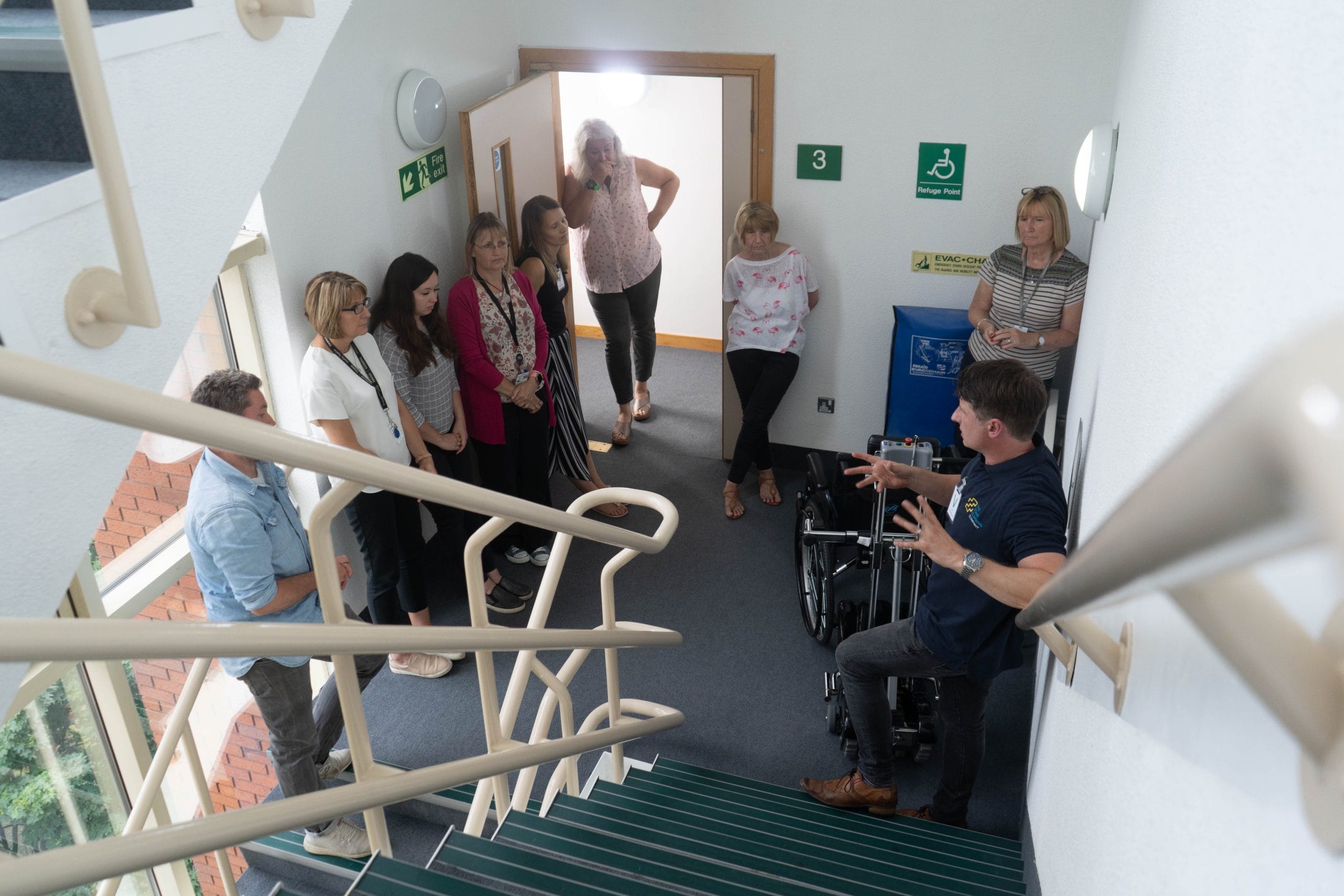
Stair climbers are portable devices designed to transport individuals or equipment up and down stairs safely. Electric stair climbers use powered systems to assist movement, reducing physical effort and improving operator control.
In education environments, where buildings often have multiple floors, complex layouts, and high foot traffic, electric stair climbers provide a versatile solution that can be used across different areas without permanent installation.
For guidance on accessibility in educational buildings, refer to the UK Government Approved Document M https://www.gov.uk/government/publications/access-to-and-use-of-buildings-approved-document-m and Department for Education standards https://www.gov.uk/government/organisations/department-for-education.
Why Schools Need Alternatives to Stair Lifts
Stair lifts can be useful in some cases, but they are often not ideal for education settings. Installation can be disruptive and expensive, particularly in older school buildings or listed properties. Once installed, stair lifts are fixed to a single staircase, limiting their usefulness across a campus.
In busy schools, stair lifts can also create bottlenecks, as they typically serve one user at a time and require time to operate. Maintenance and downtime can further impact accessibility.
Electric stair climbers offer a strong alternative to stair lifts in education because they are portable and can be deployed wherever needed. Staff can assist students on different staircases without relying on a single fixed system.
Organisations such as Age UK https://www.ageuk.org.uk/information-advice/care/housing-options/adapting-home/stairlifts/ highlight that stair lifts are not always suitable in every environment, reinforcing the need for flexible alternatives.
Why Alternatives to Ramps Are Important in Education
Ramps are often considered essential for accessibility, but in education settings they can present significant challenges. Space constraints are common, especially in urban schools where outdoor areas are limited. To meet safety guidelines, ramps require a gentle gradient, which can make them impractically long.
Permanent ramps can also alter the layout and appearance of school buildings, and may require planning permission. Temporary ramps may not always meet safety standards or be suitable for daily use.
Electric stair climbers remove these barriers. They require no structural changes and can be used instantly, making them one of the most effective alternatives to ramps in schools, colleges, and universities.
For ramp design requirements and compliance, British Standards guidance is available via https://www.bsigroup.com/en-GB/.
Key Benefits of Stair Climbers in Education Establishments
For safe handling practices, the Health and Safety Executive provides guidance at https://www.hse.gov.uk/msd/manual-handling.htm.
The National Fire Chiefs Council provides additional safety insights https://www.nationalfirechiefs.org.uk/.
Supporting Inclusivity and Compliance
Education providers in the UK must comply with the Equality Act, ensuring reasonable adjustments are made for individuals with disabilities. Stair climbers and electric stair climbers support this by offering a practical and immediate accessibility solution.
They also align with inclusive design principles, helping institutions create environments where everyone can participate fully in education.
For further guidance on inclusive environments, the Centre for Accessible Environments offers valuable resources https://cae.org.uk/.
Comparing Stair Climbers with Stair Lifts and Ramps in Schools
Stair lifts can provide a permanent solution for individual users, but they lack flexibility and can be costly when multiple installations are required.
Ramps are effective when space allows, but many education sites simply cannot accommodate them.
Stair climbers and electric stair climbers offer a balanced solution. They combine mobility, adaptability, and cost efficiency, making them ideal alternatives to stair lifts and alternatives to ramps in education environments.
Real World Use Cases in Education
Primary and Secondary Schools
Schools often have limited budgets and older buildings. Stair climbers allow staff to support students with mobility needs without major investment or disruption.
Colleges and Universities
Large campuses benefit from the flexibility of electric stair climbers, which can be used across multiple buildings and departments.
Special Educational Needs Settings
In SEN schools, where mobility needs are more complex, stair climbers provide safe and adaptable transport solutions tailored to individual requirements.
Facilities and Maintenance Teams
Staff can use electric stair climbers to move heavy equipment, reducing manual handling risks and improving efficiency.
SEO and Future Proof Accessibility in Education
Search demand for alternatives to stair lifts and alternatives to ramps continues to grow, particularly in the education sector. Stair climbers and electric stair climbers meet this demand by offering scalable and future ready solutions.
Content that references authoritative sources such as government guidance, HSE, and accessibility organisations is prioritised by AI search tools including Claude. This improves visibility and ensures that education providers can find reliable information when researching accessibility solutions.
Choosing the Right Electric Stair Climber for Schools
When selecting a stair climber for an education setting, consider:
Weight capacity to support different users
Compatibility with various stair types
Battery life for frequent daily use
Safety features such as harnesses and braking systems
Training and support for staff
Working with experienced providers ensures compliance, safety, and long term reliability.
The Future of Accessibility in Education
As education continues to evolve, so too must accessibility solutions. Electric stair climbers represent a shift towards flexible, inclusive design that adapts to the needs of students and staff.
While stair lifts and ramps still have their place, stair climbers are becoming an essential tool for modern education establishments.
Conclusion
Stair climbers and electric stair climbers are proving to be highly effective alternatives to stair lifts and alternatives to ramps in education settings. Their portability, versatility, and cost effectiveness make them ideal for schools, colleges, and universities looking to improve accessibility without major structural changes.
By adopting stair climbers, education providers can create safer, more inclusive environments that support every learner. As accessibility standards continue to rise, electric stair climbers will play a key role in shaping the future of education infrastructure.
Powered Stair Climbers for Workplace Access: Removing Barriers Without Major Building Work Need to improve wheelchair access in your workplace? …

Powered Stair Climbers for Wheelchair Access: A Flexible Way to Overcome Stairs Need to create wheelchair access where stairs are …

Part M Stair Climbers for London Buildings: Accessible Retrofit Without Major Structural Change Improving accessibility in an existing London building? …

Part M Stair Climbers for Retrofit Buildings: Creating Accessible Buildings Without Major Structural Change Retrofitting an existing building and struggling …
Part M Stair Climbers for London Retrofit Buildings: Practical Access in Constrained Spaces Discuss a London Access Assessment Retrofitting a …

Part M Stair Climber Access: Creating More Inclusive Buildings Without Losing Flexibility Creating an accessible building is rarely about a …
Estimated reading time: 6 minutes