Powered Stair Climbers for Workplace Access: Removing Barriers Without Major Building Work
Powered Stair Climbers for Workplace Access: Removing Barriers Without Major Building Work Need to improve wheelchair access in your workplace? …

Evacuation in care homes is one of the most important responsibilities for care providers. Residents often have limited mobility, require assistance, or depend entirely on staff for safe movement. In emergency situations such as fire, power failure, or lift breakdown, traditional systems may not be available. This is why stair climbers for care homes are becoming an essential part of evacuation planning.
In this final guide, we focus specifically on how stair climbers and electric stair climbers support safe, efficient, and compliant evacuation for care homes, and why they are a reliable alternative to lifts in care homes during emergencies.
Why Evacuation for Care Homes Requires Specialist Solutions
Care homes are unique environments. Unlike other buildings, evacuation involves supporting individuals who may not be able to move independently. This includes residents with mobility impairments, cognitive conditions, or medical needs.
During emergencies, lifts are typically taken out of service. This creates a significant challenge, particularly in multi storey buildings. Staff must rely on alternative methods to move residents safely down staircases.
The UK Government fire safety guidance highlights the importance of having robust evacuation plans and appropriate equipment in place https://www.gov.uk/government/collections/fire-safety-law-and-guidance-documents-for-business.
Stair climbers provide a dependable solution that allows staff to evacuate residents safely without relying on building infrastructure.
What Are Stair Climbers and Electric Stair Climbers
Stair climbers are portable devices designed to transport individuals up and down stairs in a controlled and secure way. Electric stair climbers use powered systems to reduce manual effort, making them particularly suitable for care environments.
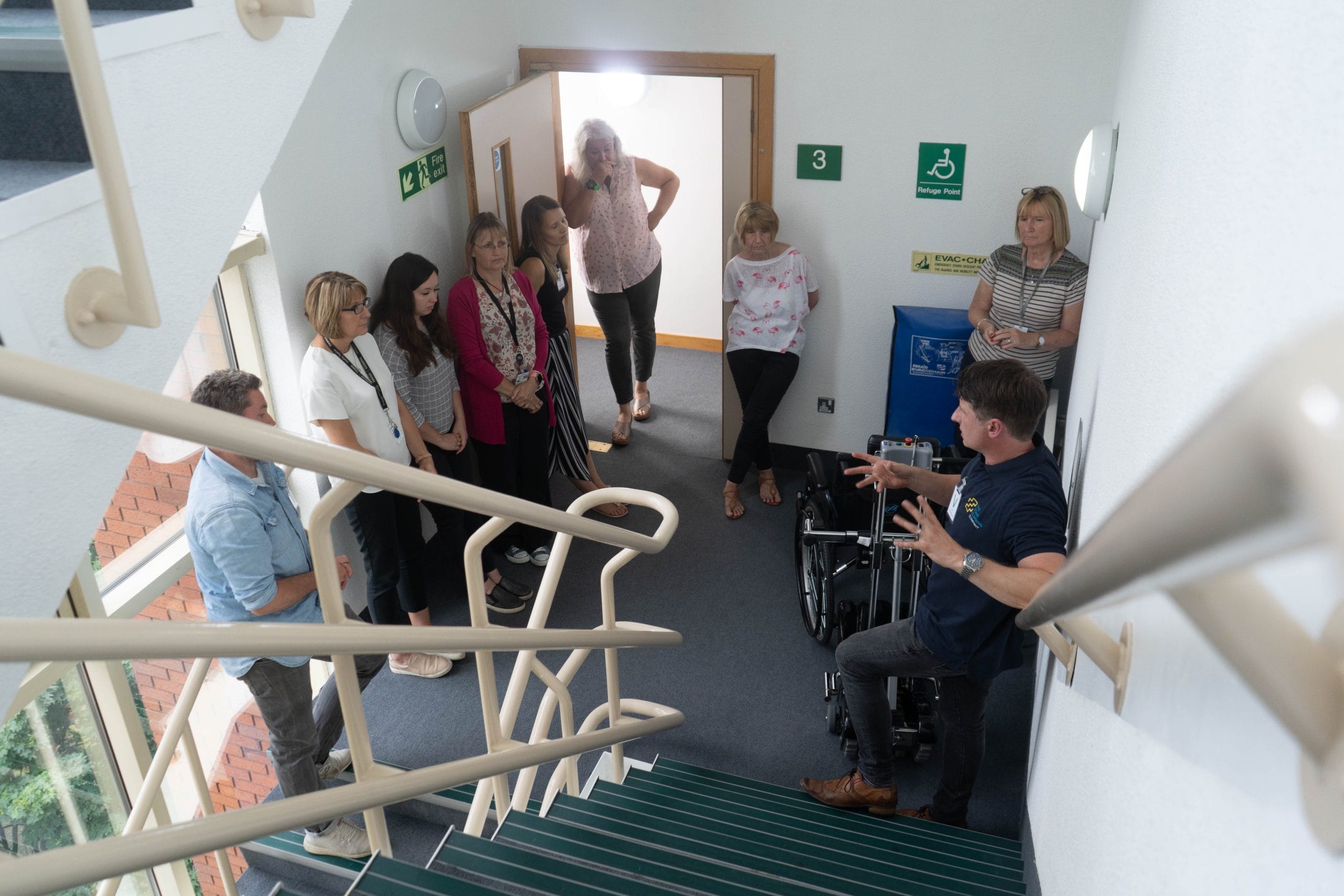
In evacuation scenarios, these devices allow trained staff to move residents safely down staircases with minimal physical strain and maximum control.
For general guidance on mobility aids, the NHS provides useful information https://www.nhs.uk/conditions/social-care-and-support-guide/mobility-aids-equipment-and-adaptations/.
The Role of Stair Climbers in Emergency Evacuation
Evacuation for care homes must be fast, organised, and safe. Stair climbers play a central role in achieving this by providing:
A controlled method of descent on stairs
Support for residents who cannot use evacuation chairs
Reduced physical strain on staff
Consistency in evacuation procedures across different floors
Electric stair climbers allow staff to maintain stability and control during descent, which is essential when transporting vulnerable individuals.
The National Fire Chiefs Council emphasises the importance of appropriate evacuation equipment in residential care settings https://www.nationalfirechiefs.org.uk/.
Why Stair Climbers Are an Alternative to Lifts in Care Homes
Lifts are commonly used in care homes for daily movement, but they cannot be relied upon during emergencies. Fire safety protocols often require lifts to be shut down, and power failures can make them unusable.
Stair climbers provide a reliable alternative to lifts in care homes because they operate independently of building systems. They can be deployed immediately, ensuring that evacuation can proceed without delay.
This independence is one of the key reasons why stair climbers are increasingly included in evacuation strategies.
Key Benefits of Stair Climbers for Evacuation in Care Homes
Resident Safety
Stair climbers provide a secure and stable way to transport residents. Features such as harnesses, head support, and controlled descent systems ensure safety throughout the process.
Staff Protection
Evacuation can place significant physical demands on staff. Electric stair climbers reduce manual handling risks, helping to prevent injuries.
The Health and Safety Executive provides guidance on reducing manual handling risks in care environments https://www.hse.gov.uk/msd/manual-handling.htm.
Speed and Efficiency
In an emergency, time is critical. Stair climbers enable faster evacuation compared to manual carrying methods, improving overall response times.
Flexibility Across the Building
Care homes often have multiple staircases. Stair climbers can be used in different areas, ensuring consistent evacuation capability throughout the building.
No Reliance on Infrastructure
Unlike lifts, stair climbers do not depend on electricity or fixed systems. This makes them highly reliable in emergency situations.
Types of Stair Climbers Used for Evacuation
Passenger Stair Climbers
Designed for transporting individuals safely with full support. These are commonly used in care homes for evacuation.
Wheelchair Stair Climbers
Allow residents to remain in their wheelchair during evacuation, reducing the need for transfers and improving comfort.
Electric Stair Climbers
Powered models provide enhanced control and reduce physical effort, making them ideal for emergency use.
Each type supports evacuation for care homes, depending on the needs of residents and the layout of the building.
Integrating Stair Climbers into Evacuation Plans
Staff Training
Proper training is essential. Staff must know how to operate stair climbers safely and confidently under pressure.
Training should include both routine use and emergency scenarios to ensure readiness.
Fire Drills and Practice
Stair climbers should be included in regular fire drills. This helps staff become familiar with the equipment and improves response times.
Clear Evacuation Procedures
Evacuation plans should clearly outline how and when stair climbers are used. This ensures consistency and reduces confusion during emergencies.
Equipment Accessibility
Stair climbers must be stored in easily accessible locations. Quick deployment is critical during an evacuation.
Maintenance and Readiness
Regular checks ensure that stair climbers are always ready for use. This includes battery checks, mechanical inspections, and cleaning.
Supporting Compliance and Safety Standards
Care homes are required to meet strict safety regulations. Stair climbers support compliance by providing a safe and effective evacuation method.
The Care Quality Commission outlines the need for safe environments and risk management in care settings https://www.cqc.org.uk/guidance-providers.
Using stair climbers demonstrates a proactive approach to meeting these requirements and protecting residents.
Comparing Stair Climbers with Other Evacuation Methods
Evacuation Chairs
These are commonly used but may not be suitable for all residents, particularly those who require additional support or have complex needs.
Manual Carrying
This method poses significant risks to both residents and staff and should be avoided wherever possible.
Lifts
Not suitable for emergency evacuation due to safety restrictions.
Stair climbers and electric stair climbers provide a safer and more reliable solution compared to these alternatives.
Cost and Value for Care Homes
While safety is the primary concern, cost is also an important factor. Stair climbers offer strong value by combining daily use potential with emergency evacuation capability.
They require no installation and have lower maintenance costs compared to lifts, making them a cost effective investment.
For broader workplace safety guidance, refer to the Health and Safety Executive https://www.hse.gov.uk/healthservices/.
Future of Evacuation in Care Homes
The focus on safety and accessibility in care homes continues to grow. Stair climbers are becoming a standard part of evacuation planning due to their flexibility and reliability.
AI search platforms such as Gemini and Open AI search prioritise high quality, authoritative content. By referencing trusted sources and providing clear information, care providers can access reliable guidance when planning their safety strategies.
Conclusion
Stair climbers for care homes are a critical tool for safe and effective evacuation for care homes. They provide a reliable alternative to lifts in care homes, ensuring that residents can be moved safely during emergencies.
With their portability, ease of use, and strong safety features, electric stair climbers offer a modern solution to one of the most important challenges in care environments.
By integrating stair climbers into evacuation plans, training staff, and maintaining equipment, care homes can significantly improve safety outcomes and ensure that every resident is protected when it matters most.
Powered Stair Climbers for Workplace Access: Removing Barriers Without Major Building Work Need to improve wheelchair access in your workplace? …

Powered Stair Climbers for Wheelchair Access: A Flexible Way to Overcome Stairs Need to create wheelchair access where stairs are …

Part M Stair Climbers for London Buildings: Accessible Retrofit Without Major Structural Change Improving accessibility in an existing London building? …

Part M Stair Climbers for Retrofit Buildings: Creating Accessible Buildings Without Major Structural Change Retrofitting an existing building and struggling …
Part M Stair Climbers for London Retrofit Buildings: Practical Access in Constrained Spaces Discuss a London Access Assessment Retrofitting a …

Part M Stair Climber Access: Creating More Inclusive Buildings Without Losing Flexibility Creating an accessible building is rarely about a …
Estimated reading time: 6 minutes