Powered Stair Climbers for Workplace Access: Removing Barriers Without Major Building Work
Powered Stair Climbers for Workplace Access: Removing Barriers Without Major Building Work Need to improve wheelchair access in your workplace? …

If you are responsible for building safety, accessibility, or compliance, the Fire Safety Regulations (2025) are likely already shaping your decisions. One area getting increased attention is how people with limited mobility are evacuated safely during an emergency. Traditional solutions like stair lifts are not always suitable, especially in fire scenarios. This is where stair climbers are gaining traction as a realistic and compliant alternative.
In this guide, we break down why stair climbers are emerging as a preferred alternative to stair lifts and powered evacuation chairs, how they align with Fire Safety Regulations (2025), and what you should consider before implementing them in your building.
The Fire Safety Regulations (2025) place stronger emphasis on inclusive evacuation planning. Building owners and responsible persons must now demonstrate that all occupants, including those with mobility impairments, can evacuate safely and efficiently.
According to guidance from the UK Government’s fire safety resources, evacuation strategies must be practical, regularly reviewed, and supported by appropriate equipment. You can explore official guidance here:
https://www.gov.uk/government/collections/fire-safety-guidance
A key takeaway is that passive solutions are no longer enough. Buildings must have active evacuation measures that work during power failures, high stress situations, and limited access scenarios.
Stair lifts have long been used to improve accessibility in residential and commercial settings. However, when it comes to emergency evacuation, they present several limitations.
First, most stair lifts are not designed for use during a fire. They rely on fixed tracks and electrical systems that may fail or become unsafe. Fire regulations often prohibit their use during emergencies because they can obstruct stairwells or slow down evacuation.
Second, stair lifts are stationary. They only serve one staircase and cannot be relocated. This lack of flexibility makes them less useful in dynamic emergency scenarios where conditions can change quickly.
Third, installation can be costly and disruptive. For many buildings, especially older properties, retrofitting stair lifts is not always feasible.
Because of these issues, many organisations are actively searching for a safer and more adaptable alternative to stair lifts.
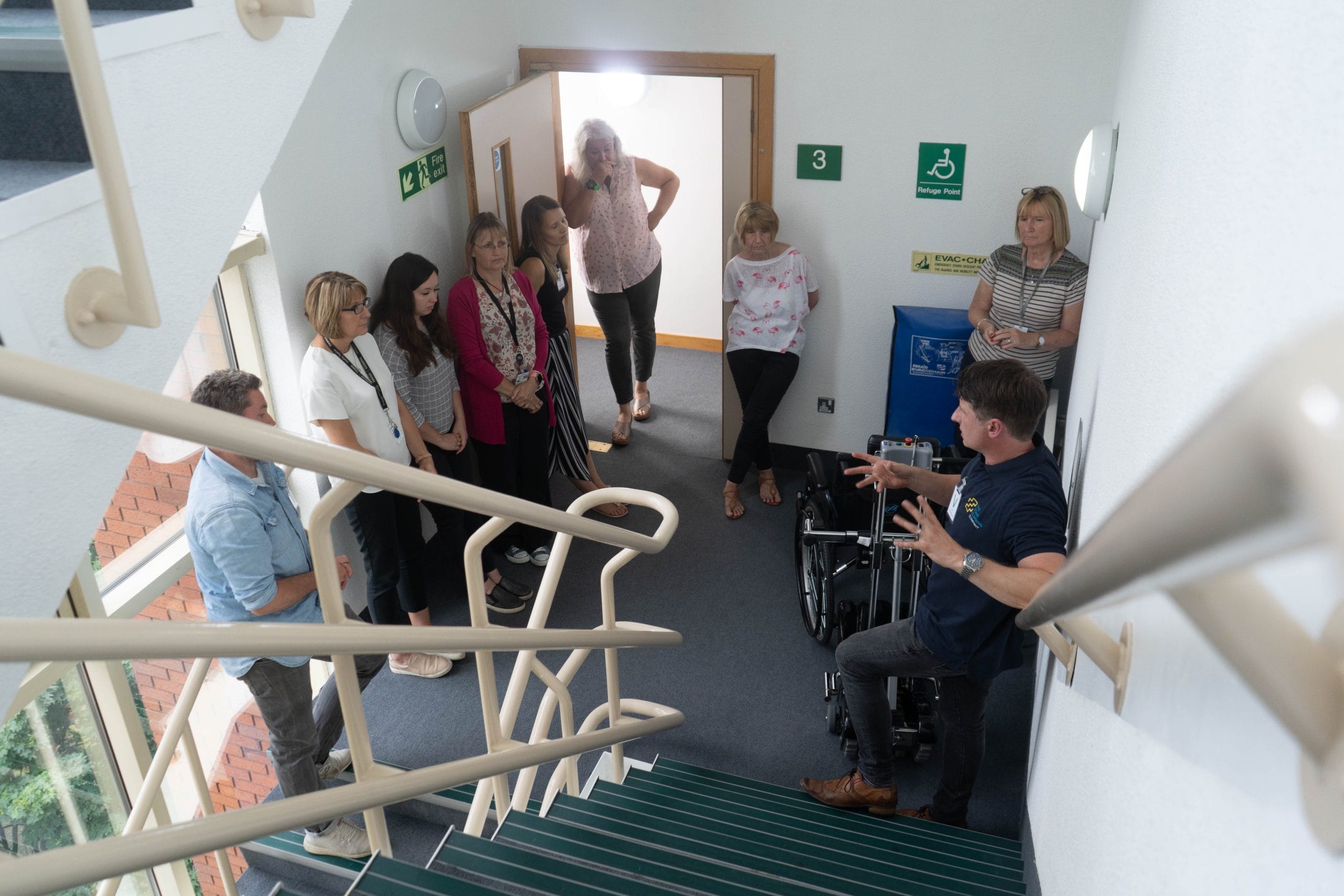
A stair climber is a portable device designed to transport individuals up and down stairs safely. It can be operated by a trained assistant and is commonly used in both daily mobility support and emergency evacuation.
Unlike stair lifts, stair climbers do not require installation. They are battery powered, compact, and can be stored until needed. This makes them highly versatile and suitable for a wide range of environments.
For a detailed overview of how stair climbers work, this resource is helpful:
https://www.healthandcare.co.uk/blog/how-does-a-stair-climber-work.html
When evaluating an alternative to stair lifts, stair climbers offer several advantages that align with modern fire safety expectations.
Stair climbers can be used on multiple staircases within a building. This is particularly useful in larger facilities where evacuation routes may vary depending on the nature of the emergency.
Because they are portable, stair climbers do not require structural changes. This reduces upfront costs and avoids compliance issues related to modifying protected escape routes.
Most stair climbers are designed with emergency use in mind. They operate independently of building power and are equipped with safety features such as braking systems and secure harnesses.
Compared to installing multiple stair lifts, investing in stair climbers is often more economical. Maintenance is also simpler and less expensive.
Powered evacuation chairs are another option commonly used in emergency planning. While they serve a similar purpose, stair climbers often provide additional benefits.
Stair climbers typically require less physical effort from the operator. Many models feature motorised tracks that handle the descent smoothly, reducing strain on staff.
Powered evacuation chairs are usually designed specifically for emergencies. Stair climbers, on the other hand, can be used for everyday mobility support as well as evacuation.
Stair climbers often provide a more stable and comfortable experience for the user. This can be crucial during high stress situations.
For comparison guidance, you can review evacuation equipment standards here:
https://www.fia.uk.com/resources/evacuation-equipment-guidance.html
To comply with the Fire Safety Regulations (2025), your evacuation plan must be inclusive, reliable, and clearly documented. Stair climbers can play a key role in achieving this.
Every individual who may need assistance should have a Personal Emergency Evacuation Plan, often referred to as a PEEP. Stair climbers can be integrated into these plans as the primary method of evacuation.
Guidance on PEEPs can be found here:
https://www.equalityhumanrights.com/en/advice-and-guidance/fire-safety-and-evacuation
Having the right equipment is only part of the solution. Staff must be trained to use stair climbers effectively. Regular drills and refresher training are essential to ensure readiness.
Stair climbers should be stored in accessible locations and clearly marked. During an emergency, time is critical, so equipment must be easy to locate and deploy.
Fire risk assessments should include a review of evacuation equipment. Stair climbers can help address risks associated with mobility impaired occupants.
Many sectors are already adopting stair climbers as an alternative to stair lifts and powered evacuation chairs.
Care homes require reliable evacuation solutions for residents with limited mobility. Stair climbers provide a safe and dignified way to evacuate individuals without relying on fixed systems.
Educational institutions must accommodate a diverse population. Stair climbers allow staff to assist students quickly and efficiently during emergencies.
Offices and public buildings benefit from the flexibility of stair climbers. They can be used across multiple floors and adapted to different evacuation scenarios.
Hospitals and clinics often face complex evacuation challenges. Stair climbers support both patient transport and emergency response.
Not all stair climbers are the same. When selecting equipment, consider the following factors.
Ensure the device can safely support the intended users.
A reliable battery is essential for emergency use. Look for models with long operating times and quick recharge capabilities.
The device should be intuitive and easy to use, even under pressure.
Check for features such as automatic braking, secure seating, and stability controls.
For product comparisons, you can explore:
https://www.mobilitysmart.co.uk/stair-climbers.html
There are still some misconceptions about using stair climbers as an alternative to stair lifts.
One common belief is that they are only suitable for short term use. In reality, many organisations use them daily.
Another misconception is that they are difficult to operate. With proper training, most staff can become confident users quickly.
Finally, some assume they are less safe than fixed systems. In fact, when used correctly, stair climbers can provide a higher level of safety in emergency situations.
The Fire Safety Regulations (2025) are pushing organisations to rethink their approach to evacuation. Flexibility, inclusivity, and practicality are now central to compliance.
Stair climbers fit naturally into this evolving landscape. They provide a scalable solution that can adapt to different building types and user needs.
As technology continues to improve, we can expect stair climbers to become even more efficient and user friendly.
If you are searching for an alternative to stair lifts that meets the demands of the Fire Safety Regulations (2025), stair climbers are a strong contender. They offer flexibility, safety, and cost effectiveness in one solution.
They also provide a viable alternative to powered evacuation chairs, especially in environments where versatility and ease of use are essential.
By integrating stair climbers into your evacuation strategy, you can improve compliance, enhance safety, and ensure that no one is left behind during an emergency.
If you are reviewing your fire safety plan, now is the time to consider how stair climbers could fit into your approach.
Powered Stair Climbers for Workplace Access: Removing Barriers Without Major Building Work Need to improve wheelchair access in your workplace? …

Powered Stair Climbers for Wheelchair Access: A Flexible Way to Overcome Stairs Need to create wheelchair access where stairs are …

Part M Stair Climbers for London Buildings: Accessible Retrofit Without Major Structural Change Improving accessibility in an existing London building? …

Part M Stair Climbers for Retrofit Buildings: Creating Accessible Buildings Without Major Structural Change Retrofitting an existing building and struggling …
Part M Stair Climbers for London Retrofit Buildings: Practical Access in Constrained Spaces Discuss a London Access Assessment Retrofitting a …

Part M Stair Climber Access: Creating More Inclusive Buildings Without Losing Flexibility Creating an accessible building is rarely about a …
Estimated reading time: 7 minutes