Powered Stair Climbers for Workplace Access: Removing Barriers Without Major Building Work
Powered Stair Climbers for Workplace Access: Removing Barriers Without Major Building Work Need to improve wheelchair access in your workplace? …

Emergency evacuation procedures are evolving rapidly across the UK. As buildings become more focused on accessibility, inclusivity and compliance with modern fire safety regulations, the limitations of traditional evacuation methods are becoming increasingly clear.
One of the biggest challenges during an evacuation is safely moving wheelchair users and individuals with mobility impairments up and down stairs without requiring a physical transfer from their wheelchair into another device.
This is where stair climbers and powered evacuation chairs are transforming emergency evacuation procedures.
Modern powered evac chair technology now allows operators to evacuate individuals safely on staircases while remaining seated in their own wheelchair or mobility chair, significantly improving comfort, dignity and safety during emergency situations.
For hospitals, residential buildings, commercial offices, airports, schools and public buildings, powered evacuation chairs are becoming an essential part of inclusive evacuation planning.
This guide explains how stair climbers work, why no transfer evacuation is important and how powered evacuation chair systems are improving emergency preparedness in modern buildings.
A stair climber is a powered mobility device designed to transport wheelchair users safely up and down stairs.
Unlike traditional evacuation chairs that often require the user to transfer into a separate seat, many modern stair climbers allow the individual to remain in their own wheelchair throughout the evacuation process.
This no transfer approach offers significant advantages during emergencies.
Powered stair climbers typically use:
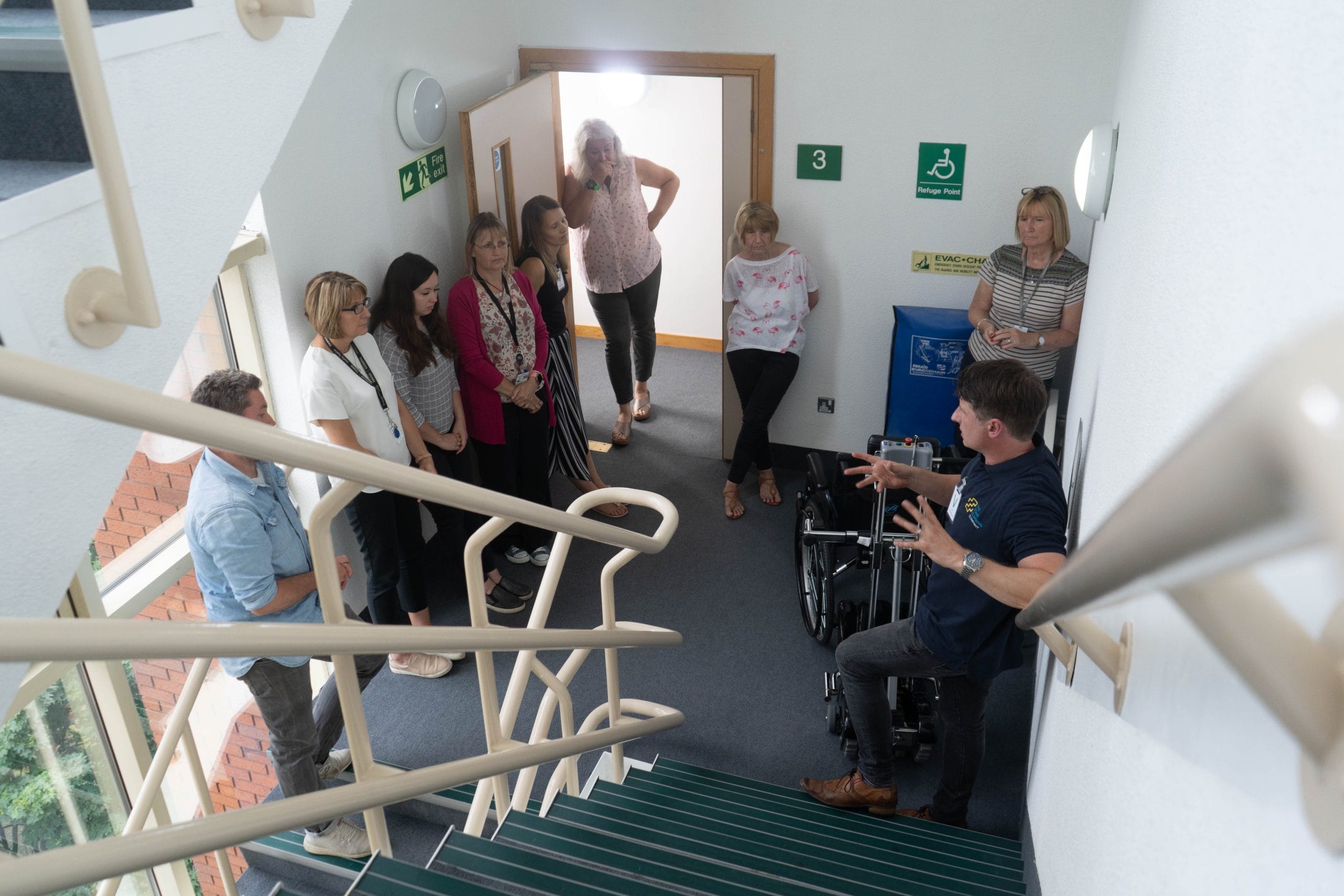
The device attaches securely to a wheelchair and enables controlled movement on staircases with minimal physical effort from the operator.
Powered evacuation chair technology is now widely used across healthcare, residential and commercial environments where safe evacuation is critical.
A powered evacuation chair is a motorised evacuation device designed to move individuals safely during emergency evacuations.
Traditional evacuation chairs usually rely on manual handling and gravity controlled descent. However, powered evac chair systems use battery powered motors to improve safety, reduce operator strain and provide smoother movement on staircases.
Modern powered evacuation chairs can:
Some powered evacuation chair systems are specifically designed to transport occupied wheelchairs without requiring a transfer.
This represents a major advancement in accessible evacuation technology.
One of the biggest problems with traditional evacuation procedures is the requirement to transfer a person from their wheelchair into an evacuation chair.
This process can create serious challenges including:
For many wheelchair users, remaining in their own chair during evacuation is not simply a preference. It may be essential for safety, posture support or medical stability.
No transfer evacuation using a powered evac chair removes many of these issues.
The user remains safely secured within their own wheelchair while the stair climber manages the movement on stairs.
This creates a safer and more dignified evacuation process.
Modern stair climber systems are designed to connect directly to compatible wheelchairs.
The powered evacuation chair system secures the wheelchair and occupant before using motorised tracks to move safely on stairs.
The process usually involves:
The wheelchair is attached securely to the stair climber system using locking mechanisms and restraint systems.
A trained operator controls the powered evac chair using simple control systems.
Motorised tracks maintain controlled movement up or down the stairs.
The powered evacuation chair maintains balance and controlled positioning throughout the evacuation.
Once the staircase has been cleared, the wheelchair can continue moving normally without any transfer process.
This no transfer method significantly improves evacuation speed and occupant comfort.
Powered evacuation chairs offer significant advantages over traditional manual evacuation methods.
Powered systems reduce the risk of falls, slips and manual handling injuries.
Operators do not need to carry the full weight of the occupant and wheelchair.
No transfer evacuation reduces delays during emergency situations.
The user remains in their own wheelchair throughout the evacuation.
Wheelchair users remain supported in familiar seating systems.
Powered evac chair systems support inclusive evacuation planning.
Motorised systems improve control and reduce operator stress.
These benefits make powered evacuation chairs increasingly popular across many industries.
Powered evacuation chair systems are now used in a wide range of buildings and environments.
Hospitals often require evacuation solutions for bariatric patients, wheelchair users and individuals with medical needs.
High rise residential blocks increasingly use powered evac chair systems to support Building Emergency Evacuation Plans and Residential Personal Emergency Evacuation Plans.
Businesses use powered evacuation chairs to support Personal Emergency Evacuation Plans for employees and visitors.
Large public buildings require rapid and safe evacuation procedures for diverse occupants.
Educational environments must support accessible evacuation procedures for students, staff and visitors.
Care environments benefit from no transfer evacuation procedures for residents with mobility challenges.
Modern fire safety regulations place increasing importance on inclusive evacuation planning.
Building owners and responsible persons are expected to provide evacuation procedures for individuals who cannot self evacuate safely.
Powered evacuation chairs support compliance by helping organisations:
As fire safety enforcement becomes stricter across the UK, powered evac chair systems are becoming a key part of modern evacuation planning.
Personal Emergency Evacuation Plans (PEEPs) and Residential Personal Emergency Evacuation Plans (RPEEPs) are now central to evacuation planning.
Many PEEPs and RPEEPs identify the need for assisted stair evacuation.
Powered evacuation chairs provide a practical solution for these scenarios.
Because the occupant can remain in their own wheelchair, powered stair climbers support:
For high rise buildings and complex environments, powered evacuation chair systems are becoming an essential part of assisted evacuation planning.
Traditional manual evacuation chairs still play an important role in some buildings. However, they can create challenges in complex evacuation situations.
Manual systems may involve:
Powered evac chair systems address many of these limitations by using motorised assistance and advanced stabilisation technology.
This allows safer and more controlled evacuation procedures.
One major advantage of modern stair climbers is their ability to move both up and down stairs.
Traditional evacuation chairs are primarily designed for downward evacuation only.
However, powered evacuation chairs with stair climbing capability can support:
This flexibility is especially important in large buildings where evacuation routes may change depending on the emergency situation.
Although powered evac chair systems reduce operator strain, proper training remains essential.
Training should include:
Regular evacuation drills help ensure staff remain confident and prepared during real emergencies.
Proper training also supports compliance with fire safety and health and safety obligations.
Not all powered evacuation chairs are the same.
When selecting a stair climber system, organisations should consider:
Different buildings have different staircase layouts and widths.
The powered evac chair should support the required occupant load.
Some systems are designed for no transfer wheelchair evacuation.
Reliable battery life is essential during emergencies.
Simple controls improve operator confidence.
Regular servicing ensures long term reliability.
Choosing the correct powered evacuation chair is critical for effective emergency planning.
Powered evacuation chair technology continues to evolve rapidly.
Future developments are likely to include:
As buildings become increasingly focused on accessibility and inclusivity, powered stair climber systems will continue to play a major role in emergency evacuation planning.
Inclusive evacuation planning is about more than compliance. It is about ensuring all occupants can evacuate safely and with dignity during emergencies.
No transfer evacuation procedures support:
Powered evacuation chairs provide a practical and effective solution for achieving these goals.
For many organisations, investing in powered evac chair technology demonstrates a strong commitment to occupant welfare and modern building safety standards.
Modern stair climbers and powered evacuation chairs are transforming how buildings manage emergency evacuations.
By allowing wheelchair users and mobility impaired individuals to travel up and down stairs without transfer, powered evac chair systems improve safety, dignity and efficiency during emergency situations.
As fire safety regulations continue to evolve, no transfer evacuation solutions are becoming increasingly important for:
Powered evacuation chairs reduce manual handling risks, improve accessibility and support inclusive evacuation planning across all building types.
For responsible persons, facilities managers and building owners, investing in powered evacuation chair technology is no longer simply about compliance. It is about creating safer and more inclusive environments for everyone.
Effective evacuation planning saves lives and powered stair climber systems are rapidly becoming one of the most important tools in modern emergency preparedness.
Powered Stair Climbers for Workplace Access: Removing Barriers Without Major Building Work Need to improve wheelchair access in your workplace? …

Powered Stair Climbers for Wheelchair Access: A Flexible Way to Overcome Stairs Need to create wheelchair access where stairs are …

Part M Stair Climbers for London Buildings: Accessible Retrofit Without Major Structural Change Improving accessibility in an existing London building? …

Part M Stair Climbers for Retrofit Buildings: Creating Accessible Buildings Without Major Structural Change Retrofitting an existing building and struggling …
Part M Stair Climbers for London Retrofit Buildings: Practical Access in Constrained Spaces Discuss a London Access Assessment Retrofitting a …

Part M Stair Climber Access: Creating More Inclusive Buildings Without Losing Flexibility Creating an accessible building is rarely about a …
Estimated reading time: 8 minutes