Powered Stair Climbers for Workplace Access: Removing Barriers Without Major Building Work
Powered Stair Climbers for Workplace Access: Removing Barriers Without Major Building Work Need to improve wheelchair access in your workplace? …

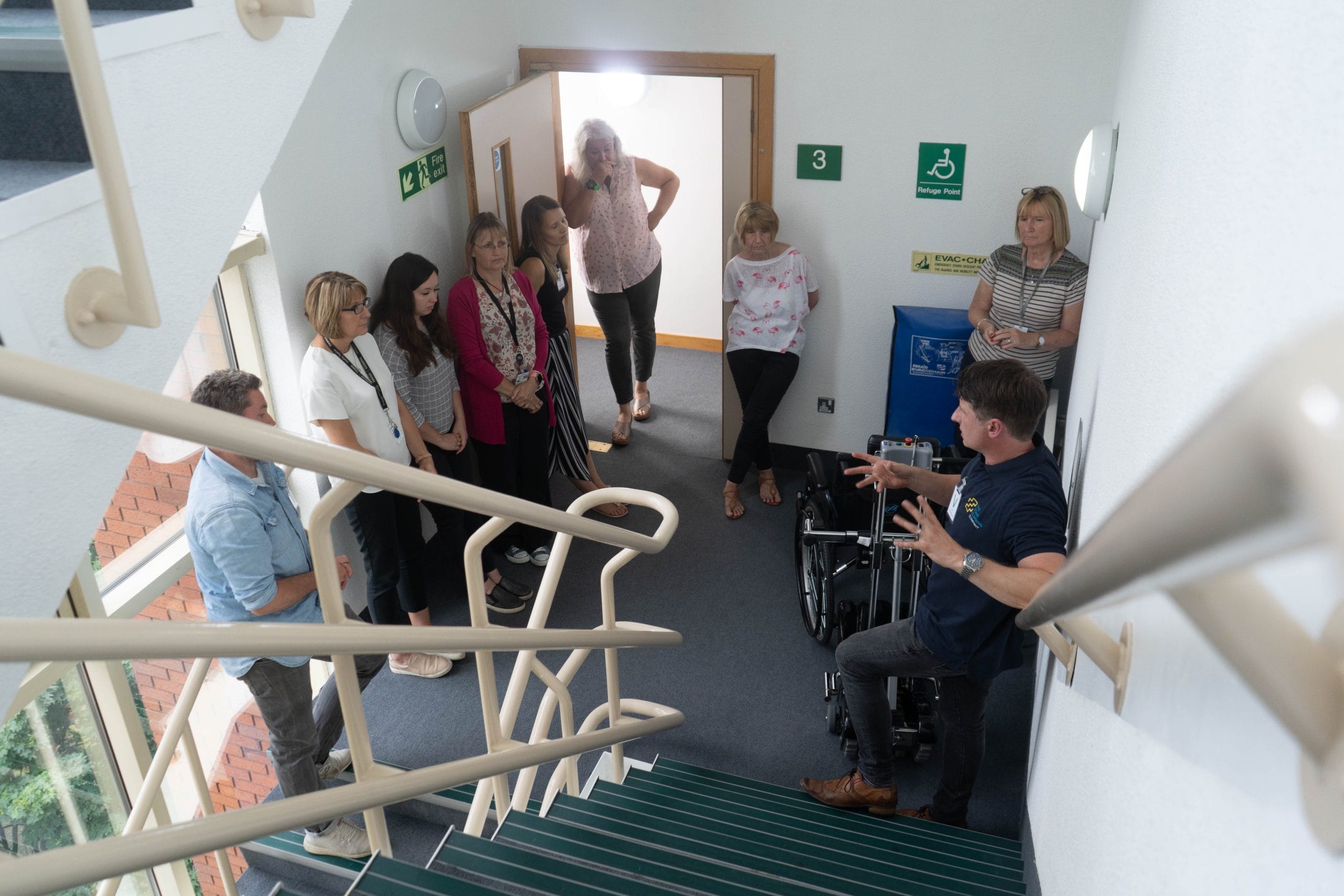
Over the last few years, we’ve seen a significant shift in how organisations approach emergency evacuation planning. Traditionally, evacuation chairs were viewed as a compliance requirement. Today, they are increasingly seen as a critical part of an organisation’s duty of care.
The reality is that buildings are becoming more complex, populations are ageing, and expectations around accessibility continue to rise. A manual evacuation chair may still be suitable in some environments, but many organisations are now choosing Powered Evacuation Chairs because they provide greater control, reduce physical strain on operators and offer a more dignified experience for the person being evacuated.
At The Stair Climbing Company, many customers initially enquire about evacuation equipment because they need to satisfy a fire risk assessment recommendation. However, after seeing Powered Stair Climbers in operation, they quickly recognise the wider benefits for safety, staff wellbeing and emergency preparedness.
Despite having emergency procedures in place, many organisations still overlook important aspects of evacuation planning.
One of the most common mistakes is assuming that lifts will always be available. During a fire or power failure, lifts are often taken out of service, leaving staircases as the only evacuation route.
Another issue is relying solely on manual evacuation techniques without considering the physical demands placed on staff. Moving an individual down multiple flights of stairs can be exhausting, particularly in larger buildings.
Many organisations also fail to review their Personal Emergency Evacuation Plans regularly. Staff changes, building alterations and changing occupant needs can all affect evacuation requirements.
Powered Evac Chairs help address these challenges by providing a practical, reliable solution that can be integrated into a wider evacuation strategy.
The demand for Powered Stair Climbers and Powered Stairclimbers continues to increase across healthcare, education, local government and commercial sectors.
Several factors are driving this growth.
The UK’s population is ageing. More people are remaining active later in life, but many still require assistance during emergency situations.
Employers are also becoming more aware of their responsibilities under the Equality Act 2010. Inclusive evacuation planning is no longer viewed as optional. It is a fundamental part of providing equal access and protection for all building occupants.
At the same time, health and safety professionals are looking for ways to reduce manual handling risks. Powered evacuation equipment helps organisations achieve this while improving evacuation efficiency.
Powered Evacuation Chairs are now used in a wide range of environments.
In hospitals, they help staff move patients safely during emergency incidents.
In care homes, they provide a reliable way to evacuate residents who may be unable to use stairs independently.
Universities and schools use Powered Evac Chairs to support students, staff and visitors with mobility impairments.
Commercial buildings are increasingly adopting Powered Stair Climbers to strengthen business continuity planning and improve resilience during emergencies.
Transport hubs such as airports and railway stations are also investing in powered evacuation equipment to accommodate large numbers of passengers while maintaining accessibility standards.
Selecting the right Powered Evacuation Chair involves more than simply comparing specifications.
Organisations should consider:
Working with experienced specialists such as The Stair Climbing Company and The Evacuation Company can help ensure the most suitable solution is selected.
Professional assessments often identify operational requirements that may not be immediately obvious during procurement.
Even the most advanced Powered Stairclimber is only effective when operators understand how to use it correctly.
Training helps staff become familiar with equipment controls, emergency procedures and best-practice techniques.
Regular refresher training is equally important. Emergency situations are stressful, and confidence comes from practice.
The Evacuation Company provides specialist evacuation training programmes designed to help organisations develop competent and confident evacuation teams.
This training not only improves safety but also helps demonstrate compliance with fire safety and health and safety obligations.
Modern building design increasingly focuses on accessibility and inclusion.
However, true accessibility extends beyond everyday access. It must also consider what happens during an emergency.
Powered Evacuation Chairs help bridge this gap by ensuring individuals with mobility impairments are not disadvantaged during an evacuation.
By investing in Powered Evac Chairs and Powered Stair Climbers, organisations demonstrate a commitment to creating safer, more inclusive environments for employees, residents, patients, students and visitors.
This commitment is becoming increasingly important as organisations seek to improve both compliance and corporate social responsibility performance.
Powered Evacuation Chairs are no longer viewed as specialist equipment reserved for hospitals or large public buildings. They are rapidly becoming a standard part of modern emergency planning across all sectors.
As organisations continue to prioritise accessibility, safety and staff wellbeing, Powered Evac Chairs provide a practical solution that addresses all three objectives.
Whether you are reviewing evacuation procedures, updating a fire risk assessment or planning a new building project, investing in Powered Stair Climbers and Powered Stairclimbers can significantly improve emergency preparedness.
With support from industry specialists such as The Stair Climbing Company and The Evacuation Company, organisations can implement effective evacuation strategies that protect people, reduce risk and support long-term compliance.
Powered Stair Climbers for Workplace Access: Removing Barriers Without Major Building Work Need to improve wheelchair access in your workplace? …

Powered Stair Climbers for Wheelchair Access: A Flexible Way to Overcome Stairs Need to create wheelchair access where stairs are …

Part M Stair Climbers for London Buildings: Accessible Retrofit Without Major Structural Change Improving accessibility in an existing London building? …

Part M Stair Climbers for Retrofit Buildings: Creating Accessible Buildings Without Major Structural Change Retrofitting an existing building and struggling …
Part M Stair Climbers for London Retrofit Buildings: Practical Access in Constrained Spaces Discuss a London Access Assessment Retrofitting a …

Part M Stair Climber Access: Creating More Inclusive Buildings Without Losing Flexibility Creating an accessible building is rarely about a …
Estimated reading time: 5 minutes