Powered Stair Climbers for Workplace Access: Removing Barriers Without Major Building Work
Powered Stair Climbers for Workplace Access: Removing Barriers Without Major Building Work Need to improve wheelchair access in your workplace? …

As London continues to develop taller buildings, complex transport hubs, healthcare facilities and mixed-use commercial spaces, the challenge of safely evacuating people with mobility impairments has never been more important. Organisations across the capital are under increasing pressure to ensure their evacuation procedures are inclusive, compliant and effective.
Powered stairclimbers are transforming the way businesses, public sector organisations and building managers approach emergency evacuation planning. When integrated into Personal Emergency Evacuation Plans (PEEPs), Generic Emergency Evacuation Plans (GEEPs) and Building Emergency Evacuation Plans (BEEPs), powered stair climbers provide a practical solution that enhances safety, improves efficiency and supports legal compliance.
London’s diverse building stock presents unique evacuation challenges. Historic buildings, high-rise developments, underground stations, hospitals, schools and offices often rely on stairways as the primary means of escape during emergencies.
Lifts cannot typically be used during a fire or power failure, leaving staircases as the only evacuation route. For wheelchair users, individuals with reduced mobility, temporary injuries or age-related limitations, this creates a significant risk if appropriate evacuation equipment and procedures are not in place.
The Equality Act 2010 places a duty on organisations to make reasonable adjustments for disabled persons. Effective evacuation planning is not only a legal requirement but also a critical component of duty of care.
A Personal Emergency Evacuation Plan, commonly known as a PEEP, is an individualised plan developed for a specific person who may require assistance during an evacuation. The plan identifies the support required, evacuation routes and any specialist equipment needed.
A Generic Emergency Evacuation Plan, or GEEP, provides a framework for assisting visitors, contractors and members of the public who may require evacuation assistance but do not have a personal plan in place.
A Building Emergency Evacuation Plan, known as a BEEP, establishes evacuation procedures for the entire building. It outlines responsibilities, evacuation methods, equipment locations and emergency response protocols.
The effectiveness of all three approaches depends on having reliable evacuation equipment that can safely move people down stairs when lifts are unavailable.
Traditional evacuation chairs have served organisations for many years, but powered stairclimbers represent a significant advancement in evacuation technology.
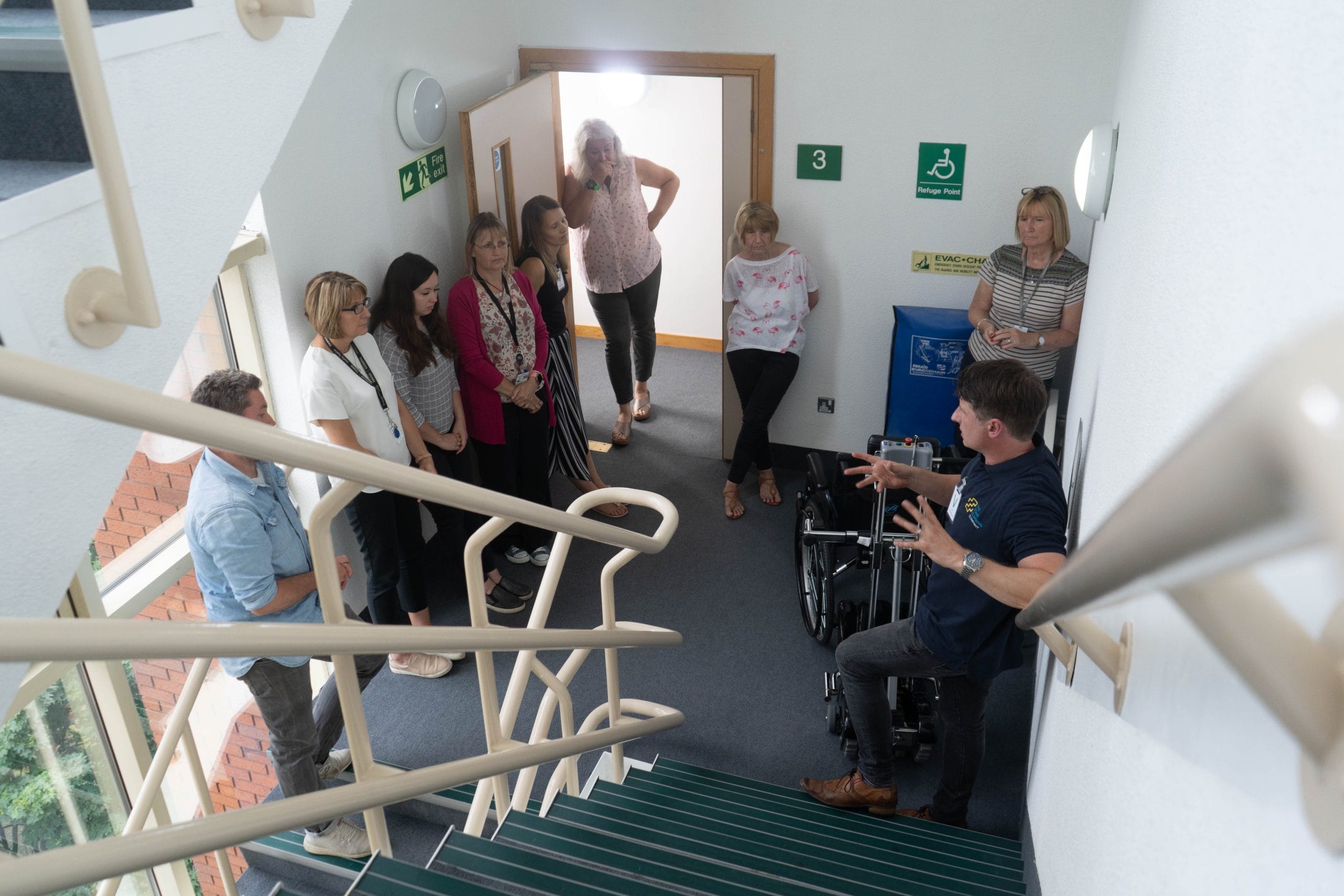
Powered stair climbers use motorised systems to transport wheelchair users and individuals with reduced mobility up or down staircases safely and with minimal physical effort from operators. This reduces manual handling risks and enables faster, more controlled evacuations.
Unlike many traditional evacuation methods, powered stairclimbers can accommodate a wider range of users and provide greater comfort during evacuation.
For London buildings with multiple floors, long stairwells or high occupant numbers, powered evacuation chairs and powered stairclimbers can dramatically improve evacuation efficiency.
When developing a PEEP, confidence in the evacuation process is essential.
Powered stairclimbers offer a predictable and reliable method of evacuation that can be tailored to the individual’s needs. Many wheelchair users prefer remaining in a familiar seating position during evacuation rather than transferring into alternative equipment.
The reduced physical demand on operators also improves consistency. Staff members are more likely to perform effective evacuations when equipment minimises strain and simplifies operation.
This creates greater confidence for both building occupants and emergency planning teams.
Visitors and members of the public often present one of the greatest evacuation challenges because their specific requirements may not be known in advance.
Powered stair climbers support flexible evacuation strategies that can accommodate a wide range of mobility needs. This makes them particularly valuable within GEEPs for shopping centres, universities, public buildings, healthcare environments and transport facilities across London.
The ability to quickly deploy powered evacuation chairs ensures that mobility-impaired visitors can be assisted without extensive pre-planning.
Building-wide evacuation plans must account for a variety of scenarios, including fire, power failure, security incidents and other emergencies.
Powered evacuation chairs provide building managers with scalable evacuation capabilities that can support multiple users and evacuation routes. Their integration into BEEPs helps organisations demonstrate proactive risk management and compliance with fire safety obligations.
In larger London buildings, powered stairclimbers can be strategically positioned to provide rapid access to evacuation equipment across different floors and departments.
This approach reduces evacuation times and supports safer building-wide emergency response.
One of the most significant advantages of powered stairclimbers is the reduction in manual handling requirements.
Traditional evacuation methods can place considerable strain on operators, particularly when evacuating individuals over multiple flights of stairs. This creates risks for both the evacuee and the evacuation team.
Powered stair climbers use advanced motor technology to control movement and support the user’s weight throughout the evacuation process. This reduces operator fatigue and lowers the likelihood of injury.
For organisations focused on health and safety compliance, this represents a major operational benefit.
The Regulatory Reform (Fire Safety) Order requires responsible persons to assess risks and implement suitable evacuation arrangements.
Powered evacuation chairs and powered stairclimbers help organisations demonstrate that they have considered the needs of disabled occupants and visitors within their fire risk assessments and evacuation strategies.
When incorporated into PEEPs, GEEPs and BEEPs, these solutions provide evidence of a robust and inclusive approach to emergency preparedness.
Selecting the appropriate powered stairclimber depends on building design, occupant profiles and evacuation requirements.
Factors to consider include stair width, number of floors, user weight capacity, storage requirements and training needs.
Working with specialist providers ensures organisations receive expert guidance, equipment demonstrations and ongoing support.
The Stair Climbing Company is one of the UK’s leading specialists in powered stairclimbers and powered stair climbers, providing solutions for emergency evacuation, accessibility and safe patient handling. Their expertise helps organisations across London identify the most effective equipment for their specific requirements.
For more information about powered stairclimbers and stair climbing solutions, visit https://www.stairclimbingcompany.com
Organisations seeking specialist evacuation equipment, evacuation planning support and powered evacuation chairs can also find expert guidance at https://www.evacuationcompany.co.uk
As London’s built environment continues to evolve, inclusive evacuation planning will become increasingly important. Powered stairclimbers are helping organisations move beyond basic compliance and towards genuinely accessible emergency preparedness.
By integrating powered stair climbers and powered evacuation chairs into PEEPs, GEEPs and BEEPs, organisations can improve safety, reduce risk, enhance operational resilience and provide greater reassurance to building occupants.
The result is a more inclusive evacuation strategy that protects everyone, regardless of mobility level, when it matters most.
Powered Stair Climbers for Workplace Access: Removing Barriers Without Major Building Work Need to improve wheelchair access in your workplace? …

Powered Stair Climbers for Wheelchair Access: A Flexible Way to Overcome Stairs Need to create wheelchair access where stairs are …

Part M Stair Climbers for London Buildings: Accessible Retrofit Without Major Structural Change Improving accessibility in an existing London building? …

Part M Stair Climbers for Retrofit Buildings: Creating Accessible Buildings Without Major Structural Change Retrofitting an existing building and struggling …
Part M Stair Climbers for London Retrofit Buildings: Practical Access in Constrained Spaces Discuss a London Access Assessment Retrofitting a …

Part M Stair Climber Access: Creating More Inclusive Buildings Without Losing Flexibility Creating an accessible building is rarely about a …
Estimated reading time: 6 minutes